Hope Is The Thing With Feathers Sheet Music Preview

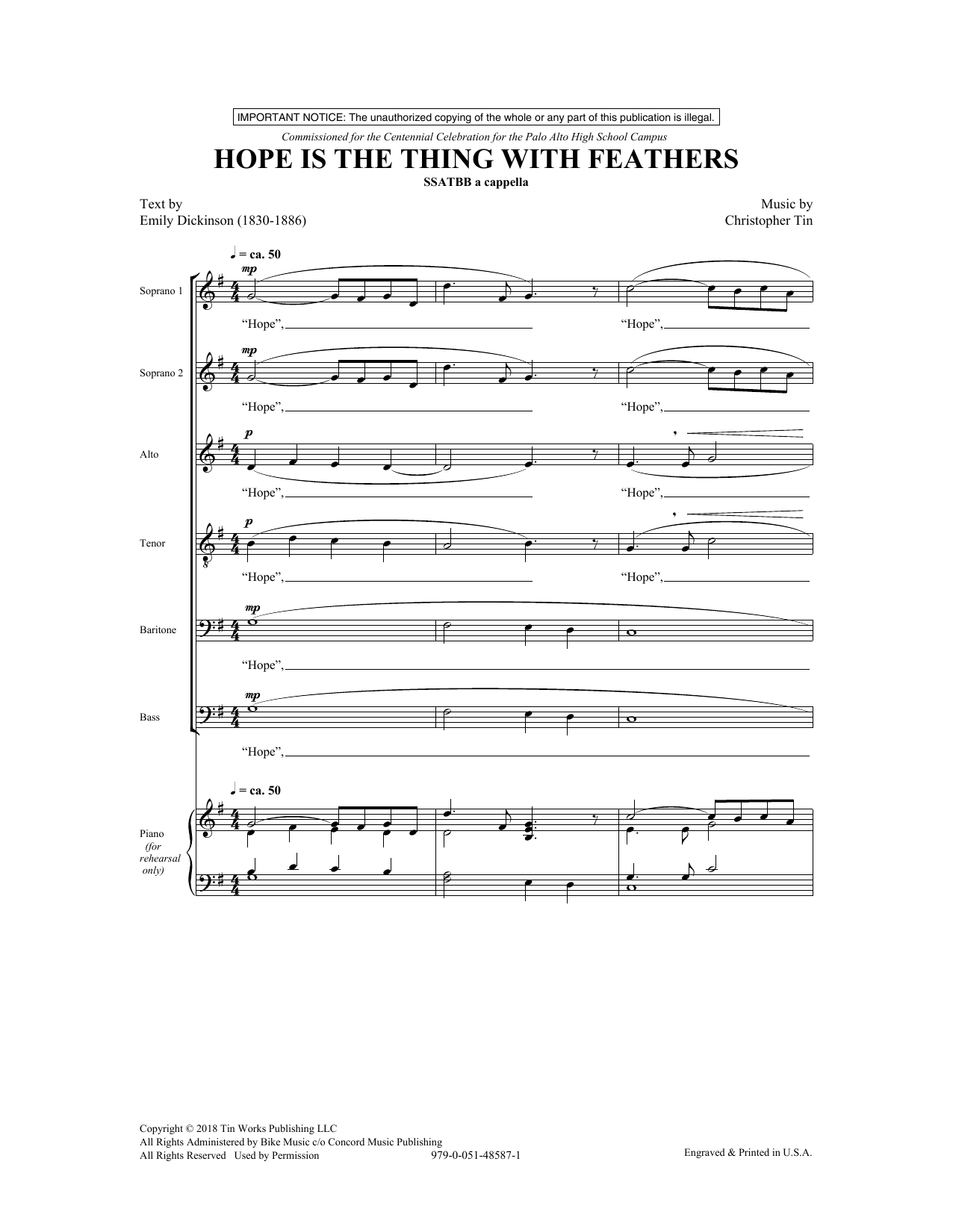
Hope Is The Thing With Feathers: SATB Choral Octavo

By Christopher Tin

Item: 35-DS00460823

Digital Download
$2.65
Description

Hope Is The Thing With Feathers: SATB Choral Octavo isn't in MakeMusic Cloud just yet...but it could be. Let us know you'd like to see it, and you'll help shape what comes next. In the meantime, start a free trial and dive into thousands of interactive titles your students can play along with today.

Sample Audio
No sample audio found.
Sample Video
Additional Details
Publisher: Hal Leonard
Page Count: 8
SKU: 35-DS00460823

More about this title

About the Composer: Christopher Tin

Christopher Tin

Christopher Tin brings the sensibility of a film composer to everything he writes, from concert works to advertising campaigns. His education at Stanford, Oxford, and the Royal College of Music in London shaped a compositional voice that prizes melodic clarity and dramatic impact. A Grammy winner for his album Calling All Dawns and an acclaimed video game composer (Civilization IV), Tin has built a career moving fluidly between concert stages, orchestras, and recording studios.

Tin's work reflects his multicultural background: California-born, of Chinese descent, educated in England, and steeped in the classical tradition of some of Britain's greatest composers. His Fulbright-supported studies at the Royal College culminated in an MMus with Distinction and the prestigious Horovitz Composition Prize. Whether composing for orchestras like the National Symphony or arranging for amateur choirs worldwide, Tin brings a gift for elegant gesture and accessible lyricism to every project.

Why we love this

Tin's setting finds exactly the right musical language for Emily Dickinson's poem: economical, elegant, and deeply expressive without a wasted note. The four-part writing sits naturally in the voice while respecting the poetry's quiet power, and a cappella forces your singers to focus on ensemble blend and textual communication. This is the kind of piece that sounds deceptively simple in the score but reveals layers of craft in rehearsal.

What to expect

Hushed and contemplative, yet buoyant with hope. The a cappella texture creates intimacy, while Tin's melodic gift ensures the piece never feels static or academic. It has the quality of overhearing something deeply personal, shared with a listener leaning in close.

Who it's for

Choirs with solid intonation and a comfort with contemporary harmonic language will thrive with this piece. It suits advanced high school choirs, college ensembles, and community groups looking for concert repertoire that engages both performer and audience intellectually.

How to get the most out of it

  • Release consonants together to maintain the choral sound; Dickinson's language deserves the clarity of precise diction without it fragmenting your blend.
  • Shape the harmonic progression rather than treating each chord equally; Tin's harmonic language moves with intention, and your phrasing should follow that architecture.
  • Let the silence breathe between sections. A cappella writing without rests can feel rushed; resist the urge to fill every moment and let listeners absorb the words.
  • Balance soloistic moments with full-choir weight; the piece likely features passages where one voice predominates, and these need to sing forward without losing blend with the ensemble.

How to use it

Pair this with other poetry-based choral works for a thematic concert exploring how music illuminates the written word. Its eight pages and accessible difficulty make it a strong choice for a spring concert closer or as a palate cleanser between heavier repertoire. The piece also works well as a teaching tool for contemporary compositional technique in a rehearsal focused on harmony and voice leading.

Skills your students will build

  • Singing sustained harmonic structures in a cappella writing
  • Listening for blend and balance without instrumental support
  • Phrasing shaped by text rather than metrical pulse
  • Reading and interpreting modern harmonic language
  • Collaborative interpretation of contemporary composition

You May Also Like