
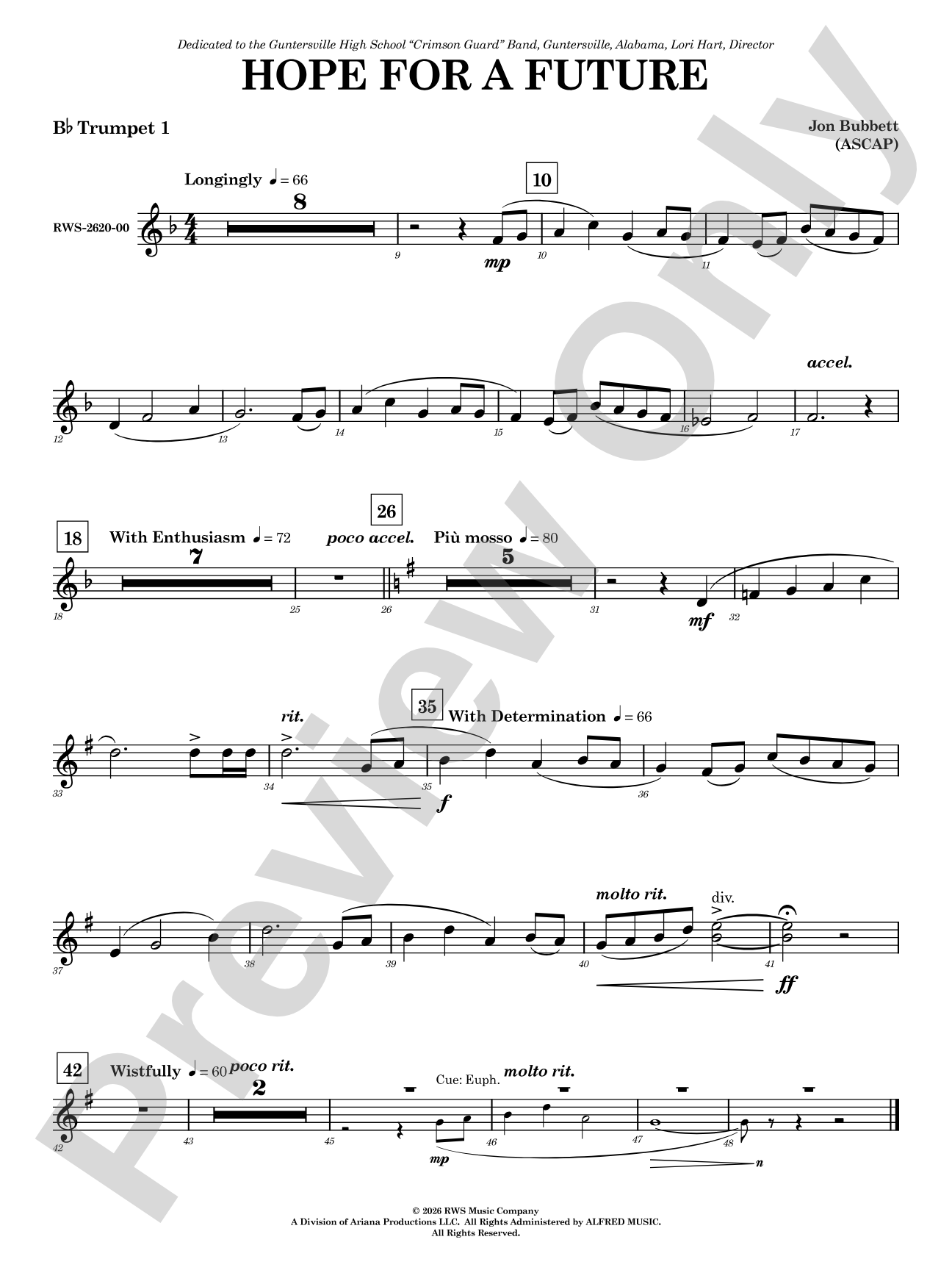

Hope for a Future: 1st B-flat Trumpet
By Jon Bubbett
Grade: 2
Item: 98-PC-0000020_T1
$3.00
Pickup currently not available
Description
Hope for a Future is a beautiful, lyrical work for concert band that celebrates optimism, gratitude, and the promise of what lies ahead. Though lyrical in nature, its forward-moving tempo creates a strong sense of momentum and uplift. Accessible for bands of all sizes, it inspires both performers and audiences with its spirit of joy, purpose, and anticipation for what's to come.


Hope for a Future: 1st B-flat Trumpet isn't in MakeMusic Cloud just yet...but it could be. Let us know you'd like to see it, and you'll help shape what comes next. In the meantime, start a free trial and dive into thousands of interactive titles your students can play along with today.
Request This Title
Tell us you want it.
Start Your Free Trial
Explore everything that's ready to play right now.
Sample Audio
1
Audio File
--:--
0:00
0:00
Sample Video
Additional Details
Series:
RWS - Developing Band
Publisher:
RWS Music Company
SKU:
98-PC-0000020_T1
More about this title
About the Composer: Jon Bubbett

Jon Bubbett spent 38 years in music education, with 26 of those years directing the band program at Thompson High School in Alabaster, Alabama. His contributions to the field earned him six NBA Citations of Excellence and recognition as Phi Beta Mu's Bandmaster of the Year in 2015. Since retiring from full-time teaching, he has remained deeply involved in the profession as a clinician, composer, and adjudicator throughout Alabama, Georgia, and Mississippi.
Bubbett's compositions have been published by major publishers including Belwin, Make Music, RWS Music, and Eighth Note Publishing. He holds memberships in the National Association for Music Education, National Band Association, Phi Beta Mu International Bandmasters Fraternity, and ASCAP. Currently, he conducts the Celebration Winds Community Concert Band while continuing to serve as a panelist and clinician at regional and national music education conferences.
Why we love this
Bubbett understands what Grade 2 bands need: music that feels substantial without becoming a slog to learn. The forward momentum here prevents the lyricism from ever becoming static, which means your students stay engaged while building genuine musicianship. It's the kind of piece that works equally well in a festival setting or a spring concert because the emotional authenticity lands with any audience.
What to expect
There's an undeniable brightness here, a sense of moving toward something good rather than dwelling in reflection. The lyrical writing has warmth without sentimentality, and the forward-moving tempo keeps everything feeling purposeful and alive.
Who it's for
This piece fits naturally into the library of any Grade 2 concert band looking for accessible repertoire with genuine emotional substance. Directors programming festivals or spring concerts will find it serves both contexts well, and the manageable difficulty level means less rehearsal time spent on technical hurdles and more spent on musicianship.
How to get the most out of it
- Maintain consistent pulse through the lyrical passages so the piece doesn't lose its optimistic drive; the beauty comes from direction, not from slowing down.
- Balance the melody across sections rather than letting one voice dominate; this piece works best when the harmonic progression feels inevitable rather than accompanied.
- Shape phrases with slight dynamic swells that follow the text's emotional arc; resist the urge to make everything uniformly soft just because it's lyrical.
- Work the articulation carefully in the accompaniment figures so they support rather than clutter the primary melodic line.
How to use it
Open a spring concert with this piece to establish an optimistic tone for the entire program, or place it in a sequence of contrasting works where its momentum provides welcome energy. It also pairs well with more abstract or complex pieces later in the program, as audiences appreciate its clear emotional honesty.
Skills your students will build
- Sustaining tone quality across dynamic ranges while maintaining forward momentum
- Balancing ensemble texture to support rather than overshadow the primary melody
- Shaping lyrical phrases through subtle dynamic inflection within a moderate tempo
- Reading and executing articulation patterns that enhance harmonic progression
- Developing sensitivity to harmonic movement and functional chord relationships