
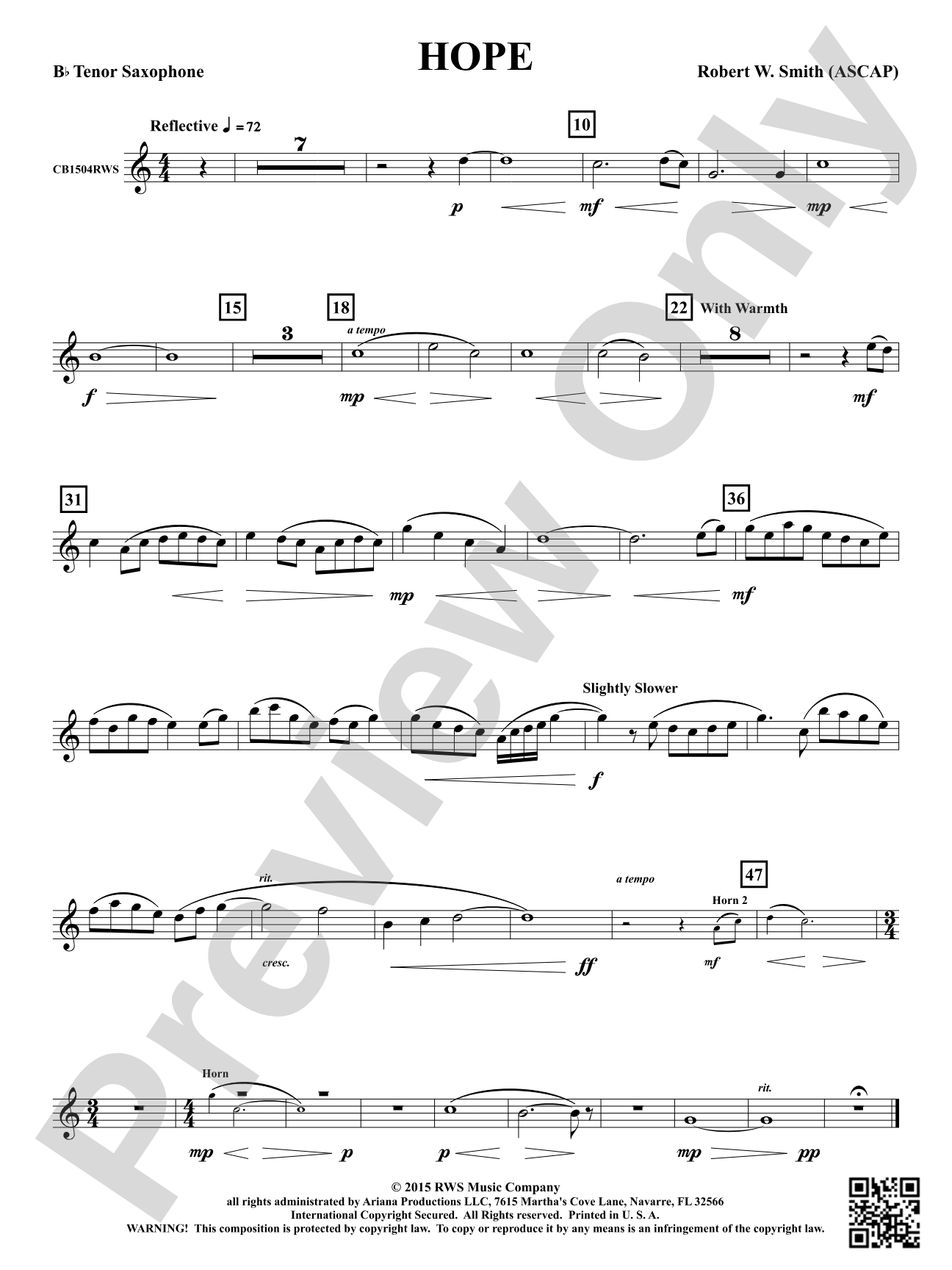

Hope: B-flat Tenor Saxophone
By Robert W. Smith
Grade: 3
Item: 98-PC-RWS1504_TX1
$3.99
Pickup currently not available
Description
Once heard and experienced, the melody of this exquisite lyrical work by Robert W. Smith stays in the hearts and minds of musician and listener. From the opening phrases in the solo clarinet to the full band melodic statements, "Hope" takes us on a warm and beautiful musical journey of reflection and promise. Appropriate for concert/festival programming, "Hope" will become a staple in your concert band repertoire.
Original Item#: RWS-1504-00


Original Item#: RWS-1504-00
Hope: B-flat Tenor Saxophone isn't in MakeMusic Cloud just yet...but it could be. Let us know you'd like to see it, and you'll help shape what comes next. In the meantime, start a free trial and dive into thousands of interactive titles your students can play along with today.
Request This Title
Tell us you want it.
Start Your Free Trial
Explore everything that's ready to play right now.
Sample Audio
1
Audio File
--:--
0:00
0:00
Sample Video
No sample videos found.
Additional Details
Series:
RWS - Concert Band
Publisher:
RWS Music Company
SKU:
98-PC-RWS1504_TX1
More about this title
About the Composer: Robert W. Smith

Robert W. Smith stands among America's most performed composers for concert band and orchestra, with more than 400 published works across major publishers including Alfred Music. He studied music education at Troy State University and earned a Master's degree from the University of Miami, launching a career that has seen his original compositions performed across North America, Europe, Australia, and Asia. His symphonic works like The Divine Comedy and The Odyssey have become touchstones in the repertoire, while pieces written for developing ensembles such as The Tempest remain staples in band programs nationwide.
Beyond the concert hall, Smith's music has reached audiences through television broadcasts, Olympic ceremonies, and ceremonial state events. His work as a conductor and clinician has taken him across the United States, Canada, Japan, Australia, and several European countries, where he continues to shape ensemble performance and composition pedagogy. Smith's prolific output reflects his deep understanding of both the concert band medium and the musicians who perform it.
Why we love this
Smith crafts a lyrical journey that feels both substantial and accessible at Grade 3, with the opening solo clarinet statement setting an intimate tone before the full band enters with genuine melodic warmth. The piece avoids saccharine sentimentality while maintaining the emotional clarity that makes it memorable long after the final note. Directors appreciate how naturally it programs between more virtuosic works, offering a moment of reflection without sacrificing musical integrity.
What to expect
From the first notes of the solo clarinet, the piece establishes an atmosphere of gentle introspection. As the band joins, the melody broadens into a statement of quiet confidence and warmth, inviting both performer and listener into a space of musical contemplation. The arc moves from intimate reflection toward affirmation without ever losing its graceful simplicity.
Who it's for
Band directors seeking repertoire that builds melodic awareness and expressive playing at Grade 3. Student musicians benefit from the chance to craft a lyrical line without technical demands that obscure musicality. Concert and festival programming both accommodate this work equally well.
How to get the most out of it
- Shape the opening clarinet solo with a sense of quiet confidence. The melody should float clearly without forcing; let the natural legato of the line carry the emotion.
- Balance the full band passages so the primary melody remains audible above the harmonic foundation. This requires precise dynamic control from both melodic and supporting voices.
- Allow the piece to breathe at phrase endings rather than rushing forward. The reflective character depends on giving each musical thought room to resonate.
- Work the section entrances with the ensemble so transitions feel seamless. Clean attacks on new phrases maintain the continuity of the musical story.
How to use it
Program this after a more energetic opening work to give the audience a chance to settle into deeper listening. It pairs naturally with contrasting pieces of substance on a concert, offering a programming anchor that allows directors to build meaningful variety throughout the set. The piece also serves well as a festival submission or as part of a ceremonial event where music provides emotional grounding.
Skills your students will build
- Sustained legato phrasing across multiple measures
- Dynamic control in both solo and ensemble textures
- Balance between melody and harmonic accompaniment
- Expressive interpretation of lyrical melodic lines
- Sectional precision in staggered entrances