
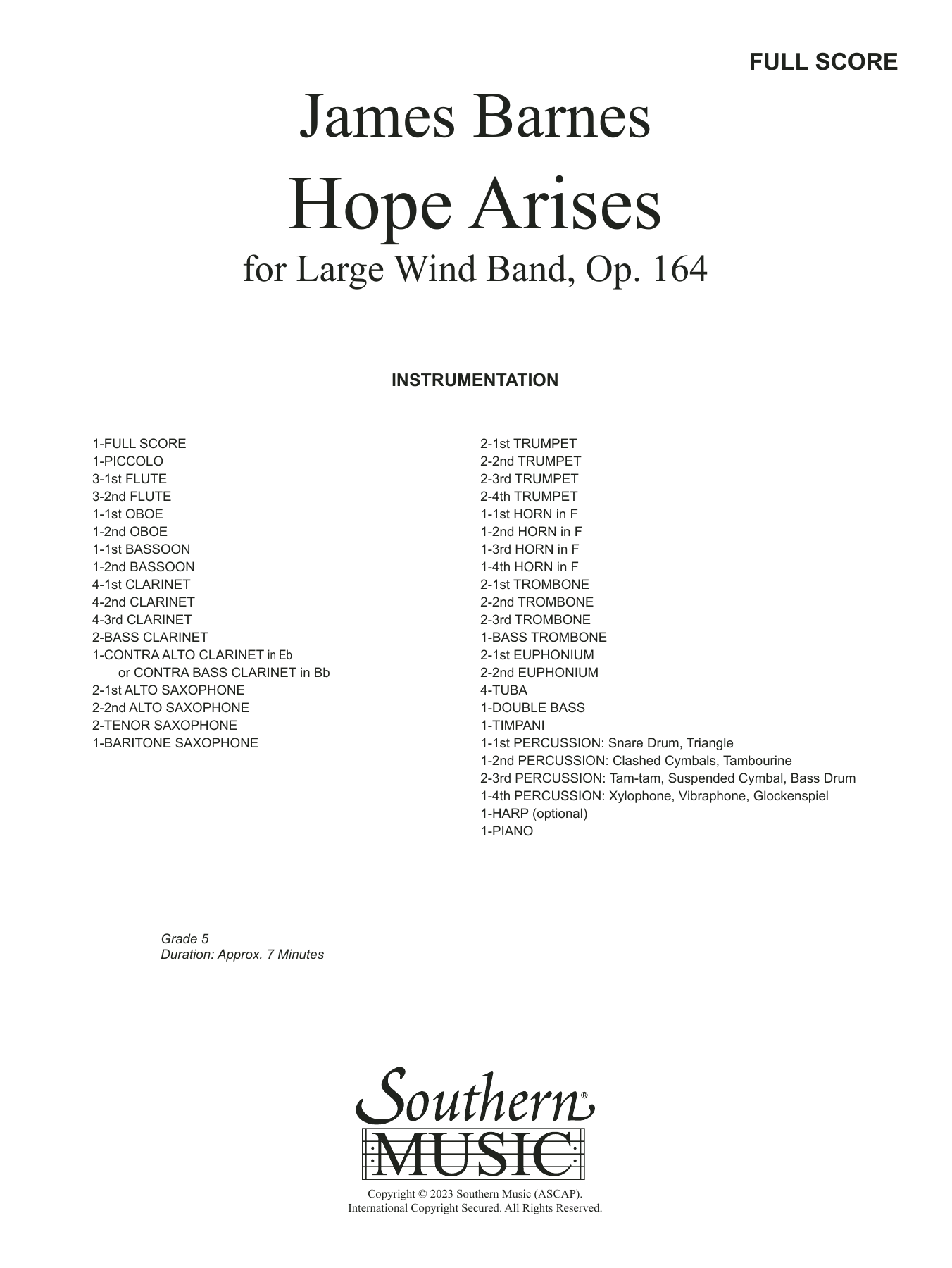

Hope Arises: Concert Band Conductor Score & Parts
By James Barnes
Grade: 5
Item: 35-PK01469655
$85.00
Pickup currently not available
Buy Extra Parts (Digital PDF Download)
Parts Added to Cart!
Description
Hope Arises is one of two new works requested in 2021 of composer James Barnes by Colonel Donald Schofield, to be written for the United States Air Force Band. It is a short piece intended to be used as an opener for AFB's tour concerts. It opens with a dramatic brass fanfare, based on consecutive perfect fourths first introduced by horns and euphoniums, followed by a short oboe solo. An ascending line in mallets and woodwind provide a rather celestial transition, taking the listener to a lively, melodic allegro, which is based on the same opening fourths. This allegro theme is developed until a return to the opening fanfare is powerfully re-announced in brass. The work concludes quite dramatically, and includes a return of the ascending line in woodwinds, mallets, harp and piano.


Hope Arises: Concert Band Conductor Score & Parts isn't in MakeMusic Cloud just yet...but it could be. Let us know you'd like to see it, and you'll help shape what comes next. In the meantime, start a free trial and dive into thousands of interactive titles your students can play along with today.
Request This Title
Tell us you want it.
Start Your Free Trial
Explore everything that's ready to play right now.
Sample Audio
No sample audio found.
Sample Video
No sample videos found.
Additional Details
Publisher:
Hal Leonard
SKU:
35-PK01469655
More about this title
About the Composer: James Barnes
James Barnes stands among the most frequently performed composers in American concert band repertoire. His works span from accessible educational pieces to sophisticated concert works, and his deep understanding of wind band sonorities has made him a trusted voice for ensembles at every level. Barnes has received numerous commissions from prestigious military ensembles, university bands, and school programs, cementing his role as a defining voice in the modern concert band canon.
Why we love this
Barnes delivers exactly what a tour opener demands: instant audience engagement paired with serious musical substance. The architectural clarity of this work, with its recurring fourths motif and carefully balanced return to the opening fanfare, gives you a piece that sounds impressive without requiring excessive rehearsal time to lock down the fundamentals.
What to expect
The piece captures its title immediately: a sense of rising momentum and affirmation. From the commanding brass gesture through the gentle interlude and into the spirited allegro, the musical arc feels inevitable and uplifting. The final restatement of the opening fanfare lands with earned power, leaving audiences energized.
Who it's for
Concert bands working at the Grade 5 level who need a confident, polished opener that lives up to professional programming standards. This works equally well for university bands seeking shorter works and for advanced high school ensembles building a concert season.
How to get the most out of it
- Shape the opening brass fanfare with clarity and weight; the consecutive fourths should ring with confidence rather than bluster, setting the dramatic tone without overshadowing the oboe solo that follows.
- Find the lift in that ascending transition line through woodwinds and mallets. This celestial passage needs buoyancy and space, a true shift in energy that prepares listeners for the allegro theme.
- Keep the allegro theme conversational and forward-moving. The melody sings here, and your middle voices should support it warmly rather than competing for attention.
- Coordinate the final dramatic return of the opening fanfare with the ensemble's collective breath. Precision in the restatement matters more than raw volume; let the musical moment land naturally.
How to use it
Open your concert with this and you establish authority from the downbeat. Its brevity makes it an ideal complement to a substantial work that follows, or use it strategically on a multi-concert season where you need a piece that projects confidence without demanding disproportionate rehearsal investment.
Skills your students will build
- Reading and executing brass fanfare figures with rhythmic precision and tonal projection
- Balancing ensemble voicing when a primary melodic line shares the stage with supporting harmonies
- Interpreting contrasting tempos and textures across a single continuous form
- Responding to clear architectural cues (return of material, key transitional moments) for musical shape