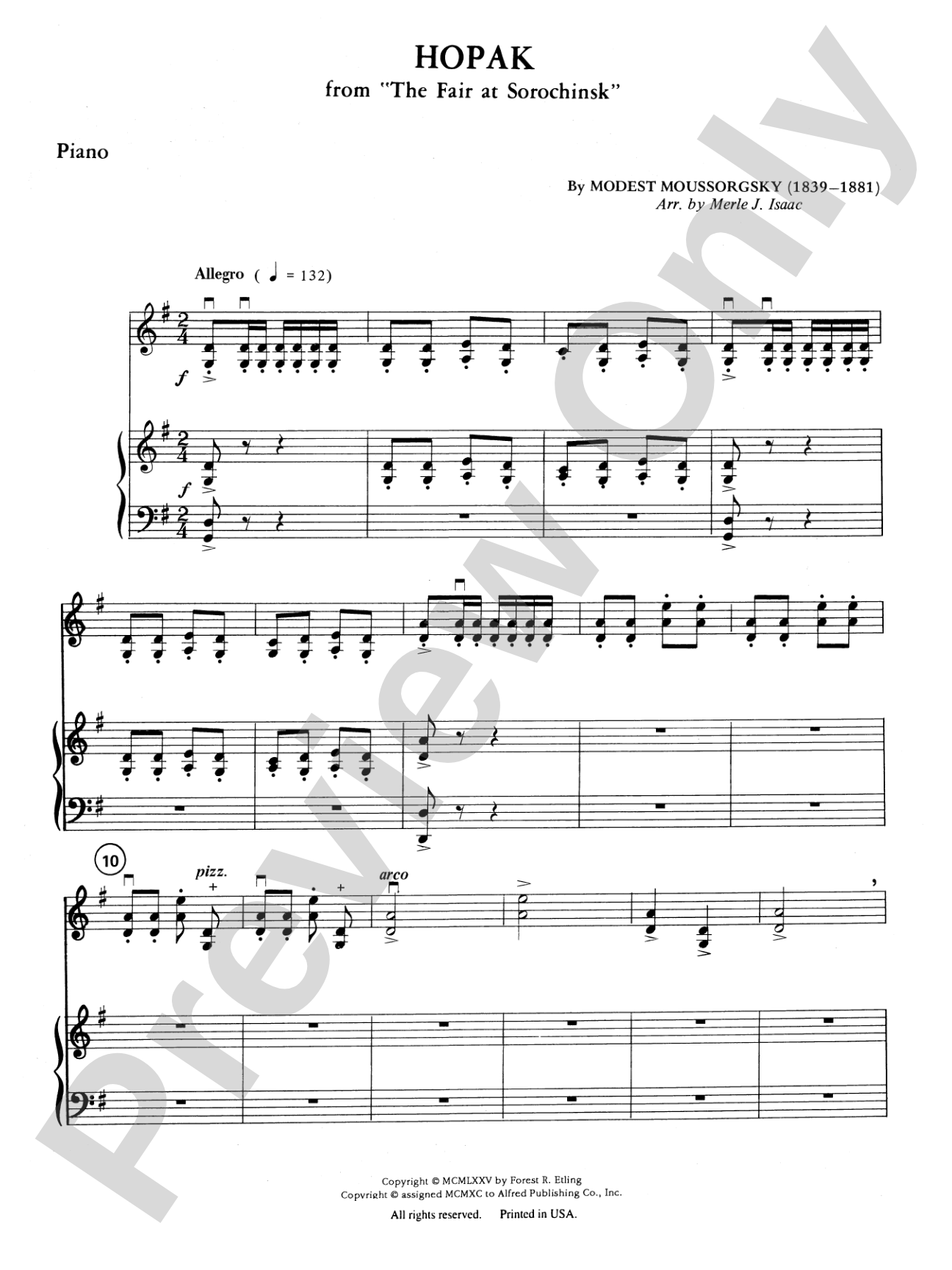
Hopak: Piano Accompaniment Sheet Music Preview

Hopak: Piano Accompaniment

By Modest Mussorgsky / arr. Merle J. Isaac

Grade: 3

Item: 00-PC-0000104_K

Digital Download
$5.99
Description
This title is available in MakeMusic Cloud.

Don't just read it, hear it, play along with it, and watch your students grow with it. In MakeMusic Cloud, Hopak: Piano Accompaniment comes alive with professional accompaniment, adjustable tempo, and built-in practice tools that turn solo practice into real progress.

Sample Audio
No sample audio found.
Sample Video
Additional Details
Series: Highland/Etling String Orchestra
Publisher: Alfred Music
Page Count: 144
SKU: 00-PC-0000104_K

More about this title

About the Composer: Modest Mussorgsky

Modest Mussorgsky (1839-1881) stands among Russia's most distinctive nationalist composers, creating music that captured the spirit and character of Russian culture with unflinching honesty. His works, including Pictures at an Exhibition and Boris Godunov, reject the polished conventions of Western European tradition in favor of direct expression and authentic folk idiom. For string orchestra students, his music offers access to this revolutionary approach through arrangements that preserve the boldness and emotional clarity of his original voice.

Why we love this

Merle Isaac's arrangement captures the unrelenting energy of this Russian folk dance while keeping the part writing manageable for Grade 3 players. The piece delivers genuine concert impact without asking your strings to navigate extreme technical demands, making it ideal for building confidence alongside musicality. Hopak fits perfectly into festival programming or a concert celebrating world music traditions.

What to expect

Hopak dances with unbridled joy and relentless forward drive. The piece crackles with the energy of a village celebration, mixing moments of exuberance with sudden shifts in color and intensity. It's music that makes you want to move, filled with the character and vitality that defines Russian folk tradition.

Who it's for

String orchestra directors teaching at Grade 3 level who want to add a Russian masterwork to the repertoire without compromising ensemble balance or intonation demands. This arrangement works equally well for festival competition, concert programming, or classroom performance, reaching students ready to engage with genuine compositional voice rather than simplified exercises.

How to get the most out of it

  • Establish the dance rhythm early in rehearsals and keep it infectious throughout; Hopak thrives on rhythmic vitality and forward momentum, not on lingering phrasing.
  • Balance the ensemble so the melodic material sings clearly above the accompaniment figures, particularly when the melody passes between violin sections.
  • Mark the dynamic shifts crisply in parts; the contrasts between forte sections and softer moments create the piece's dramatic shape and prevent it from becoming one-dimensional.
  • Unify articulation across all sections for passages that move in similar rhythm patterns, which tightens ensemble response and sharpens rhythmic definition.

How to use it

Program Hopak alongside other world music traditions or pair it with a concert theme exploring nationalism in Romantic-era composition. Its festival potential makes it especially valuable as a competition piece that stands out through authentic character rather than technical fireworks. Consider placing it mid-program where its energy and distinct cultural voice create memorable contrast.

Skills your students will build

  • Rhythmic precision in folk dance meter and traditional Russian rhythmic patterns
  • Dynamic control and sudden shifts in tone color
  • Ensemble balance when melody and accompaniment figures are distributed across multiple sections
  • Stylistic flexibility in approaching nationalist composition and authentic folk idiom

You May Also Like