
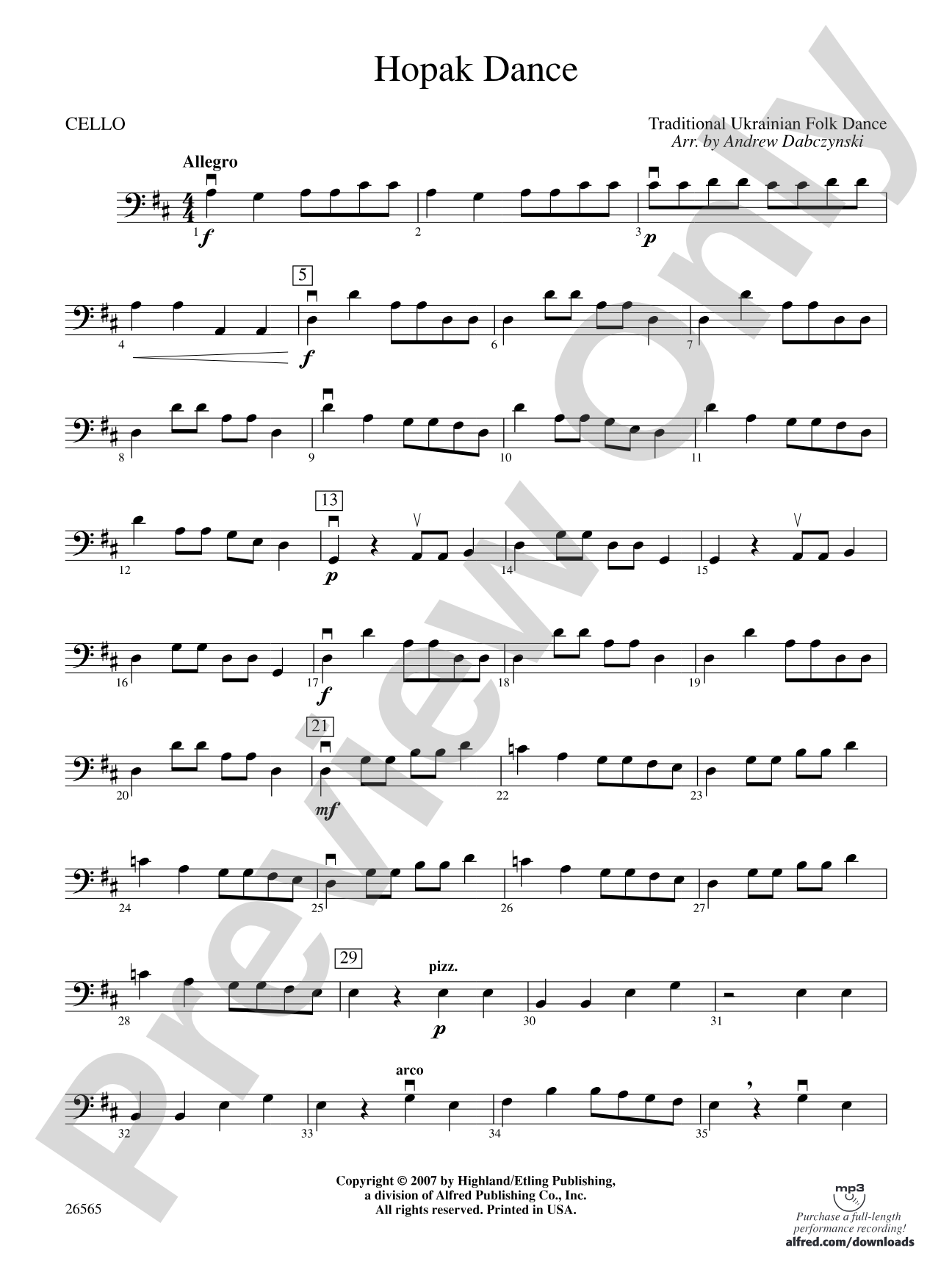

Hopak Dance: Cello
Traditional Ukrainian Folk Song / arr. Andrew H. Dabczynski
Grade: 1.5
Item: 00-PC-0001081_VC1
$5.99
Pickup currently not available
Description
An energetic piece that both beginning and more advanced string players will want to play over and over, faster and faster! Based on a Ukrainian dance melody, all sections alternate leading during this arrangement. The surprising appearance of a contrasting slower section played by the lower strings will conjure delightful images of brightly costumed dancers. Correlates with String Explorer Book 1, Unit 13. This title is available in MakeMusic Cloud.


Don't just read it, hear it, play along with it, and watch your students grow with it. In MakeMusic Cloud, Hopak Dance: Cello comes alive with professional accompaniment, adjustable tempo, and built-in practice tools that turn solo practice into real progress.
Open in the Player
Jump straight in and assign it today.
Start Your Free Trial
Open this title and explore the full library in minutes.
Sample Audio
1
Audio File
--:--
0:00
0:00
Sample Video
No sample videos found.
Additional Details
Series:
Highland/Etling String Explorer
Publisher:
Alfred Music
Page Count:
72
SKU:
00-PC-0001081_VC1
More about this title
About the Arranger: Andrew H. Dabczynski

Andrew H. Dabczynski served as Emeritus Professor of Music Education at Brigham Young University, where he founded and directed the BYU "New Horizons Orchestra," an ensemble designed for beginning adult string players and as a training ground for string educators. His contributions to music education earned him BYU's Joseph E. White Fellowship for Teaching and Learning, recognition from the Utah chapter of the American String Teachers Association as "Higher Education Teacher of the Year" in 2005, and an award for "Outstanding Contributions to Music Education" in 2014.
Throughout his career, Dabczynski has held positions at the Eastman School of Music and in public school systems across New York and Michigan, including his role as Supervisor of Fine Arts Education in Waterford, Michigan. As a violist, he performed with regional orchestras including the Rochester Philharmonic, Hartford Symphony, and others, and spent six years as a member of the Colden String Quartet at Western Michigan University. His deep interest in folk music and ethnomusicology has shaped his research and pedagogical approach; he co-authored the String Explorer method series with Alfred, a comprehensive resource widely used in string education.
Why we love this
This arrangement captures the infectious energy of Ukrainian folk dance while remaining genuinely accessible at Grade 1.5. The design is clever: rotating the melodic lead among sections keeps all players engaged and accountable, and the unexpected shift to a slower section performed by lower strings provides textural relief and a moment of musical storytelling that surprises even young listeners.
What to expect
Bright, fleet-footed, and full of character. The melody dances with urgency and playfulness, inviting faster and faster interpretations, while the central slower section paints a vivid tableau of color and movement before the energy returns.
Who it's for
String orchestras at the Grade 1.5 level will find this arrangement immediately rewarding to play and teach. The piece works equally well for groups just beginning to balance independent section roles and for more advanced beginning orchestras seeking folk-based material with rhythmic drive and textural variety.
How to get the most out of it
- Build momentum gradually across the faster passages. Resist the urge to lock into the fastest tempo immediately; let the dancers metaphorically warm up as they would in performance.
- Balance the alternating sections carefully. When the melody passes from violins to violas to cellos, the receiving section should enter with equal confidence, not as an echo.
- Shape the slower section with attention to the lower strings' lyrical quality. This moment shouldn't feel like a break in energy; rather, it shifts the character and invites the audience to imagine the visual spectacle described in the program notes.
How to use it
Open a concert with this piece to establish an energetic, welcoming mood and showcase your string section's ability to pass material between groups with clarity. It also pairs naturally with other folk-based orchestral works and serves as an effective pre-contest or festival selection that demonstrates musicality alongside technical facility.
Skills your students will build
- Executing rhythmic figures in a moderately fast tempo with clarity
- Passing melodic material between string sections and maintaining line continuity
- Balancing dynamic contrast between the fast and slow sections
- Responding to metric pulse and conducting gestures during tempo shifts
- Coordinating bowings and articulation within a section while listening to other parts