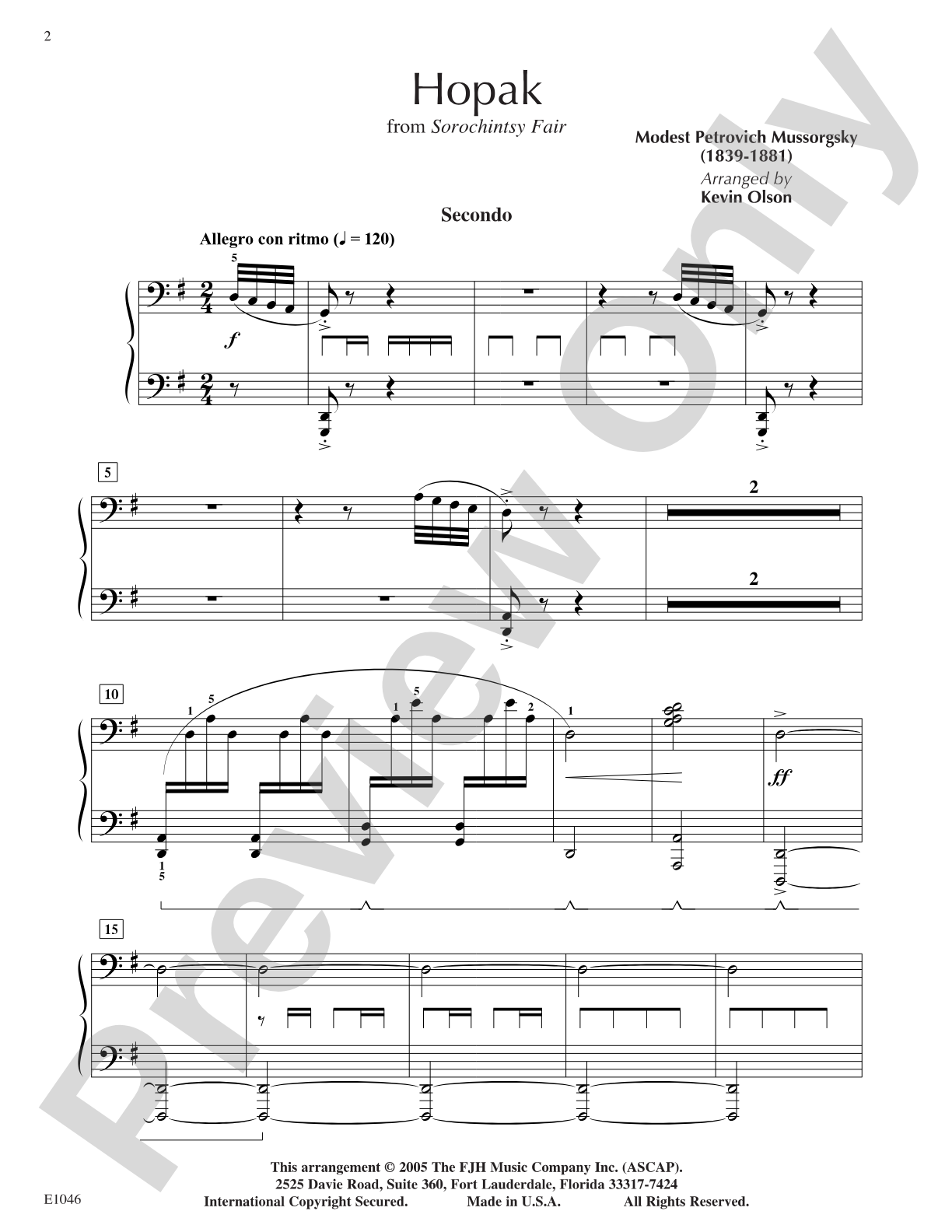
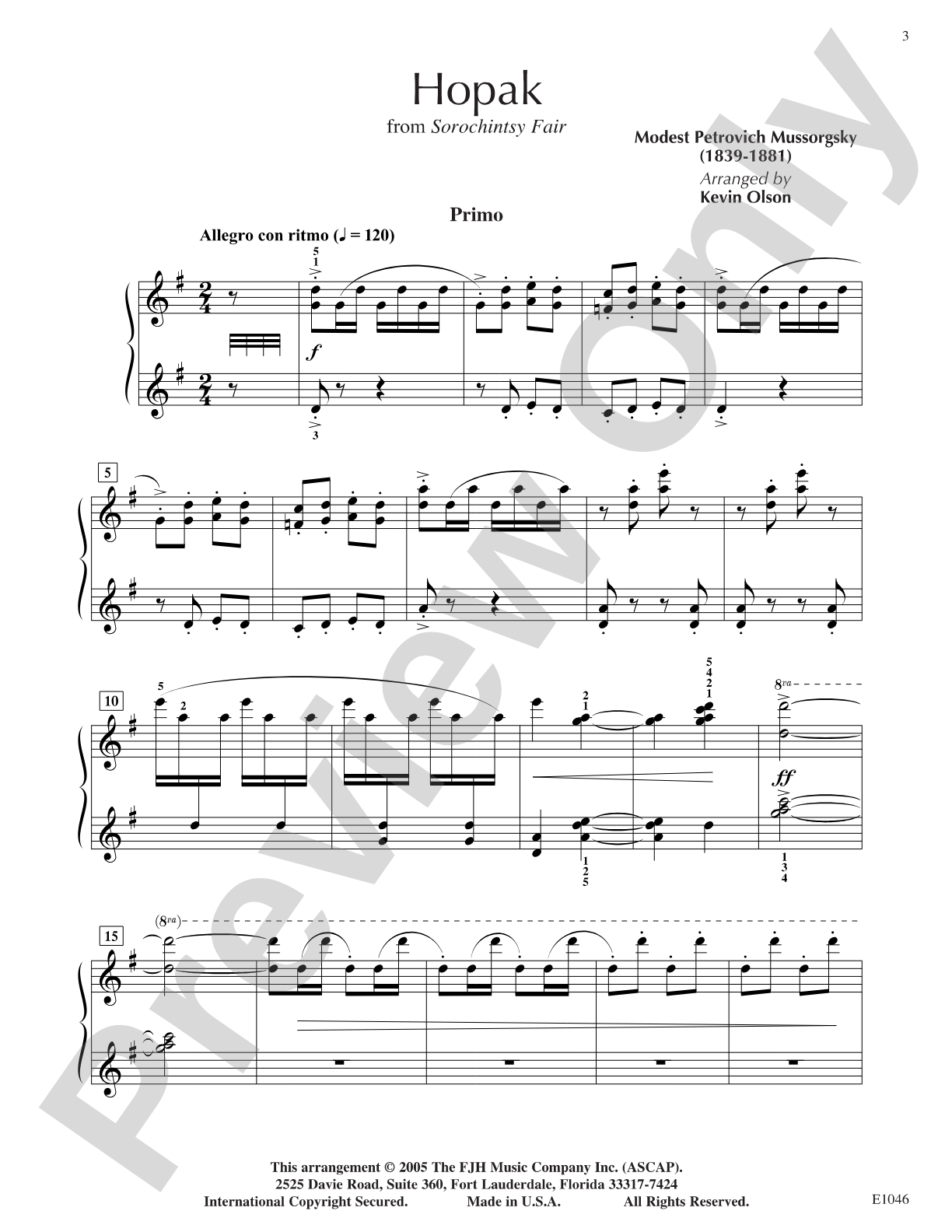
Hopak Sheet Music Preview

Hopak: Piano

By Modest Mussorgsky / arr. Kevin Olson

Item: 98-DE1046

Digital Download
$3.95
Description
The excitement of this brilliant orchestral favorite by Mussorgsky has been skillfully recreated in this piano duet by Kevin Olson. For you musicologists, a hopak is a strongly rhythmic Ukranian folk song in duple meter. A great way to end a recital program!.

Hopak: Piano isn't in MakeMusic Cloud just yet...but it could be. Let us know you'd like to see it, and you'll help shape what comes next. In the meantime, start a free trial and dive into thousands of interactive titles your students can play along with today.

Sample Audio
No sample audio found.
Sample Video
Additional Details
Series: The FJH Piano Ensemble Series
Publisher: The FJH Music Company, Inc.
SKU: 98-DE1046

More about this title

About the Composer: Modest Mussorgsky

Modest Mussorgsky (1839, 1881) was a Russian composer whose music bridged nationalism and modernism. He drew deeply from Russian folk traditions, modal harmonies, and the spoken rhythms of the Russian language itself, creating orchestral and operatic works that felt both exotic and emotionally raw to Western ears. His Pictures at an Exhibition and Night on Bald Mountain remain cornerstones of the orchestral repertoire.

For music students, Mussorgsky offers a masterclass in orchestration and folk idiom. His work shows how to honor traditional material without prettifying it, how to make rhythm and timbre carry as much weight as melody, and how to write music that sounds inevitable rather than merely clever.

Why we love this

Kevin Olson has captured the propulsive energy and infectious rhythm of the original hopak while writing genuinely playable parts for two pianists at different levels. The arrangement breathes, it doesn't shrink the piece into a solo vehicle. Pianists get to experience the joy of ensemble playing without the logistics of an orchestra, and audiences hear a work that crackles with authentic Russian vigor.

What to expect

Relentless forward momentum and infectious rhythmic swagger. The hopak pulses with the earthy confidence of a Ukrainian folk celebration, all sharp accents and propulsive energy, never soft or apologetic. By the final bars, both players should feel exhilarated rather than exhausted.

Who it's for

Intermediate and late intermediate pianists ready to experience Russian folk repertoire and ensemble playing. This works beautifully for recitals, competitions, or a semester culmination where you want pianists to feel the satisfaction of bringing a beloved orchestral piece to life together.

How to get the most out of it

  • Lock the rhythmic pulse between both players before worrying about detail. The hopak drives forward on its own momentum, so a solid metric foundation lets both hands breathe.
  • Lean into the folk character. The duple meter is insistent, almost relentless, so avoid over-pedaling the primo part, clarity matters more than bloom.
  • Balance the parts so the secondo's rhythmic ostinato remains audible. It's the heartbeat of the arrangement; if it disappears into the texture, the piece loses its propulsive character.
  • Take the ending with confidence. A hopak should feel like it's barely containing its energy right up to the final note.

How to use it

Finish a recital with this and you've given the audience an unforgettable exit. Its sheer exuberance transforms the final moments of a concert, and it lands perfectly when programmed after slower, more introspective works. It also works well as the anchor of an all-duet or Russian-repertoire themed program.

Skills your students will build

  • Coordinating rhythmic precision across two independent parts in duple meter
  • Balancing ensemble texture so secondary parts remain audible
  • Reading and performing folk-influenced harmonic language
  • Sustaining rhythmic drive without rushing or dragging
  • Responding to a partner's tempo and dynamics in real time

You May Also Like