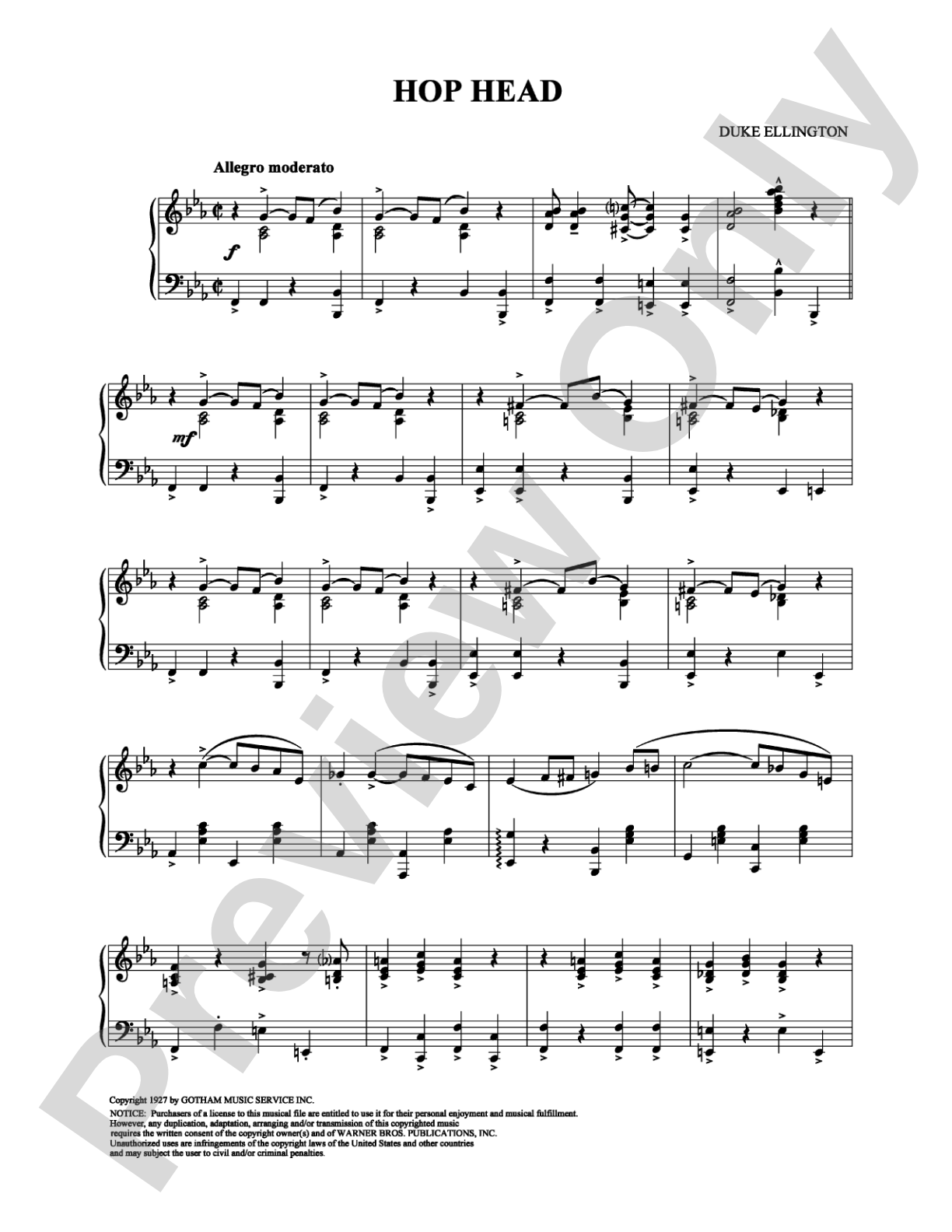
Hop Head: Piano Digital Sheet Music

Hop Head: Piano Digital Sheet Music

Duke Ellington

Item: 00-PS-0008185

Digital Download
$3.99
Description

Hop Head: Piano Digital Sheet Music isn't in MakeMusic Cloud just yet...but it could be. Let us know you'd like to see it, and you'll help shape what comes next. In the meantime, start a free trial and dive into thousands of interactive titles your students can play along with today.

Sample Audio
No sample audio found.
Sample Video
Additional Details
SKU: 00-PS-0008185

More about this title

About the Artist: Duke Ellington

Duke Ellington (1899-1974) stands as one of the most consequential composers in American music history. His contributions span jazz composition, big band arranging, extended works for concert settings, and the elevation of jazz as a serious art form worthy of the concert hall. Ellington's harmonic sophistication, orchestral innovation, and prolific output influenced generations of musicians across jazz, classical, and popular music traditions.

Why we love this

Ellington's stride piano writing makes this accessible yet genuinely rewarding for intermediate pianists. The jazz vocabulary is idiomatic without requiring extensive stylistic training, and the composition itself teaches voice-leading and harmonic movement that transfers directly to classical repertoire. Teachers value pieces like this because they legitimize jazz study within classical piano curricula.

What to expect

Sophisticated and playful in equal measure. The piece has an easygoing charm that belies its harmonic intelligence, with the stride patterns creating a propulsive, dancing quality that feels both relaxed and energetic. The overall mood is bright and conversational, as though the piano is speaking directly to the listener.

Who it's for

Intermediate pianists with at least foundational jazz vocabulary or willingness to develop it. This works well for students transitioning from classical repertoire into jazz, or for pianists seeking accessible jazz standards that reward close musical attention. It also suits adult learners and hobbyists who want engaging popular repertoire with substance.

How to get the most out of it

  • Approach the left hand as a conversation with the right; stride patterns should breathe rather than plod, creating a bounce that feels conversational rather than metronomic.
  • Honor the harmonic color changes by adjusting touch and dynamics within phrases; Ellington wrote for pianists who understood the instrument's tonal palette.
  • Practice the swing feel separate from the written rhythms; listening to Ellington's own recording or other skilled jazz pianists will calibrate your sense of where notes sit relative to the beat.
  • Shape phrase contours across the full span of the piece rather than treating it as isolated sections; momentum and narrative arc matter as much as individual passages.

How to use it

Include this in a jazz-focused recital or mixed concert exploring American songwriting across classical and jazz idioms. It pairs well with other stride piano standards or with classical pieces that share harmonic language. Consider programming it to introduce audiences to Ellington's compositional voice before moving into larger ensemble works.

Skills your students will build

  • stride piano technique and left-hand independence
  • jazz swing articulation and phrasing
  • harmonic improvisation over standard changes
  • voice-leading awareness through listening to jazz voicings
  • stylistic interpretation of jazz composition

You May Also Like