
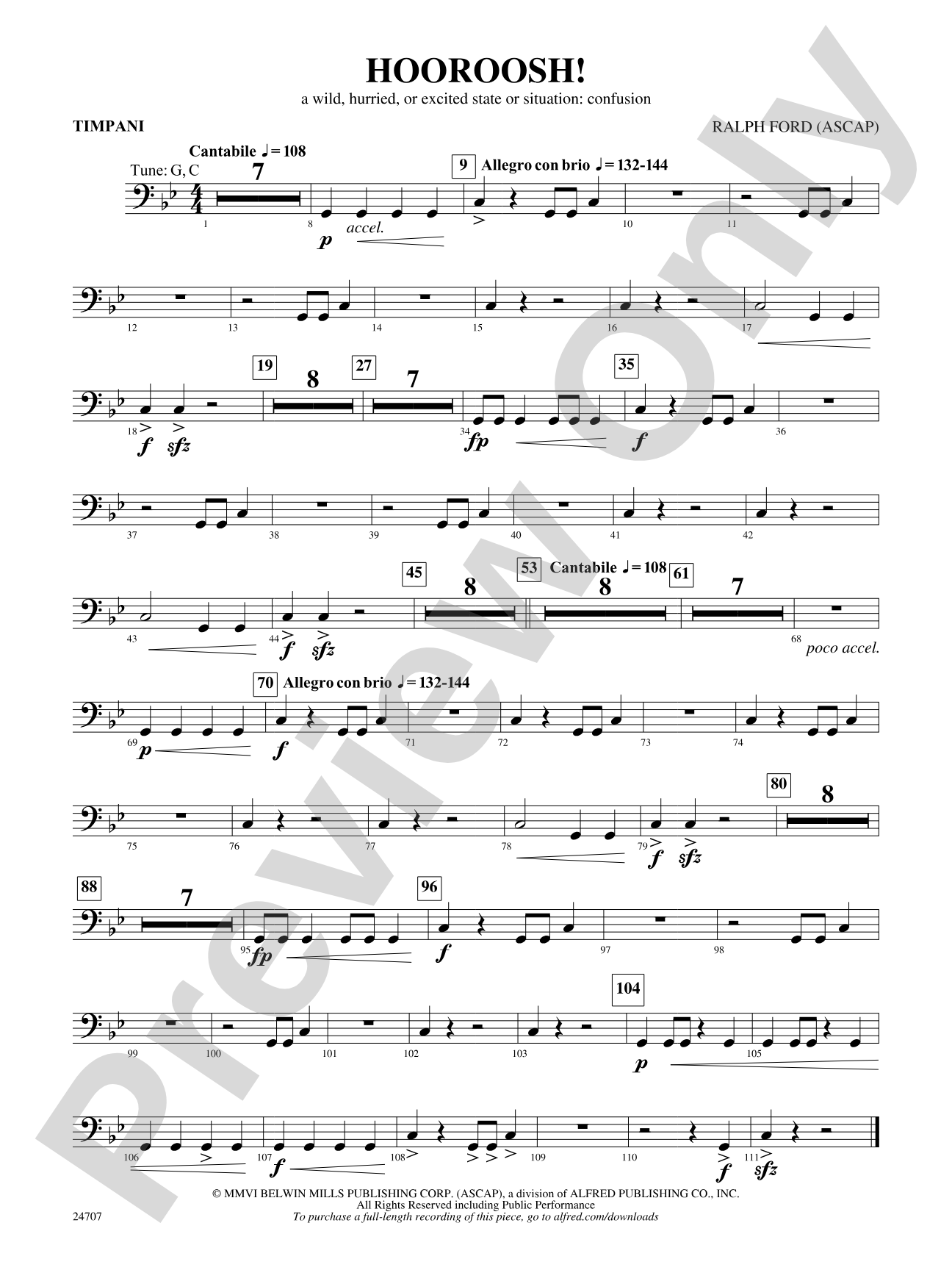

Hooroosh!: Timpani
By Ralph Ford
Grade: 1.5 (Very Easy to Easy)
Item: 00-PC-0000865_TMP
$3.00
Pickup currently not available
Description
It's defined as "a wild, hurried, or excited state or situation." "Hooroosh!" begins with a quiet and mysterious lyric clarinet melody that quickly builds and accelerates into the main theme. The contrasting styles guarantee a bold performance. A driving dynamic new work for your beginners. This title is available in MakeMusic Cloud.


Don't just read it, hear it, play along with it, and watch your students grow with it. In MakeMusic Cloud, Hooroosh!: Timpani comes alive with professional accompaniment, adjustable tempo, and built-in practice tools that turn solo practice into real progress.
Open in the Player
Jump straight in and assign it today.
Start Your Free Trial
Open this title and explore the full library in minutes.
Sample Audio
1
Audio File
--:--
0:00
0:00
Sample Video
No sample videos found.
Additional Details
Series:
Belwin Beginning Band
Publisher:
Alfred Music
Page Count:
270
SKU:
00-PC-0000865_TMP
More about this title
About the Composer: Ralph Ford

Ralph Ford combines three decades of university teaching with an prolific career as a composer and arranger for Belwin/Alfred Music. Based in Los Angeles, he has created over 250 works for orchestra, concert band, jazz ensemble, and marching band, performed by ensembles ranging from school groups to military and professional orchestras. His output reflects equal fluency across educational and professional contexts.
Beyond the concert hall, Ford's work spans media and broadcast production. He has scored jingles and animations, produced news packages for national network affiliates, and contributed to live radio broadcasts and television productions. He earned his Master of Science degree from Troy State University in 1988, where he served as both staff arranger and instructor in orchestration, arranging, theory, and applied brass before transitioning to full-time composition and arrangement work.
Why we love this
Ford nails the Grade 1.5 sweet spot by giving young ensembles a piece with real contrast and momentum. The mysterious opening clarinet line immediately captures attention, then the payoff arrives as the main theme surges forward—exactly what beginners need to feel the arc of a performance without wrestling with complexity.
What to expect
The piece unfolds like a sudden burst of energy emerging from stillness. Quiet, introspective moments give way to propulsive momentum as the main theme takes hold, creating a visceral contrast that young musicians can feel in their playing and audiences hear immediately. The result is dynamic and engaging without demanding technical pyrotechnics.
Who it's for
Emerging concert band programs at the Grade 1.5 level will find accessible orchestration and clear part writing that doesn't condescend. This works equally well as a festival selection or a concert opener that builds student confidence and gives audiences a glimpse of musical storytelling, even at the beginning band stage.
How to get the most out of it
- Establish the mysterious character of the opening clarinet solo by having that section practice the line separately first, focusing on phrasing rather than rushing the quiet, sustained notes.
- When the acceleration begins, use a consistent prep gesture and clear beats to keep the ensemble locked together through the tempo shift; mark exact beat subdivisions in parts if needed.
- Balance the contrasting sections by exaggerating dynamic changes in rehearsal; let students feel the dramatic shift from quiet to bold, then pull back slightly for the actual performance.
- Address potential intonation drift in the lyric sections by checking voicing stability before accelerating; early beginners often sharpen under pressure, so anchor the pitch at a moderate dynamic first.
How to use it
Open a concert with this title to set an energetic mood and showcase how even beginning ensembles can command attention through compositional contrast rather than volume alone. The Grade 1.5 level and dramatic arc also make it an excellent choice for a festival performance that stands out in a schedule of standard beginner repertoire.
Skills your students will build
- Executing dynamic contrast between quiet lyric passages and bold themes
- Maintaining ensemble cohesion during tempo acceleration
- Balancing sustained melodic lines in clarinet with harmonic support
- Responding to conducting cues for section entry and style changes
- Building confidence in performance through structured musical narrative