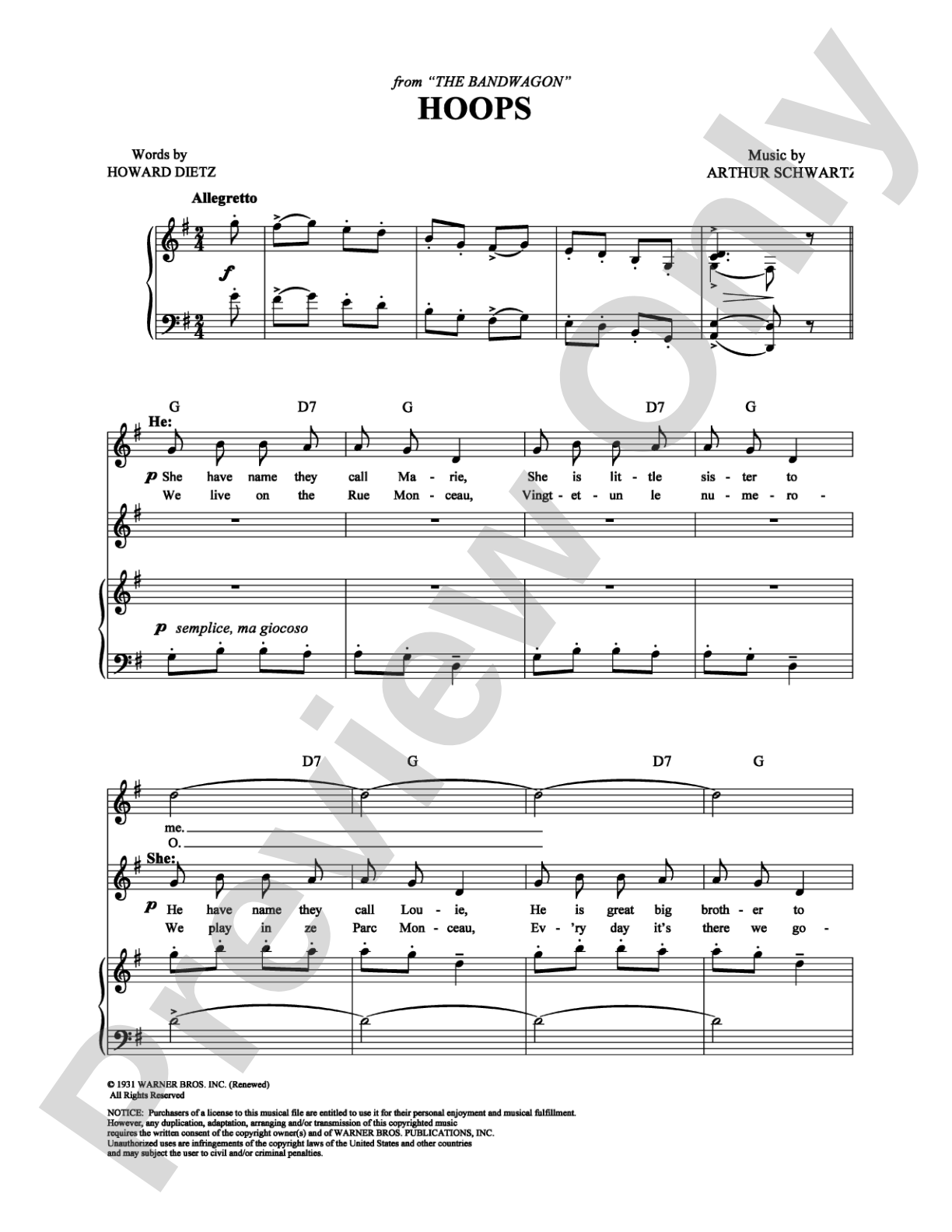
Hoops: Piano/Vocal/Chords Digital Sheet Music

Hoops: Piano/Vocal/Chords Digital Sheet Music

Arthur Schwartz, Fred Astaire

Item: 00-PS-0005284

Digital Download
$3.99
Description

Hoops: Piano/Vocal/Chords Digital Sheet Music isn't in MakeMusic Cloud just yet...but it could be. Let us know you'd like to see it, and you'll help shape what comes next. In the meantime, start a free trial and dive into thousands of interactive titles your students can play along with today.

Sample Audio
No sample audio found.
Sample Video
Additional Details
SKU: 00-PS-0005284

More about this title

About the Artist: Fred Astaire

Fred Astaire (1899-1987) revolutionized American dance and musical theater through his innovative choreography, rhythmic precision, and integration of dance with song. Though primarily known as a dancer and choreographer, Astaire was also a skilled vocalist and interpreter of the Great American Songbook, recording numerous standards and performing in films and stage productions that showcased both his dancing and singing abilities.

For music educators, Astaire's vocal recordings and interpretations offer valuable models of phrasing, swing rhythms, and the relationship between lyrical storytelling and musical accompaniment. His work across decades of popular music makes his songs accessible teaching and performance repertoire for students exploring American song traditions.

Why we love this

"Hoops" gives pianists and singers a chance to explore rhythmic sophistication and conversational phrasing in a piece rooted in American popular song. The piano/vocal/chords format makes it ideal for students developing their ability to comp from chord symbols while a vocalist carries the melody, a skill essential for jazz, musical theater, and collaborative repertoire work.

What to expect

"Hoops" carries the light sophistication and rhythmic playfulness characteristic of American entertainment standards from the classic era. The song invites singers to bring conversational warmth and pianists to respond with flexible, attentive accompaniment that breathes with the vocalist.

Who it's for

This piece works well for intermediate to advanced vocalists exploring American popular song standards, pianists developing their skills accompanying singers and reading chord symbols, and students in jazz, musical theater, or popular music courses. It's equally suitable for recital performance or classroom study of mid-20th-century American songwriting.

How to get the most out of it

  • Keep the piano accompaniment conversational rather than heavy; the chords are there to support the vocalist's phrasing, not to dominate it.
  • Use the chord symbols to experiment with different voicings and rhythmic textures on the piano, especially as you become comfortable with the melody.
  • Shape the vocal line with attention to the lyrical content; these songs reward thoughtful interpretation and natural speech rhythm rather than strict metric adherence.
  • Rehearse the piano and voice separately at first, then focus on the moments where they need tight rhythmic coordination or intentional independence.

How to use it

Include this in a recital exploring American popular song standards or in a mixed program that balances classical art song with American song traditions. It also works well in a musical theater or jazz ensemble setting where students need accessible vocal repertoire with manageable piano accompaniment.

Skills your students will build

  • Reading and comping from chord symbols
  • Coordinating vocal and piano phrasing across phrase boundaries
  • Interpreting swing and jazz rhythms in a popular song context
  • Building expressive interpretation through lyrical understanding

You May Also Like