
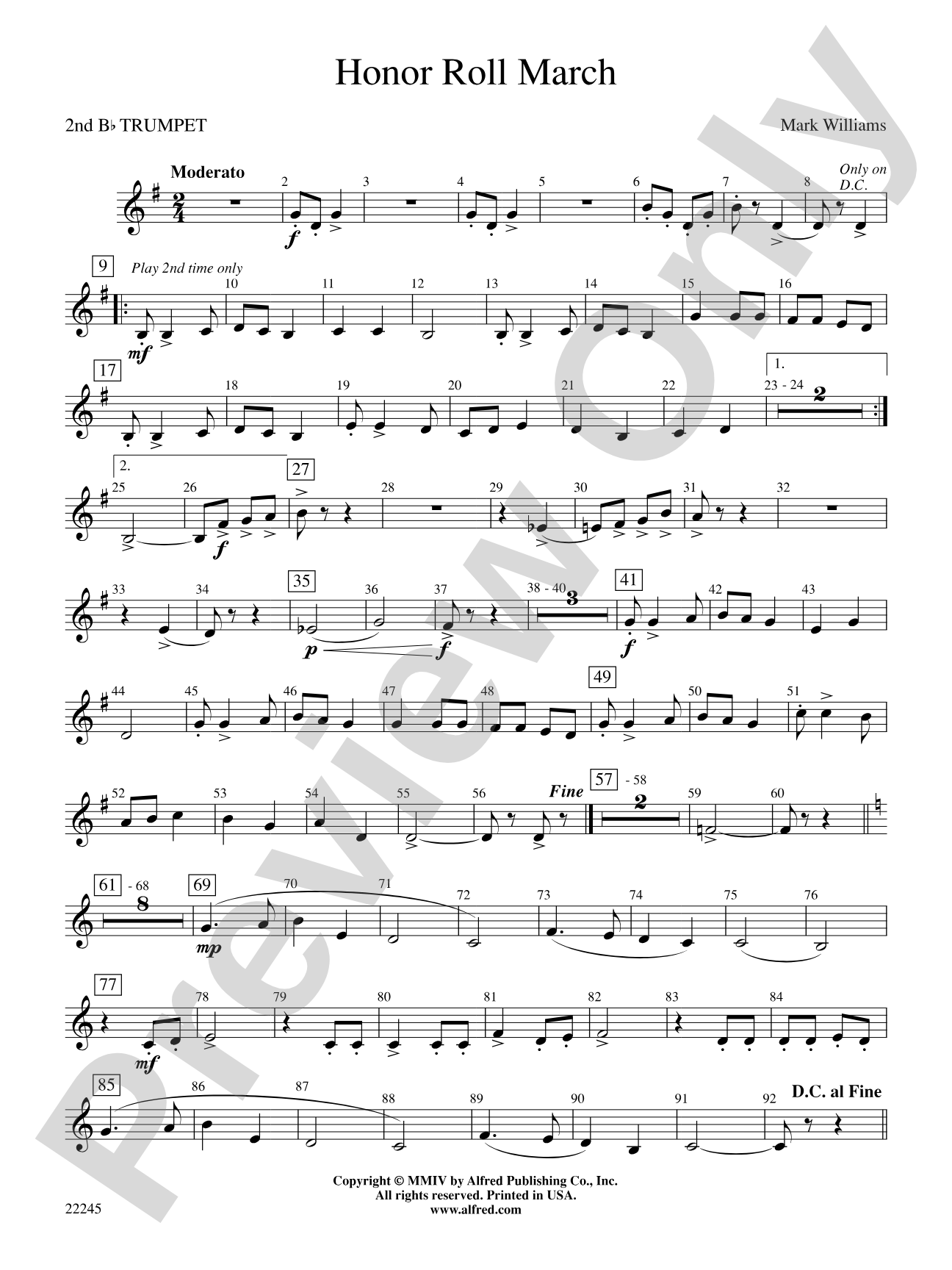

Honor Roll March: 2nd B-flat Trumpet
By Mark Williams
Grade: 1 (Very Easy)
Item: 00-PC-0000499_T2
$3.00
Pickup currently not available
Description
Correlated with Accent on Achievement, Book 1, page 33, this rousing original march by Mark Williams is an excellent choice for your next concert or contest program. Featuring catchy syncopated figures and active percussion breaks, this piece also includes a lyric trio section that provides opportunities for developing your band's musicianship and tone quality. (2:55) This title is available in MakeMusic Cloud.


Don't just read it, hear it, play along with it, and watch your students grow with it. In MakeMusic Cloud, Honor Roll March: 2nd B-flat Trumpet comes alive with professional accompaniment, adjustable tempo, and built-in practice tools that turn solo practice into real progress.
Open in the Player
Jump straight in and assign it today.
Start Your Free Trial
Open this title and explore the full library in minutes.
Sample Audio
1
Audio File
--:--
0:00
0:00
Sample Video
Additional Details
Series:
Accent on Achievement
Publisher:
Alfred Music
Page Count:
118
SKU:
00-PC-0000499_T2
More about this title
About the Composer: Mark Williams

Mark Williams built his career on understanding what young bands need to play. Co-author of the Accent on Achievement Band Method, he created over 200 works for school ensembles while maintaining a rigorous schedule as guest conductor and clinician across 34 states, 5 Canadian provinces, and Australia. His own training at Eastern Washington University, combined with years teaching elementary band in Washington state and performing as a bassoonist with the 560th Air Force Band, shaped his approach to composition for developing musicians.
Williams earned recognition throughout his career, including awards from the Western International Band Clinic's Gralia Competition and multiple ASCAP Special Awards. Beyond the page, he remained an active performer on bassoon and served as Conductor and Artistic Director for the Spokane British Brass Band, bringing the same commitment to excellence that defined his published works for band, orchestra, and choir.
Why we love this
Williams writes marches that actually work in Grade 1 ensembles. The syncopated figures snap without requiring virtuosic execution, and the lyric trio gives your band genuine musicality to develop rather than just running through notes. This is the kind of piece that builds confidence while sounding polished enough for any program.
What to expect
A traditional march with contemporary energy. The syncopation catches your ear while the melody stays memorable, and the lyric trio offers a genuine shift in mood that shows young musicians how arrangement and texture can reshape the same basic structure. There's celebration in this piece without sentimentality.
Who it's for
Band directors leading Grade 1 ensembles who need repertoire that sounds finished and keeps students engaged. This works equally well for concert programs and festival competition, and it aligns with Accent on Achievement curricula for seamless integration into your band's learning path.
How to get the most out of it
- Isolate the syncopated rhythmic figures in sectional rehearsals so the ensemble locks the phrasing together before full ensemble runs.
- Bring out the percussion breaks as brief moments of spotlighting rather than accompaniment; these lines deserve clarity and presence.
- Shape the trio section with dynamic contrast between phrases to let the lyric writing breathe and help younger players hear how tone quality changes the character of a melody.
- Establish a steady tempo early and hold it through the march sections; younger bands often rush syncopated figures when the tempo slips.
How to use it
Open a concert with this to establish confidence in your ensemble and audience, or place it mid-program as a contrast to ballads or more lyrical works. Its festival-friendly length (2:55) makes it ideal for contest programming, and the clear structural divisions give adjudicators multiple angles to assess your band's fundamentals.
Skills your students will build
- Reading and executing syncopated rhythmic figures across multiple parts
- Balancing melody and accompaniment texture
- Sustaining longer phrases with controlled dynamics and tone quality
- Precision ensemble playing in fast-moving passages