
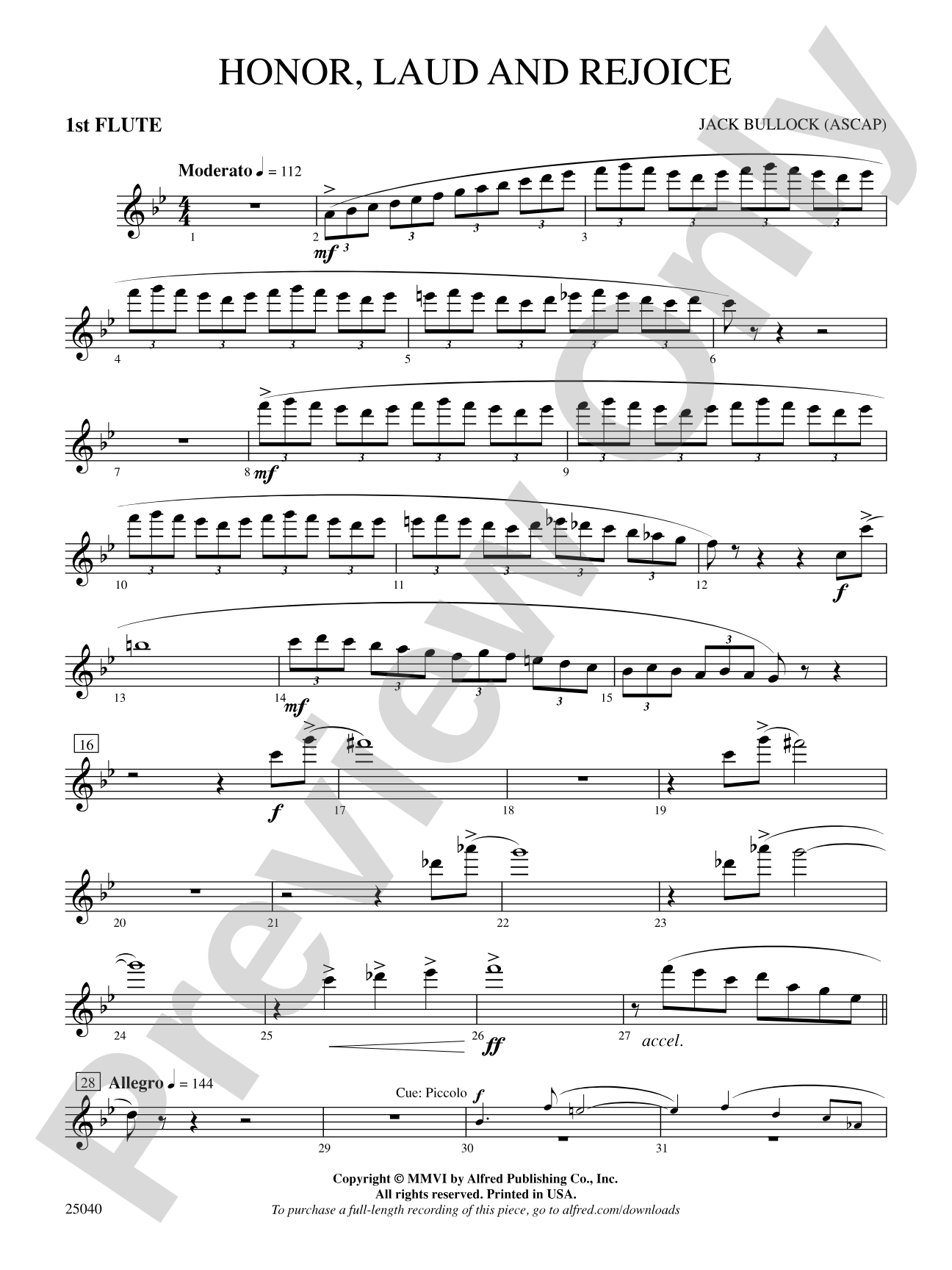

Honor, Laud and Rejoice: Flute
By Jack Bullock
Grade: 4
Item: 00-PC-0001011_F1
$3.00
Pickup currently not available
Description
"Honor, Laud and Rejoice" is a joyous and festive selection written for full orchestra at the intermediate level. The piece was commissioned in the memory of a student musician who passed away at the beginning of her senior year in high school. Rather than write a somber piece, Jack Bullock has crafted a piece that she and her classmates would have enjoyed performing together. The title describes the admiration, praise and feeling of joy and great delight that those who commissioned this work felt for this young lady.


Don't just read it, hear it, play along with it, and watch your students grow with it. In MakeMusic Cloud, Honor, Laud and Rejoice: Flute comes alive with professional accompaniment, adjustable tempo, and built-in practice tools that turn solo practice into real progress.
Open in the Player
Jump straight in and assign it today.
Start Your Free Trial
Open this title and explore the full library in minutes.
Sample Audio
1
Audio File
--:--
0:00
0:00
Sample Video
No sample videos found.
Additional Details
Series:
Belwin Concert Full Orchestra
Publisher:
Alfred Music
Page Count:
216
SKU:
00-PC-0001011_F1
More about this title
About the Composer: Jack Bullock

Jack Bullock brings together deep training in music education with a prolific career as a composer and arranger. He holds degrees at the undergraduate, graduate, and doctoral levels in Music Education, and studied trumpet with renowned pedagogues Harry Glantz, James Ode, and Craig McHenry. His performance experience spans the Miami Philharmonic Orchestra, Miami Opera Company, regional show bands, and touring dance ensembles.
With more than 600 published works across concert band, orchestra, jazz ensemble, and marching band, Bullock has shaped music education through both composition and institutional leadership. He taught instrumental music in K-12 settings for 20 years and served as assistant band director at Ithaca College's School of Music, where he also chaired the Music Education Department for four years. His contributions to music curriculum include co-authoring the Belwin 21st Century Band Method and arranging for Music Expressions, Alfred Music's school music program. An ASCAP member since 1980, Bullock has conducted clinics and workshops across North America and Europe.
Why we love this
Bullock has written a work that honors grief through celebration rather than elegy. The piece channels genuine joy and pride into music that an entire orchestra section can play together with spirit, making it as meaningful for your ensemble to perform as it is for audiences to hear. At Grade 4, the orchestration remains accessible while the emotional authenticity gives students something substantive to express.
What to expect
Joyful, ceremonial, and earnest. The music radiates warmth and affirmation without sentimentality, capturing the spirit of shared achievement and collective respect. There is brightness throughout, paired with moments of substance that ask the orchestra to play with maturity and care.
Who it's for
Orchestra directors seeking intermediate-level repertoire with genuine emotional depth. This piece works for ensembles ready to tackle full orchestration and prepared to engage with music that carries real human meaning beyond technical display.
How to get the most out of it
- Balance the festive character across all sections; full orchestra works like this thrive when every player feels their part contributes to the overall brightness rather than settling into accompaniment roles.
- Attend to vertical alignment between woodwinds and strings, especially in passages where they carry the primary melodic material together. Bullock's scoring rewards ensemble cohesion.
- Shape the phrasing with intention. Even celebratory music breathes. Find natural resting points and guide the orchestra through them without losing forward momentum.
- Use rehearsal markings strategically to isolate balance issues by section before bringing the full orchestra together. This piece's effectiveness depends on clarity across all parts.
How to use it
This work shines as a concert centerpiece or festival selection where its combination of accessibility and emotional resonance speaks to both musicians and listeners. Consider pairing it with contrasting repertoire (perhaps something darker or more intimate) to showcase the breadth of your orchestra's range in a single concert.
Skills your students will build
- Full orchestral balance and blend across diverse instrumental families
- Sustained phrasing and breath control in longer melodic lines
- Vertical alignment between woodwinds and strings in unison and harmony passages
- Expression of emotional content through instrumental performance
- Part independence within ensemble texture