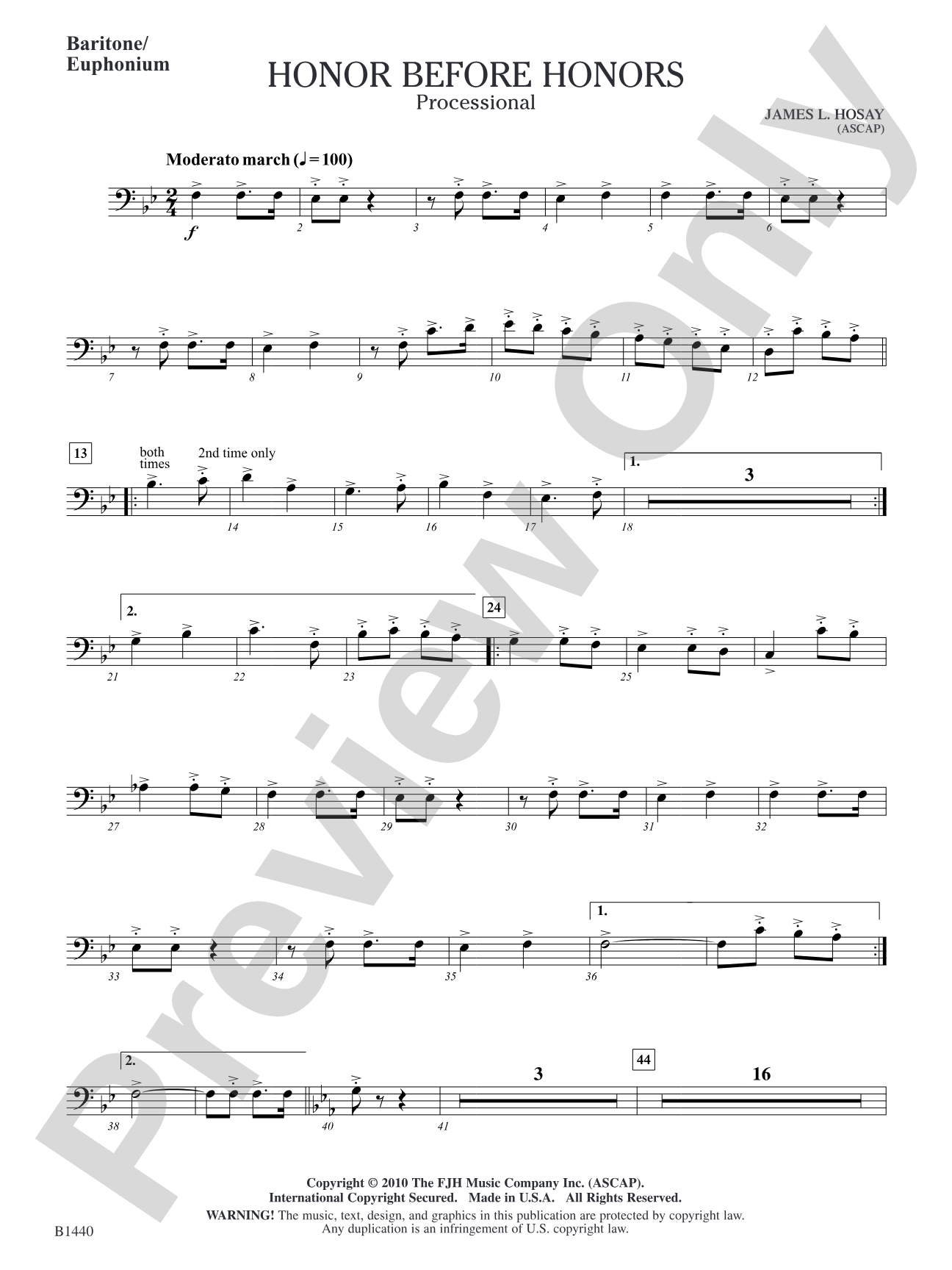
Honor Before Honors: Baritone/Euphonium Sheet Music Preview

Honor Before Honors: Baritone/Euphonium

By James L. Hosay

Grade: 2.5

Item: 98-PC-DB1440_BBC1

Digital Download
$7.00
Description
This bold and musical processional is ideal for graduations, assemblies, and a wide array of occasions where ceremonial music is necessary. After a majestic introduction and broad statements by the brass, the music becomes more subdued and reflective. Ultimately, the theme becomes quite dramatic and powerful before the opening fanfare returns one final time to depict the true meaning of honor!

Honor Before Honors: Baritone/Euphonium isn't in MakeMusic Cloud just yet...but it could be. Let us know you'd like to see it, and you'll help shape what comes next. In the meantime, start a free trial and dive into thousands of interactive titles your students can play along with today.

Sample Audio
0:00
0:00
Sample Video
Additional Details
Series: FJH Young Band
Publisher: The FJH Music Company, Inc.
SKU: 98-PC-DB1440_BBC1

More about this title

About the Composer: James L. Hosay

James L. Hosay is a prolific composer and arranger whose catalog spans concert band, jazz ensemble, and choral literature. His work appears regularly on festival and contest programs across North America, and he has earned recognition for writing that balances musical substance with accessibility across grade levels. Hosay understands the needs of school musicians and directors: his pieces challenge students without overwhelming them, and they work in real performance contexts rather than as abstract exercises.

Why we love this

This processional delivers genuine ceremonial impact without requiring a veteran ensemble. The architecture is clear and transparent, allowing Grade 2.5 musicians to execute something that sounds confident and purposeful. Hosay's brass writing cuts through the ensemble texture naturally, and the reflection-to-drama arc gives your graduation or assembly program an emotional shape that matters.

What to expect

Honor Before Honors announces itself with brass fanfare and ceremonial weight, then invites introspection before building toward real dramatic power. The opening theme returns transformed, creating a satisfying sense of completion that feels earned rather than tacked on.

Who it's for

This piece belongs in any Grade 2.5 concert band that needs processional music for graduation, assembly, or formal ceremony. It works equally well as a concert opener or a festival submission where you want to start strong without programming something technically overwhelming.

How to get the most out of it

  • Balance the majestic introduction so the brass statement emerges without dominating. Young bands often overpush forte sections; encourage the ensemble to think of the brass as leading singers, not drowning everyone else.
  • Shape the reflective middle section with deliberate dynamic control and clear phrase breathing. This quieter material is where many young bands lose focus; treat it with the same care you would a slow movement.
  • Build the dramatic climax gradually by layering instrumental families. Have the ensemble identify where each section enters the swell so the growth feels intentional rather than accidental.
  • Return to the opening fanfare with confidence and precision on the final statement. This reprise is your chance to showcase how much tighter and more musical the band has become since measure 1.

How to use it

Open a graduation ceremony or all-state assembly with this piece to set a formal, purposeful tone immediately. It also works as a contest selection where the transparent orchestration and clear emotional arc impress judges without obscuring the young musicians' work. The Grade 2.5 level means you can program it confidently early in the school year without waiting until the ensemble has reached peak condition.

Skills your students will build

  • Balancing brass and woodwind ensemble sound in homophonic textures
  • Executing dynamic contrast across a full range (p to ff) with control
  • Sustaining phrase shape through quiet, reflective sections
  • Transitioning between contrasting moods and tempos while maintaining ensemble cohesion

You May Also Like