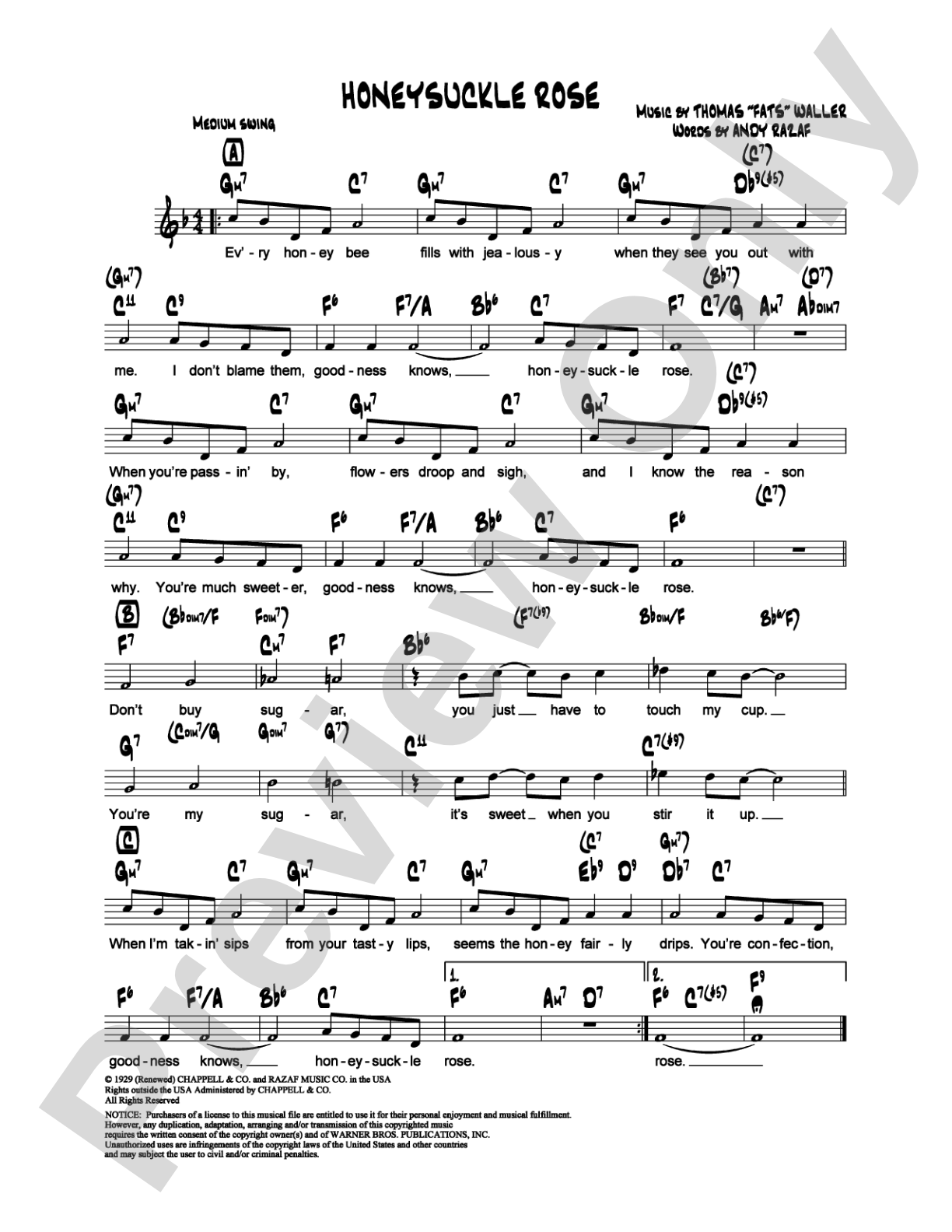
Honeysuckle Rose: Lead Sheet Digital Sheet Music

Honeysuckle Rose: Lead Sheet Digital Sheet Music

Thomas "Fats" Waller, Tommy Dorsey, Fats Waller

Item: 00-PS-0000930

Digital Download
$1.99
Description

Honeysuckle Rose: Lead Sheet Digital Sheet Music isn't in MakeMusic Cloud just yet...but it could be. Let us know you'd like to see it, and you'll help shape what comes next. In the meantime, start a free trial and dive into thousands of interactive titles your students can play along with today.

Sample Audio
No sample audio found.
Sample Video
Additional Details
SKU: 00-PS-0000930

More about this title

About the Artist: Fats Waller

Fats Waller (1904-1943) was a pianist, organist, composer, and vocalist who became one of jazz's most influential figures. His prolific output combined stride piano virtuosity with infectious swing and witty songwriting, and he composed or co-composed hundreds of standards that remain central to jazz repertoire. Waller's ability to blend technical brilliance with genuine warmth made him a beloved entertainer whose work shaped how musicians approach jazz phrasing, comping, and melodic interpretation.

Why we love this

Honeysuckle Rose is the kind of standard that teaches itself. Its melody sits naturally under the fingers, the harmonic progression reinforces common jazz vocabulary, and the swing feel practically invites players to explore improvisation without overthinking it. This lead sheet puts one of jazz's most joyful compositions directly in your students' hands so they can focus on developing taste and phrasing rather than wrestling with page turns.

What to expect

Honeysuckle Rose bounces with unforced charm. There's a lilting quality to the melody that sits just slightly behind the beat, creating space and ease rather than urgency. The harmonic movement is logical and warm, never surprising but always satisfying, which is exactly why this tune has endured for nearly a century.

Who it's for

Jazz musicians at the intermediate level and beyond will find a tune that rewards both straight-ahead playing and creative interpretation. This is essential material for anyone learning to read changes, develop a swing feel, or build a standards repertoire that will serve them in combos, big band sections, and jam sessions.

How to get the most out of it

  • Study Waller's original recording to absorb the phrasing and rhythmic lilt. Notice how he delays the melody slightly and catches the backbeat, creating space for comping that might feel too sparse without that reference.
  • Treat the melody as a launching point, not a destination. Lead sheets invite personalization; add passing tones, adjust articulation, and find where your voice wants to bend the line.
  • Balance transparency in the changes with confidence in your groove. Comping musicians need clear harmonic signposts, but overplaying the progression kills the simplicity that makes this tune sing.
  • If you're improvising over this, anchor your soloing to the song's natural phrasing. The melody suggests where phrases breathe; respect those moments rather than running over them.

How to use it

Pair this with other Waller compositions or early swing standards in a jazz concert to give students a coherent historical anchor. It also works beautifully as a foundation for student improvisation projects, since the changes are approachable but the melody is strong enough to guide listeners through solos. Consider featuring it in a big band or combo context where rhythm section students can develop their comping voice.

Skills your students will build

  • Reading jazz changes and understanding functional harmonic progression
  • Interpreting swing feel and phrasing in a standard melody
  • Basic improvisation over a 32-bar AABA form
  • Comping vocabulary and rhythmic independence in ensemble settings

You May Also Like