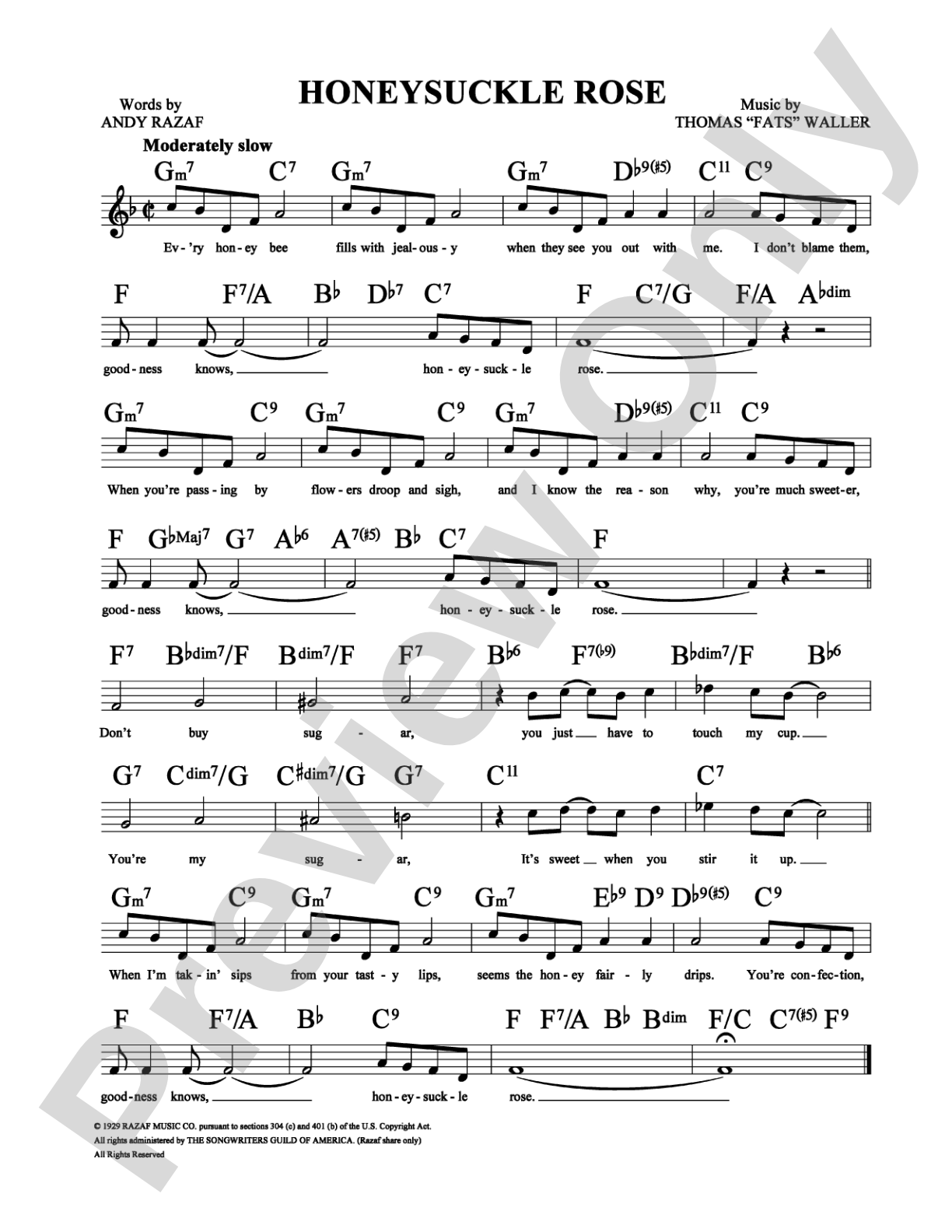
Honeysuckle Rose: Lead Sheet Digital Sheet Music

Honeysuckle Rose: Lead Sheet Digital Sheet Music

Tommy Dorsey, Fats Waller

Item: 00-PS-0000927

Digital Download
$1.99
Description

Honeysuckle Rose: Lead Sheet Digital Sheet Music isn't in MakeMusic Cloud just yet...but it could be. Let us know you'd like to see it, and you'll help shape what comes next. In the meantime, start a free trial and dive into thousands of interactive titles your students can play along with today.

Sample Audio
No sample audio found.
Sample Video
Additional Details
SKU: 00-PS-0000927

More about this title

About the Artist: Fats Waller

Fats Waller (1904, 1943) was a pianist, organist, composer, and entertainer who shaped early jazz and swing with his technical brilliance and infectious humor. His prolific songwriting output, often in collaboration with lyricist Andy Razaf, produced standards that remain central to the jazz repertoire, while his ability to make any tune swing made him a bandleader and recording artist of lasting influence.

Why we love this

Honeysuckle Rose endures because it swings effortlessly and rewards musicians at multiple levels. The lead sheet format lets players from beginning jazz students to advanced combo members find their own voice in the changes, whether they're comping chords or improvising a melody line.

What to expect

Honeysuckle Rose radiates warmth and optimism without a hint of schmaltz. The melody bounces along with natural buoyancy, and the harmonic movement, rooted in the blues tradition but dressed up in jazz colors, creates gentle surprises that keep the ear engaged. There's a lightness to it that invites both careful listening and pure joy in playing.

Who it's for

Jazz combos, small ensembles, and solo improvisers looking for a reliable standard that teaches jazz vocabulary without overwhelming complexity. Piano players, guitarists, and horn players all find their role in this tune.

How to get the most out of it

  • Clarify the underlying 12-bar blues structure in your mind before soloing, so your harmonic choices anchor back to the form rather than drifting into free territory.
  • Lean into the swing feel; straight eighths will drain the tune of its character and bounce.
  • Leave space in your solo for the rhythm section to breathe and respond, especially the drummer and bassist who will lock tighter if you give them room to listen.

How to use it

Feature this in a jazz recital or student jam session where it can anchor an evening of standards. Its familiarity also makes it ideal for student combos preparing for competitions or informal performances where demonstrating solid changes-playing matters more than stretching into obscure repertoire.

Skills your students will build

  • Reading and navigating 12-bar blues changes
  • Swung eighth-note feel and phrasing
  • Chord-scale relationships in functional harmony
  • Call-and-response improvisation with rhythm section
  • Comping rhythms that complement soloist phrasing

You May Also Like