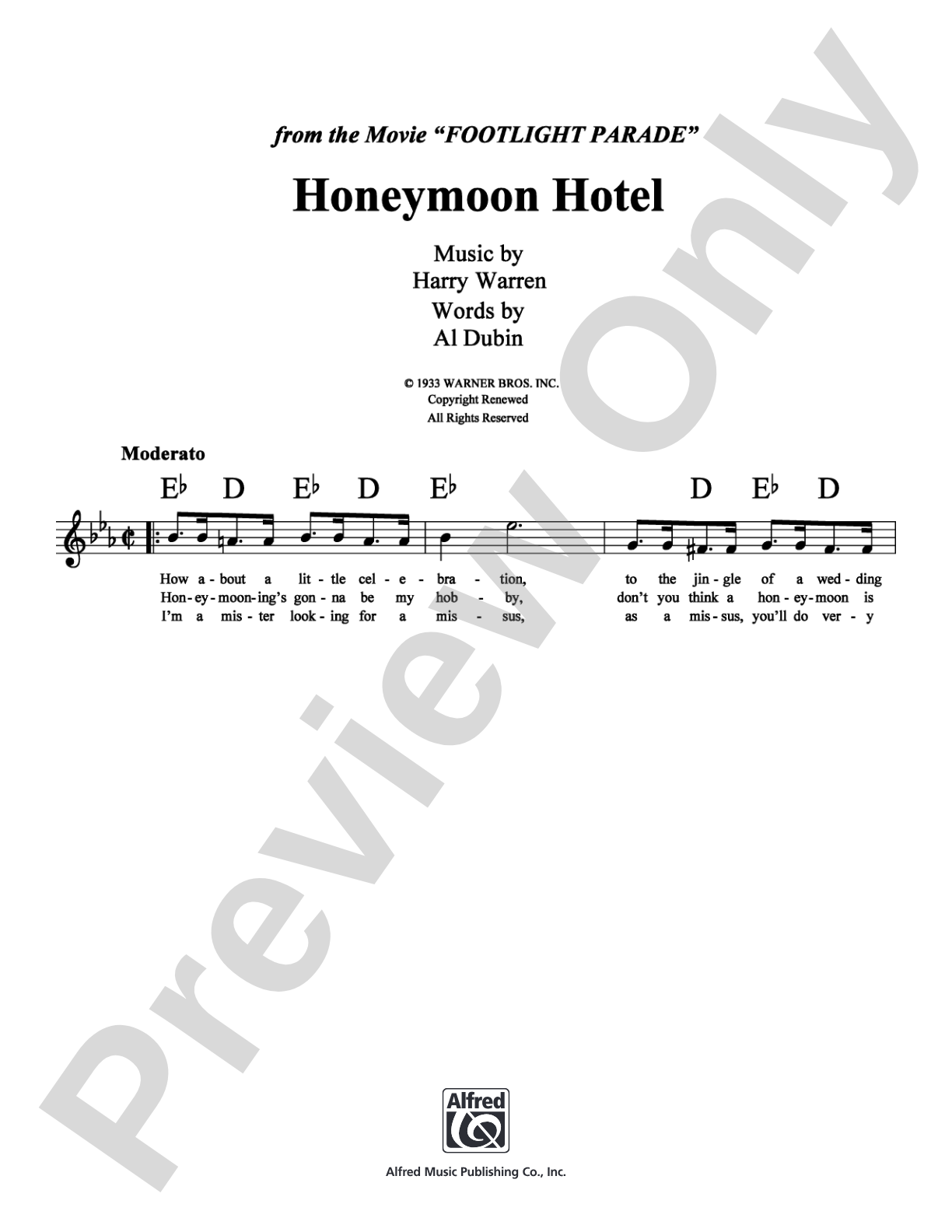
Honeymoon Hotel: Lead Sheet Digital Sheet Music

Honeymoon Hotel: Lead Sheet Digital Sheet Music

Harry Warren, Dick Powell

Item: 00-PS-0008548

Digital Download
$1.99
Description

Honeymoon Hotel: Lead Sheet Digital Sheet Music isn't in MakeMusic Cloud just yet...but it could be. Let us know you'd like to see it, and you'll help shape what comes next. In the meantime, start a free trial and dive into thousands of interactive titles your students can play along with today.

Sample Audio
No sample audio found.
Sample Video
Additional Details
SKU: 00-PS-0008548

More about this title

About the Artist: Dick Powell

Dick Powell (1904-1963) was a multitalented entertainer who excelled as a singer, dancer, and actor during Hollywood's Golden Age. He performed in numerous film musicals throughout the 1930s and 1940s, bringing charm and vocal polish to standards of the era. Powell's recordings and film appearances helped popularize many songs that remain central to the American songbook.

Why we love this

Lead sheets are the most practical way to learn a standard on your own terms. This sheet captures the melody and chord changes that defined Powell's recording, giving you direct access to the harmonic framework without unnecessary orchestration. Jazz musicians, pianists, and vocalists will find this format ideal for exploring voicings and improvisation.

What to expect

A bright, syncopated showstopper with the energy of 1930s Hollywood entertainment. The tune bounces along with theatrical charm and accessibility, inviting playful interpretation while maintaining the elegance of a well-crafted standard.

Who it's for

Jazz and pop musicians who want to explore a standard in its most flexible format, plus pianists and guitarists who accompany singers. This lead sheet works equally well for a pianist learning to comp or a vocalist preparing an arrangement.

How to get the most out of it

  • Study Powell's original recording to internalize the phrasing and rhythmic nuance of the melody; lead sheets often benefit from knowing how the song was first sung.
  • Experiment with the chord symbols by comping different voicings on piano or guitar rather than playing them literally; this builds harmonic fluency.
  • Use the melody line as a springboard for improvisation during a solo, then return to the written tune to anchor the form.

How to use it

Pair this with other standards from the same era in a jazz combo or piano recital. It also serves as an excellent teaching tool for a jazz ensemble learning to read lead sheets and build arrangement skills from chord changes alone.

Skills your students will build

  • Reading and interpreting lead sheet notation and chord symbols
  • Building jazz comping skills from a melody and harmonic framework
  • Understanding the structure and phrasing of a classic American standard
  • Developing improvisation over a predetermined melodic form

You May Also Like