
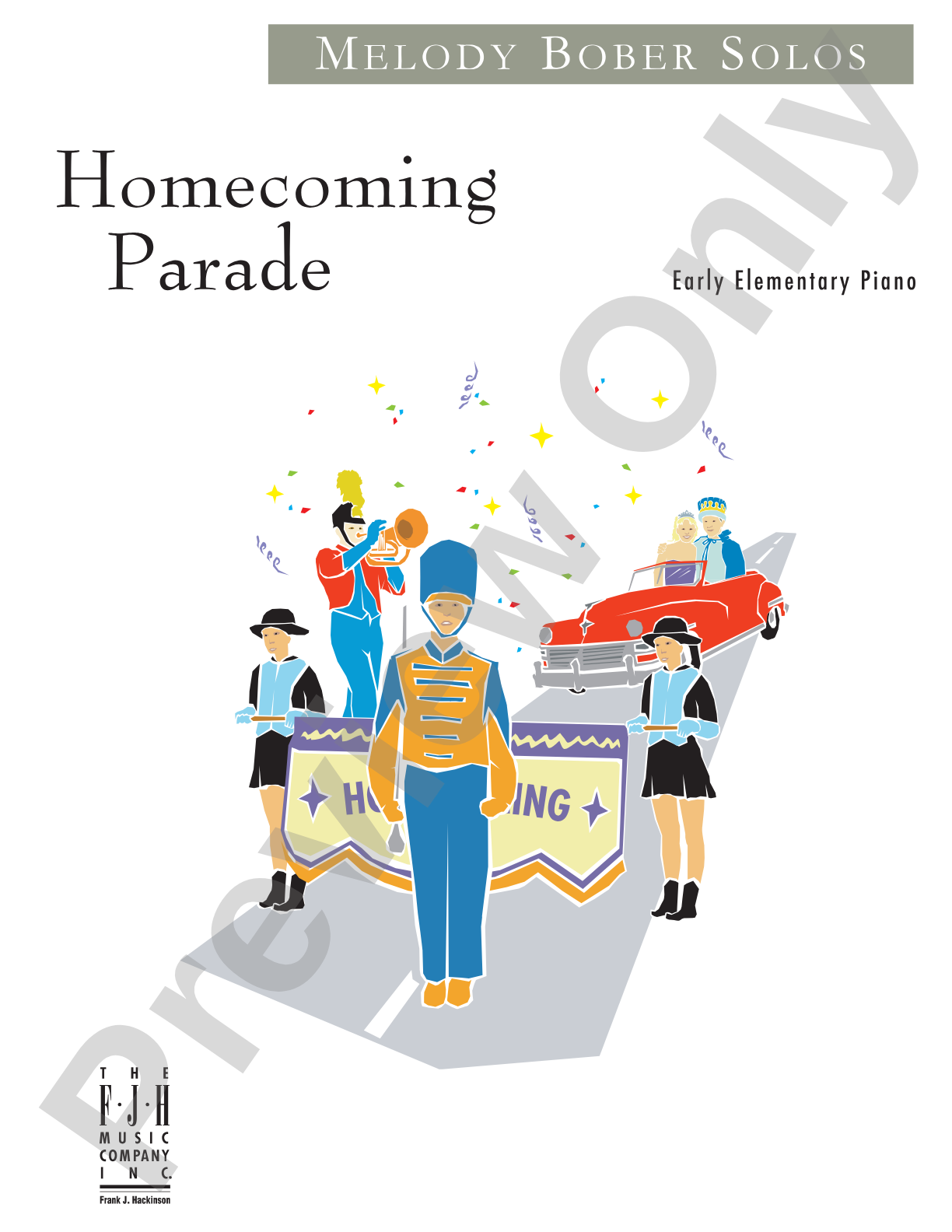

Homecoming Parade: Piano
By Melody Bober
Item: 98-DW9196
$2.50
Pickup currently not available
Related Items
Homecoming Parade: Early Elementary Piano Sheet |
$2.50
|
View |
Description
Written mostly in Middle C position, this happy, upbeat piece contains lyrics that describe the sights and sounds of a homecoming parade. Including a variety of dynamic levels, it features an optional teacher accompaniment, few hand position changes, and some use of accidentals.


Homecoming Parade: Piano isn't in MakeMusic Cloud just yet...but it could be. Let us know you'd like to see it, and you'll help shape what comes next. In the meantime, start a free trial and dive into thousands of interactive titles your students can play along with today.
Request This Title
Tell us you want it.
Start Your Free Trial
Explore everything that's ready to play right now.
Sample Audio
No sample audio found.
Sample Video
No sample videos found.
Additional Details
Series:
Written For You
Publisher:
The FJH Music Company, Inc.
SKU:
98-DW9196
More about this title
About the Composer: Melody Bober

Melody Bober brings two decades of public school teaching experience and university-level instruction together with her private studio work to create piano repertoire that genuinely connects with students. A summa cum laude graduate of the University of Illinois at Champaign-Urbana in music education and holder of a Master of Arts in piano performance from Minnesota State University, Moorhead, she studied piano with Joel Shapiro and Andrew Froelich, drawing on their mentorship to develop her distinctive compositional voice.
Beyond the studio and classroom, Bober serves as an active church pianist and has directed church music programs. She is a sought-after clinician and presenter at piano teacher conventions and workshops across North America, known for her innovative approach to composition and music pedagogy. She lives in Minnesota with her husband Jeff.
Why we love this
Bober writes for where students actually are technically, which means a piece centered in Middle C position will genuinely excite them rather than frustrate them. The optional teacher accompaniment transforms a student solo into a duet experience, adding color and motivation without requiring a more advanced player. Accidentals appear naturally throughout the melodic line, introducing chromatic thinking without disrupting the celebratory character that makes this piece rewarding to learn and play.
What to expect
The piece captures the forward motion and brightness of a parade: bright major key colors, rhythmic clarity, and a steady sense of momentum. Lyrics describing sights and sounds anchor the student in storytelling, turning technical work into emotional narrative. The dynamic range keeps the listener's attention lively without ever becoming aggressive or overly complex.
Who it's for
This piece is ideal for early intermediate piano students who have moved beyond absolute beginner repertoire but still benefit from a comfortable hand position and clear sense of musical direction. It works equally well for students approaching their first recital experience or those building confidence through celebratory repertoire. The optional teacher part makes it accessible for students at the younger or less experienced end of the spectrum, while the textural and dynamic variety keeps it engaging for advancing players.
How to get the most out of it
- Map out the dynamic shifts before the first full run-through; the variety of levels gives shape to the parade atmosphere and prevents the piece from settling into a single energy.
- Practice the teacher accompaniment separately, then layer it underneath at slow tempo so the student can hear how it fills in harmonic space around the melody.
- Isolate any accidental passages in isolation and name them aloud before incorporating them into context; this builds confidence and accuracy without slowing overall learning.
- Bring intentional contrast to the tempo or character when the lyrics shift themes; the piece describes different parade sights, so each section can breathe distinctly.
How to use it
Open a student recital with this piece to set an uplifting, energetic tone that signals to the audience that the program will be engaging and varied. Its celebratory character also makes it a strong closer if you want to send students and families out smiling. Consider pairing it with other narrative or descriptive piano solos at the same level to create a "scene-setting" mini-program within a larger concert.
Skills your students will build
- Playing confidently in Middle C position with minimal hand shifts
- Interpreting dynamic markings and shaping phrases through articulation and touch
- Reading and executing accidentals in context without losing forward momentum
- Balancing melody and accompaniment when playing with a teacher partner
- Connecting lyrics to musical expression and character