
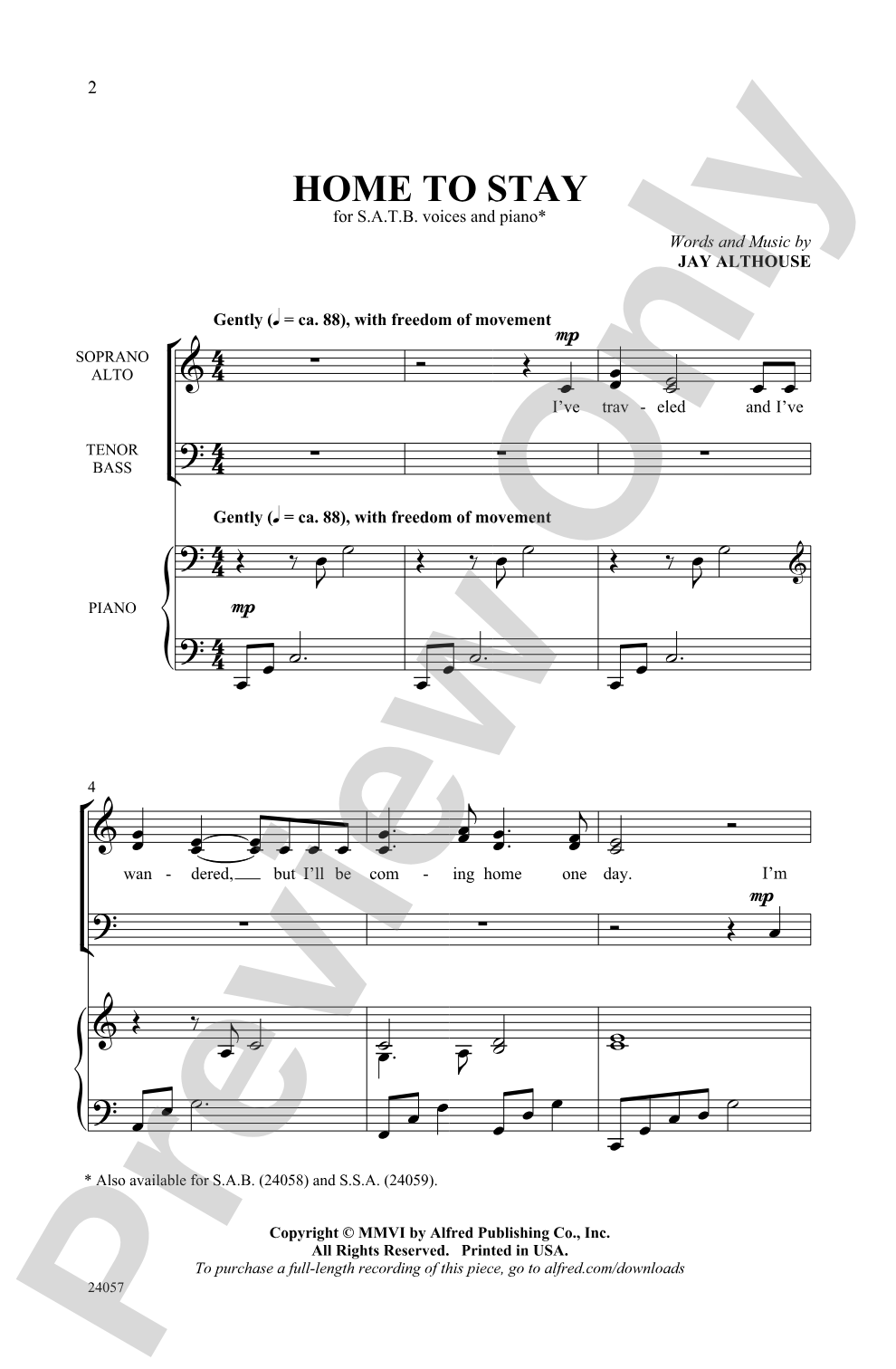
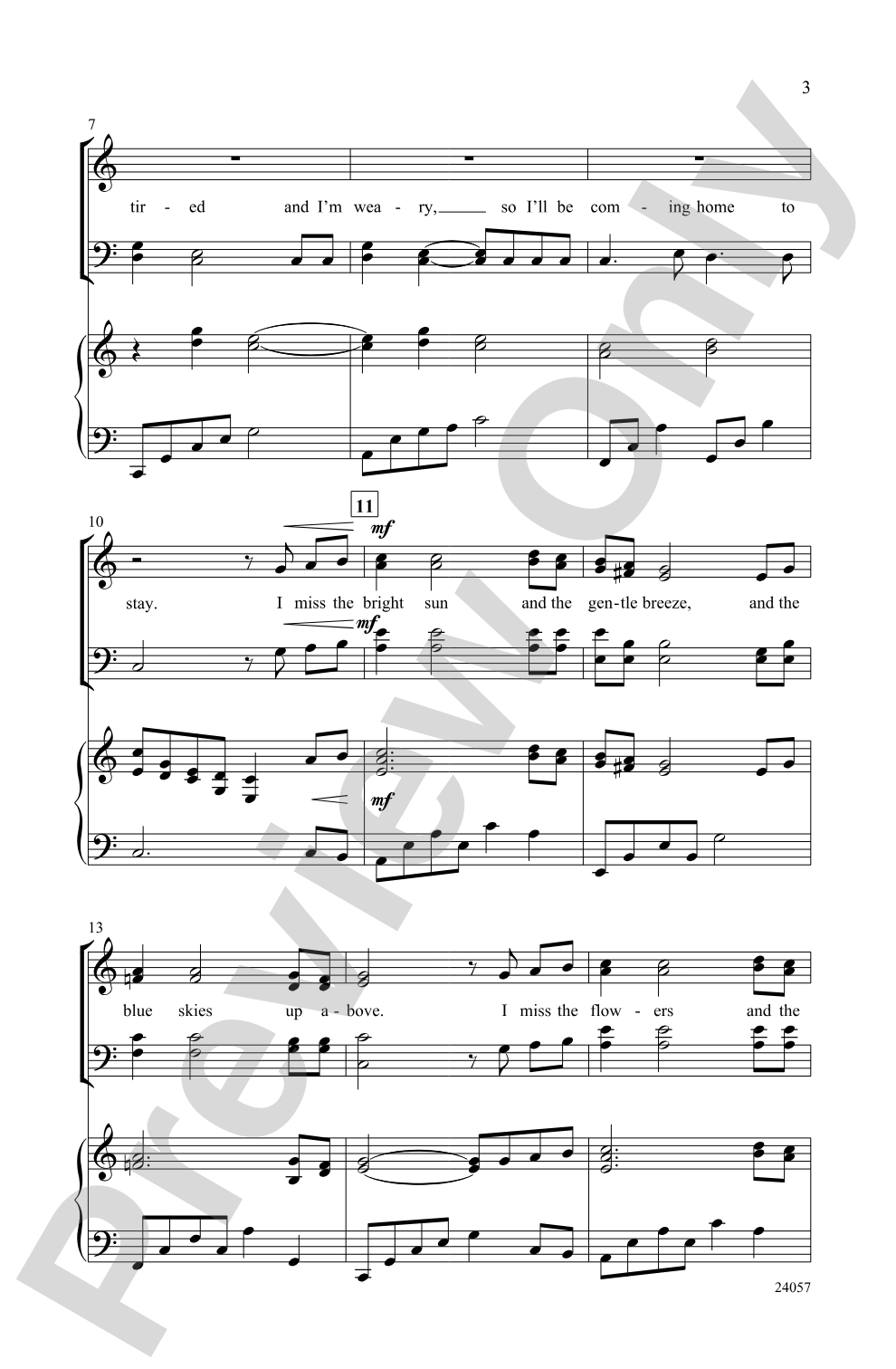

Home to Stay: SATB Choral Octavo
By Jay Althouse
Item: 00-PO-0000091
$2.25
Minimum order quantity: 20 copies
Pickup currently not available
Description
Reminiscent of folk songs from the British Isles, this choral gem has a touching text: "I've traveled and I've wandered...but I'll be coming home to stay." Especially appropriate for spring concerts or graduation time, when thoughts are turned to moving on, yet not wanting to let go.


Home to Stay: SATB Choral Octavo isn't in MakeMusic Cloud just yet...but it could be. Let us know you'd like to see it, and you'll help shape what comes next. In the meantime, start a free trial and dive into thousands of interactive titles your students can play along with today.
Request This Title
Tell us you want it.
Start Your Free Trial
Explore everything that's ready to play right now.
Sample Audio
1
Audio File
--:--
0:00
0:00
Sample Video
No sample videos found.
Additional Details
Series:
Alfred Archive Edition: Alfred Choral Designs
Publisher:
Alfred Music
Page Count:
8
SKU:
00-PO-0000091
More about this title
About the Composer: Jay Althouse

Jay Althouse holds degrees in Music Education and Music from Indiana University of Pennsylvania, where he received the Distinguished Alumni award. Early in his career, he worked for eight years in rights and licensing at a major educational music publisher and served on the Executive Board of the Music Publishers Association of America. He is a prolific composer with more than 800 choral works in print across all levels, performed regularly throughout the English-speaking world.
Althouse's contributions to music education extend well beyond composition. He has co-written children's musicals with his wife Sally K. Albrecht, compiled and arranged vocal solo collections including Folk Songs for Solo Singers, and authored instructional resources such as The Complete Choral Warm-up Book, Accent on Composers, Ready to Read Music, and Sixty Music Quizzes. A writer member of ASCAP, he is a regular recipient of the ASCAP Special Award for his standard music compositions. He co-wrote I Hear America Singing, performed by the San Francisco Girls and Boys Choirs at President Barack Obama's 2009 Inauguration. Currently based in Wake Forest, North Carolina, Althouse serves on the National Advisory Board of the Folk Art Society of America and contributes regularly to its quarterly publication.
Why we love this
Althouse captures the bittersweet specificity of a folk song without resorting to sentimentality, letting the melody carry the emotional weight of departure and belonging. The text speaks directly to the spring concert moment when students are genuinely thinking about endings and beginnings, making this feel less like a programmatic choice and more like a song your singers have been waiting to sing. The harmonic language sits comfortably in SATB voicing while maintaining enough character to feel genuinely singable across mixed abilities.
What to expect
Walking along a quiet path in early evening, with the landscape you're leaving behind still visible on the horizon. The melody unfolds with the unhurried confidence of a traditional folk song, while the harmony gently deepens the emotional landscape beneath the text. There's no drama here, only honest acknowledgment of change and the quiet certainty of finding your way home.
Who it's for
Directors programming spring or graduation concerts who need repertoire that speaks authentically to transition and reflection. Mixed choirs with singers at intermediate levels will find the SATB writing both accessible and musically satisfying. This works equally well for all-age community choirs and high school programs.
How to get the most out of it
- Lean into the folk idiom by keeping phrasing natural and conversational rather than choral. Let the singers breathe where the text naturally falls, even if it breaks a phrase.
- Balance the melody between soprano and alto sections when they share it, ensuring the lower voices maintain the sense of harmonic foundation rather than becoming accompaniment.
- The homophonic passages benefit from clear vowel unification and stillness; resist the urge to add interpretive tempo shifts in sections that ask for straightforward support.
How to use it
Pair this with other transition-themed repertoire to frame a concert section around growth and change, or open a graduation concert with it to set a reflective tone before lighter works. The folk sensibility also makes it an effective closer when you want the audience to leave thoughtful rather than energized. At eight pages, it fits naturally into any spring program without consuming excessive rehearsal time.
Skills your students will build
- Phrasing within folk song idiom and text-driven interpretation
- Balancing between melody and harmonic support in mixed voicing
- Sustaining emotional authenticity without theatrical oversinging
- Reading and blending straightforward SATB harmony