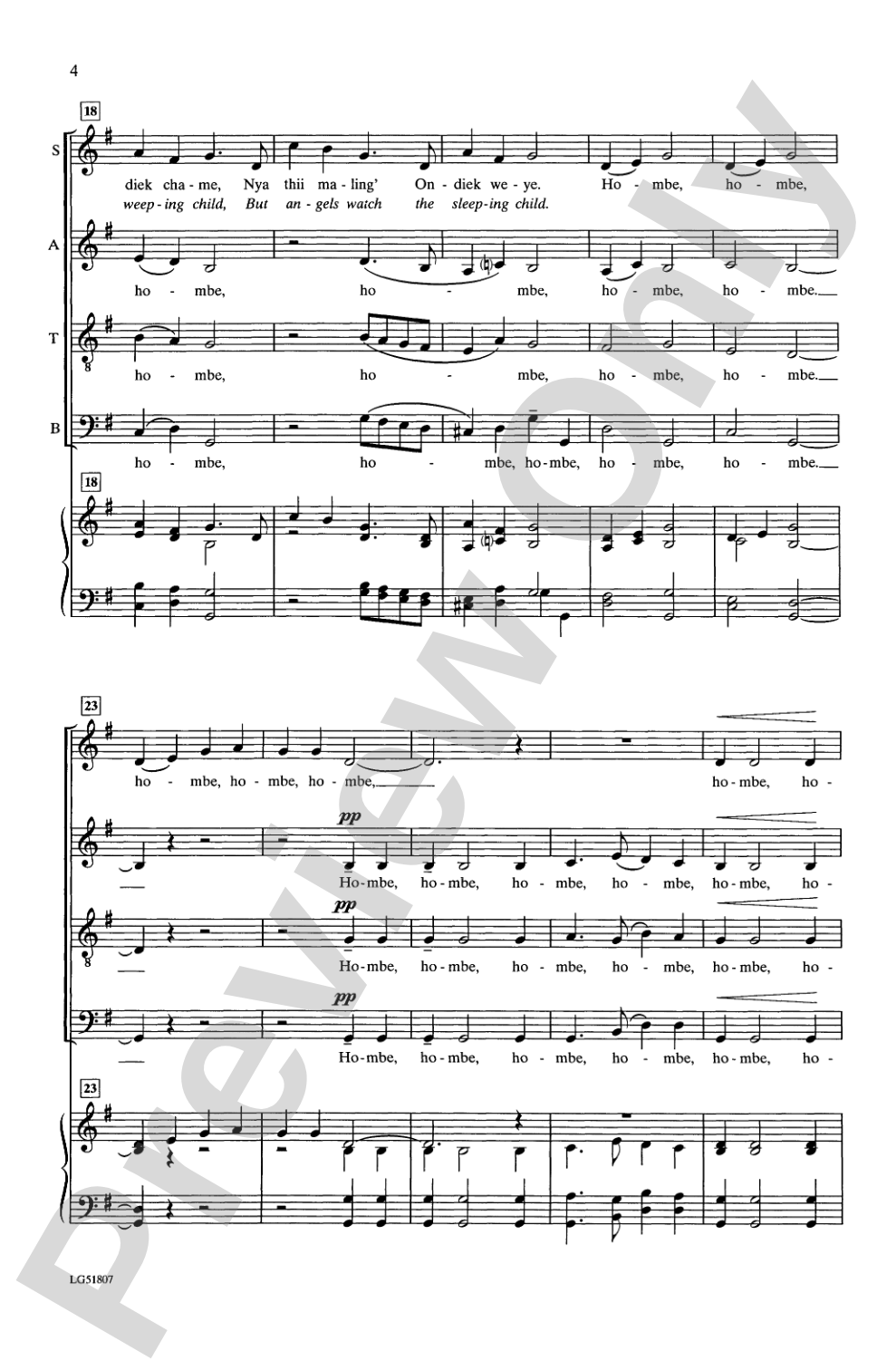
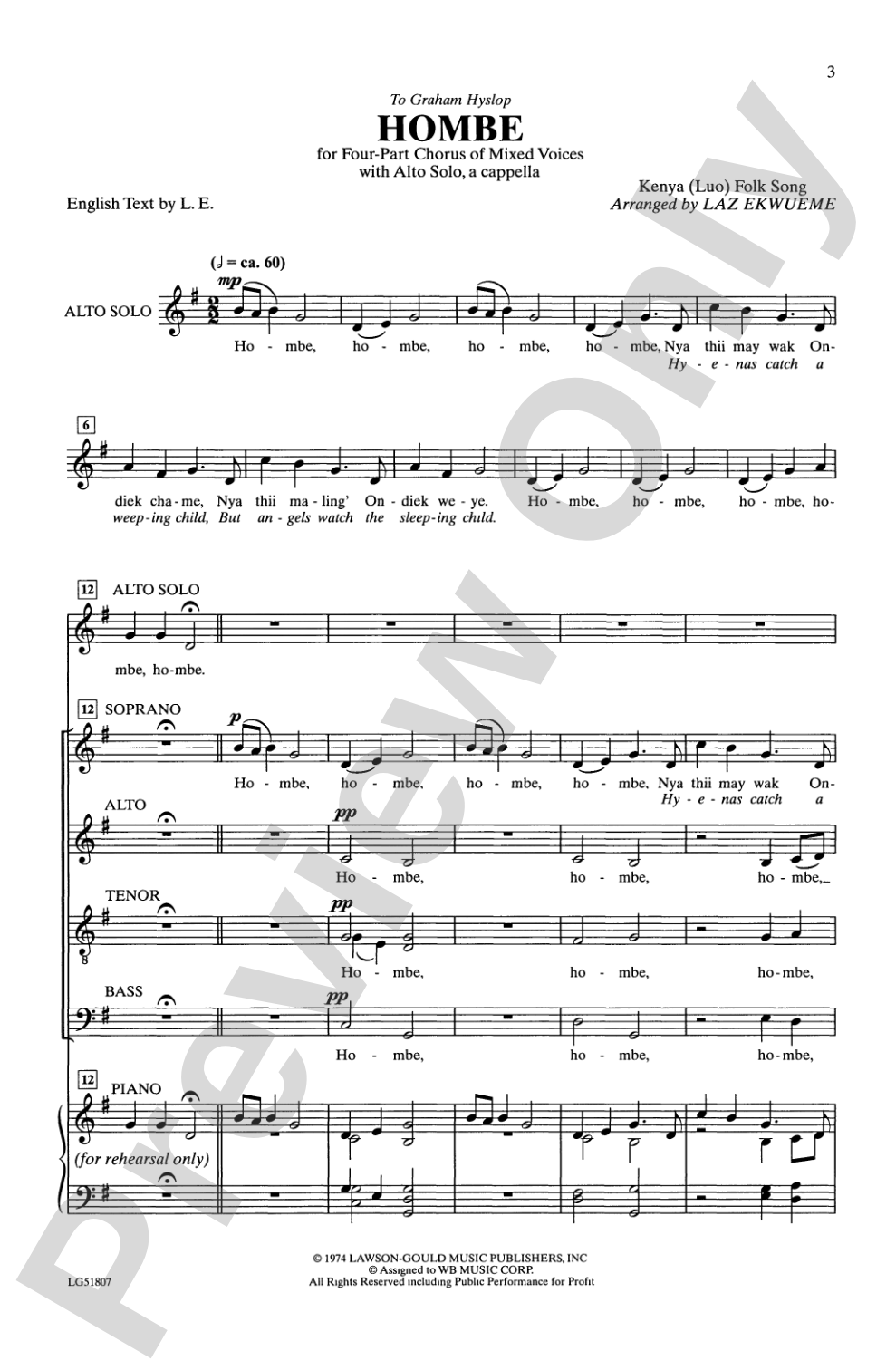
Hombe Sheet Music Preview

Hombe: SATB Choral Octavo

Kenya (Luo) Folk Song / arr. Laz Ekwueme

Item: 00-PO-0005032

Digital Download
$2.25

Minimum order quantity: 20 copies

Description

Hombe: SATB Choral Octavo isn't in MakeMusic Cloud just yet...but it could be. Let us know you'd like to see it, and you'll help shape what comes next. In the meantime, start a free trial and dive into thousands of interactive titles your students can play along with today.

Sample Audio
No sample audio found.
Sample Video
Additional Details
Series: Alfred Archive Edition: Lawson-Gould Music Publishers
Publisher: Alfred Music
Page Count: 12
SKU: 00-PO-0005032

More about this title

About the Arranger: Laz Ekwueme

Laz Ekwueme is a Nigerian composer and ethnomusicologist whose work bridges classical composition and the rich musical traditions of West Africa. His arrangements honor folk material while creating compelling choral textures that engage singers across all voice parts.

Why we love this

Ekwueme's arrangement brings authentic Nigerian folk material into the SATB repertoire without flattening its character or requiring specialized vocal techniques. The piece sits comfortably for mixed choirs while maintaining rhythmic and melodic integrity that keeps singers engaged and audiences transported.

What to expect

Hombe carries the warmth and community spirit of its Nigerian folk roots while settling into the harmonic language of Western choral writing. Singers feel grounded in something real and human; the piece doesn't ask them to perform ethnicity but to simply sing well with each other.

Who it's for

This octavo works for high school and community choirs seeking repertoire that expands beyond European traditions and engages singers in meaningful cultural material. Directors building programs that authentically represent world music will find this arrangement both accessible and artistically substantial.

How to get the most out of it

  • Anchor the harmonic movement by having lower voices establish the root positions cleanly; this creates space for upper voices to shape the melody with flexibility.
  • Approach rhythmic figures as naturally as speech rather than mechanically; the folk idiom thrives when syllables land with conversational ease.
  • Balance soprano and alto lines so the primary melody reads clearly without dominating the overall blend; this arrangement values voices equally across all parts.

How to use it

Program this alongside other world music selections to create a concert section celebrating global voices, or place it as a contrasting moment in a program of art songs and classics. Its 12-page length and accessible difficulty make it suitable for winter or spring concerts once basic learning is secure.

Skills your students will build

  • Maintaining rhythmic independence within ensemble texture
  • Singing with tonal warmth in folk-derived melody
  • Balancing four-part harmony across equal voice ranges
  • Responding to non-Western musical phrasing and accent patterns

You May Also Like