Homage to Oscar Peterson Sheet Music Preview

Homage to Oscar Peterson: Piano

By Sheila Clagg Cathey

Level: Late Intermediate

Item: 00-PS-0017766

Digital Download
$5.99
Description
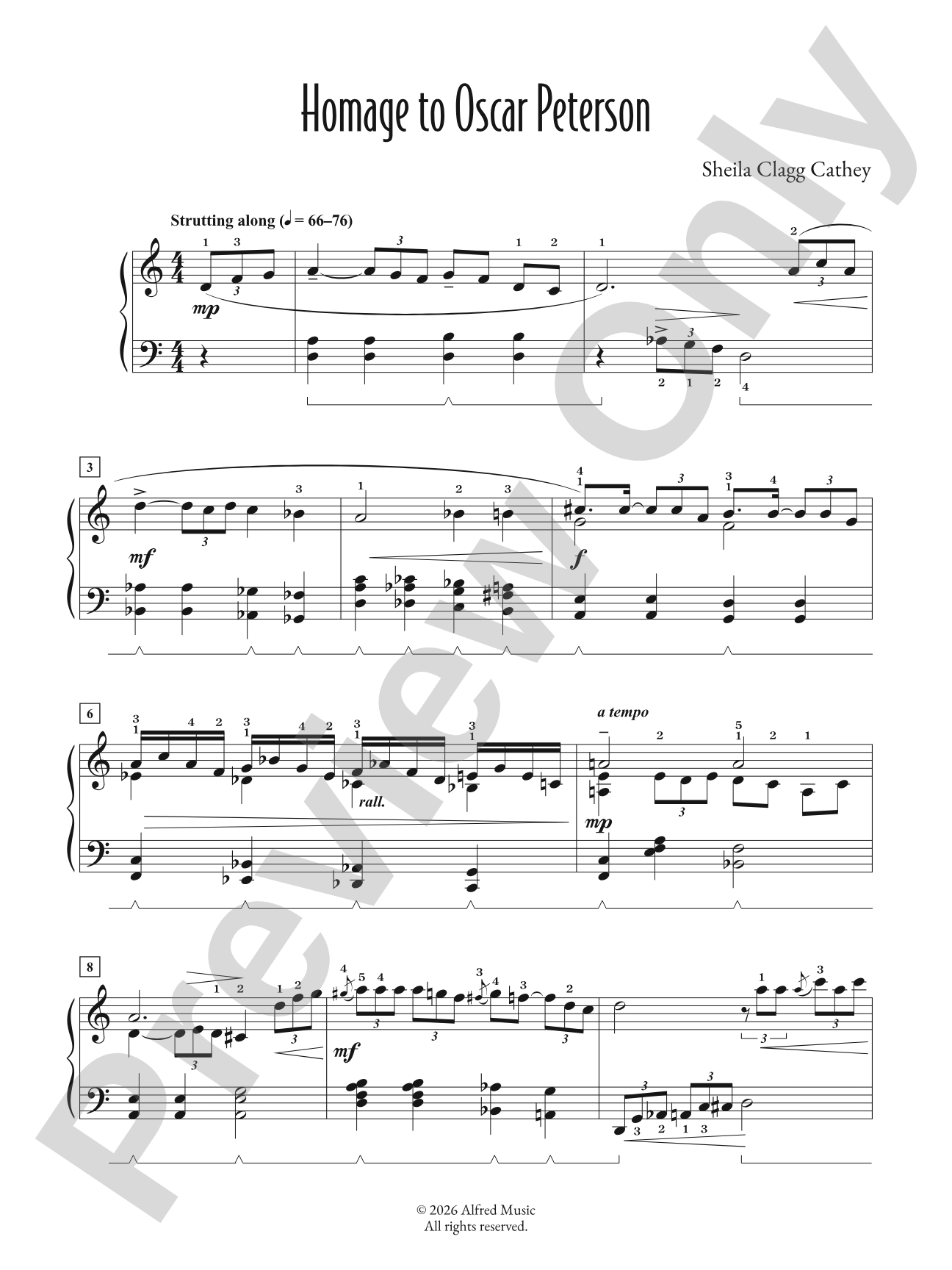
This stylish jazz showpiece pays tribute to Oscar Peterson's signature flair with lush chord textures, grace notes, tremolos, and brilliant sextuplet passages. Rhythmic shifts between triplets and straight eighths add variety as the music struts forward with relaxed confidence.

Homage to Oscar Peterson: Piano isn't in MakeMusic Cloud just yet...but it could be. Let us know you'd like to see it, and you'll help shape what comes next. In the meantime, start a free trial and dive into thousands of interactive titles your students can play along with today.

Sample Audio
0:00
0:00
Sample Video
Additional Details
Series: Signature Series
SKU: 00-PS-0017766

More about this title

About the Composer: Sheila Clagg Cathey

Sheila Clagg Cathey

Dr. Sheila Clagg Cathey brings deep expertise across music theory, composition, and piano performance to her work as an educator and adjudicator. She earned a D.M.A. in music education alongside master's degrees in music theory and composition from institutions including Texas Christian University and Webster University, complemented by certifications across multiple states and tribal membership in the Choctaw Nation of Oklahoma.

Throughout her career, Cathey has taught music at universities including TCU, Dallas Baptist University, Webster University, and Tulsa Community College, while also directing school musicals and performances. Her scholarly contributions span publications in Clavier magazine on left-hand piano writing and peer-reviewed work in music theory pedagogy. As a Nationally Certified Teacher of Music and frequent festival adjudicator, she continues to shape music education through both her compositions and mentorship of emerging musicians and teachers.

Why we love this

Cathey captures Peterson's unmistakable sound without resorting to pastiche. The composition sits comfortably at late intermediate level while demanding real jazz vocabulary, making it an excellent anchor piece for a recital that showcases genuine musicianship rather than technical complexity alone.

What to expect

Sophisticated and unrushed, like sitting in at a jazz club where the best players make difficult things look effortless. The lush harmonies and graceful ornamentation create an atmosphere of refined elegance, while the rhythmic interplay between triplets and straight eighths keeps the listener engaged in the music's forward trajectory.

Who it's for

Late intermediate pianists comfortable with jazz idioms who want to expand beyond classical repertoire into authentic contemporary jazz writing. This piece works equally well for recital preparation and for jazz ensemble pianists seeking a solo vehicle that honors a genuine jazz legacy.

How to get the most out of it

  • Shape the grace notes and sextuplet passages as ornaments within the phrase rather than as separate flourishes; they should feel like natural extensions of Peterson's harmonic language, not decorative add-ons.
  • Pay close attention to the rhythmic relationship between triplet and straight-eighth sections. These shifts should create forward momentum, not confusion. Tap through the transitions slowly until the rhythmic perspective becomes automatic.
  • Use the tremolo markings as dynamic amplifiers. A tremolo doesn't mean playing louder; it means creating intensity through textural detail. Maintain control and evenness throughout.
  • Lock into the relaxed confidence the description promises. Jazz piano at this level lives or dies on pocket and phrasing; mechanical accuracy will make the lush chord textures sound brittle.

How to use it

Feature this as a solo recital centerpiece for a pianist ready to demonstrate jazz fluency, or pair it with classical or contemporary repertoire to show stylistic range. It also works as a bridge piece in a concert exploring American musical traditions or as a showcase during a jazz-focused student recital.

Skills your students will build

  • Jazz chord voicing and harmonic movement characteristic of swing-era playing
  • Rhythmic flexibility between triplet and straight-eighth feels
  • Grace note and ornament execution in jazz context
  • Tremolo and textural control at the keyboard
  • Phrasing and articulation in jazz idiom

You May Also Like