Holy Is The Lord Sheet Music Preview

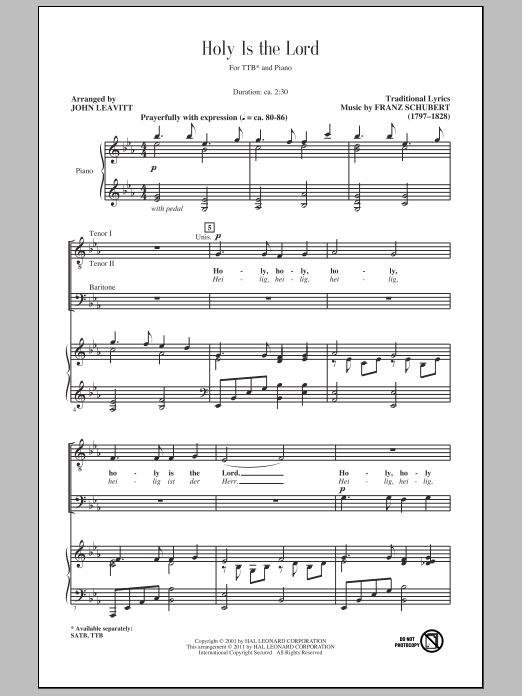
Holy Is The Lord: TTBB Choral Octavo

By Franz Schubert / Arranged by John Leavitt

Item: 35-DS00172419

Digital Download
$2.99
Description

Holy Is The Lord: TTBB Choral Octavo isn't in MakeMusic Cloud just yet...but it could be. Let us know you'd like to see it, and you'll help shape what comes next. In the meantime, start a free trial and dive into thousands of interactive titles your students can play along with today.

Sample Audio
No sample audio found.
Sample Video
Additional Details
Publisher: Hal Leonard
Page Count: 5
SKU: 35-DS00172419

More about this title

About the Composer: Franz Schubert

Franz Schubert (1797-1828) composed over 600 works across every major genre, yet spent most of his life in Vienna with limited public recognition. His gift for melody and harmonic innovation shaped Romantic music; his song cycles and symphonies remain cornerstones of the classical repertoire. For choral directors, Schubert's sacred works offer direct access to his compositional voice: clear counterpoint, singable lines, and emotional depth that never overshoots the ensemble's capabilities.

Schubert's choral output spans masses, motets, and part songs written for amateur and professional singers alike. His understanding of the voice—its range, tessitura, and natural phrasing—comes through in every piece. These works reward rehearsal with musical growth and consistently move both singers and audiences.

Why we love this

John Leavitt's arrangement opens Schubert's sacred language to men's voices without sacrificing the harmonic richness that makes this music endure. The divisi moments land purposefully; soloistic passages emerge from the ensemble naturally. This is sacred music that sounds earned, not manufactured.

What to expect

Reverent and grounded, with the kind of effortless beauty that only emerges from perfect craftsmanship. The harmony glows without fanfare; the line unfolds with intimate confidence. This is music that invites singers into something larger than themselves.

Who it's for

Men's choirs and changing-voice ensembles seeking a spiritual centerpiece that sits comfortably in the middle register. Directors programming a concert that honors both classical mastery and contemporary accessibility will find this arrangement meets both needs.

How to get the most out of it

  • Balance the inner voices carefully in passages where the second tenor or baritone carries harmonic material; resist the urge to weight everything toward the outer parts.
  • Shape phrases by listening through to the cadential goal rather than breaking at bar lines; Schubert's harmonic momentum often spans 4-8 bars.
  • Let the text inform dynamics and articulation; sacred reverence need not mean static sound, so respond to the emotional contour of the words.
  • Tune the raised scale degrees (especially leading tones and raised fourths) with precision; Romantic harmony depends on sensitive intonation.

How to use it

Pair this with other sacred works from the 19th century to build a thematic concert, or position it as the emotional core of a mixed sacred and secular program. It also serves as an excellent final rehearsal piece in a long season, offering singers a chance to explore Romantic style with repertoire that rewards focused preparation.

Skills your students will build

  • Reading and performing divisi voicing in TTBB texture
  • Balancing inner-voice harmony in four-part writing
  • Shaping long phrases guided by harmonic rhythm
  • Interpreting text expression in sacred context
  • Singing with precise intonation in chromatic and raised-scale-degree passages

You May Also Like