
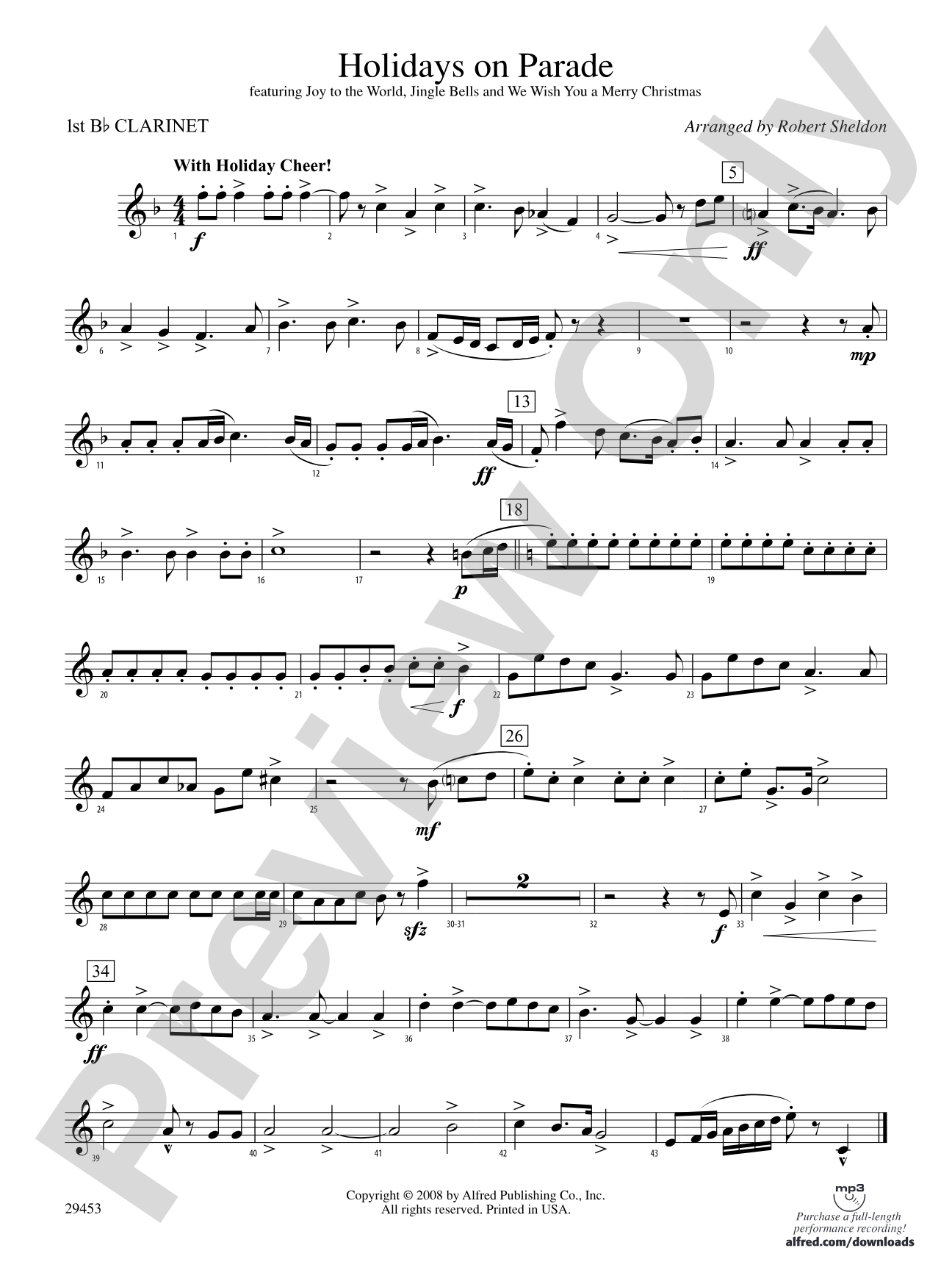

Holidays on Parade: 1st B-flat Clarinet
By Robert Sheldon
Grade: 2 (Medium Easy)
Item: 00-PC-0001410_C1
$3.00
Pickup currently not available
Description
Here is the perfect march for your holiday performance! This tuneful seasonal treat will delight your audience with effervescent settings of "Joy to the World," "Jingle Bells" and "We Wish You a Merry Christmas." With really enjoyable parts for everyone in the band, this will become a perennial favorite -- a terrific way to open or close your December concert! (1:30)


Don't just read it, hear it, play along with it, and watch your students grow with it. In MakeMusic Cloud, Holidays on Parade: 1st B-flat Clarinet comes alive with professional accompaniment, adjustable tempo, and built-in practice tools that turn solo practice into real progress.
Open in the Player
Jump straight in and assign it today.
Start Your Free Trial
Open this title and explore the full library in minutes.
Sample Audio
1
Audio File
--:--
0:00
0:00
Sample Video
No sample videos found.
Additional Details
Series:
Challenger Band Series
Publisher:
Alfred Music
Page Count:
120
SKU:
00-PC-0001410_C1
More about this title
About the Composer: Robert Sheldon

Robert Sheldon's compositions dominate the wind band repertoire worldwide. His works appear regularly on state and national contest lists, and his music is performed by ensembles ranging from school bands to professional orchestras across six continents. He has guest conducted All-State and Regional Honor Bands throughout his career and served as lead author of Sound Innovations for Concert Band, one of the field's most widely adopted instructional series.
Sheldon's contributions to music education have earned recognition from the American School Band Director's Association, Phi Beta Mu, and the American Society of Composers, Authors and Publishers. He conducts clinics and presents seminars at universities and state music education conferences regularly. His works have been performed at Carnegie Hall, Orchestra Hall, Boston Symphony Hall, the Sydney Opera House, and the Kennedy Center. In 2020, VanderCook College of Music awarded him an honorary doctorate in recognition of his influence on the field.
Why we love this
Sheldon knows exactly what Grade 2 bands can handle and what will sound great in the concert hall. Three beloved holiday melodies receive bright, energetic orchestrations with parts that give every section something to enjoy, which means your students will stay engaged from rehearsal through performance. This march delivers the polish and tuneful writing that audience members expect from a concert closer without demanding technical stretches from your ensemble.
What to expect
The piece sparkles with the bright energy of a holiday parade, marrying the ceremonial confidence of march form with familiar melodies that audiences sing along with mentally. Three beloved tunes unfold in succession, each one orchestrated to feel fresh and celebratory rather than overly sentimental. The overall effect is festive and approachable, a piece that feels like genuine celebration rather than obligatory seasonal music.
Who it's for
Grade 2 concert bands preparing a December concert need a piece that sounds polished and seasonal without requiring extensive rehearsal time. Directors seeking an opener or closer that audiences recognize and musicians enjoy playing will find this march answers both needs. It works equally well for bands building their holiday performance traditions and those adding variety to established concert programs.
How to get the most out of it
- Keep the tempo brisk and steady throughout; the march character thrives on consistent forward motion, and the 1:30 runtime moves quickly if you allow the piece to breathe naturally rather than rushing.
- Balance the three melodies as they pass between sections so each tune emerges clearly. Sheldon's scoring gives different instruments the spotlight at different points, which rewards your section leaders' musicality.
- Shape phrases with gentle dynamic swells rather than abrupt changes. The tuneful nature of these holiday melodies means small dynamic inflections will enhance the melodic contour without losing the march's lift.
How to use it
Program this as your December concert opener to set an immediate celebratory mood, or use it as a finale to send the audience out in a festive spirit. The accessibility of the melodic material and the march's natural energy make it an excellent complement to a longer classical or contemporary work earlier in the concert. At 1:30, it fits neatly into a balanced concert structure without demanding an oversized portion of rehearsal time.
Skills your students will build
- Reading march form and sectional structure
- Balancing melody and accompaniment across instrument groups
- Maintaining consistent tempo through repetitive phrase structures
- Articulation clarity in fast-moving passages
- Phrasing and shaping within tonal melodies