
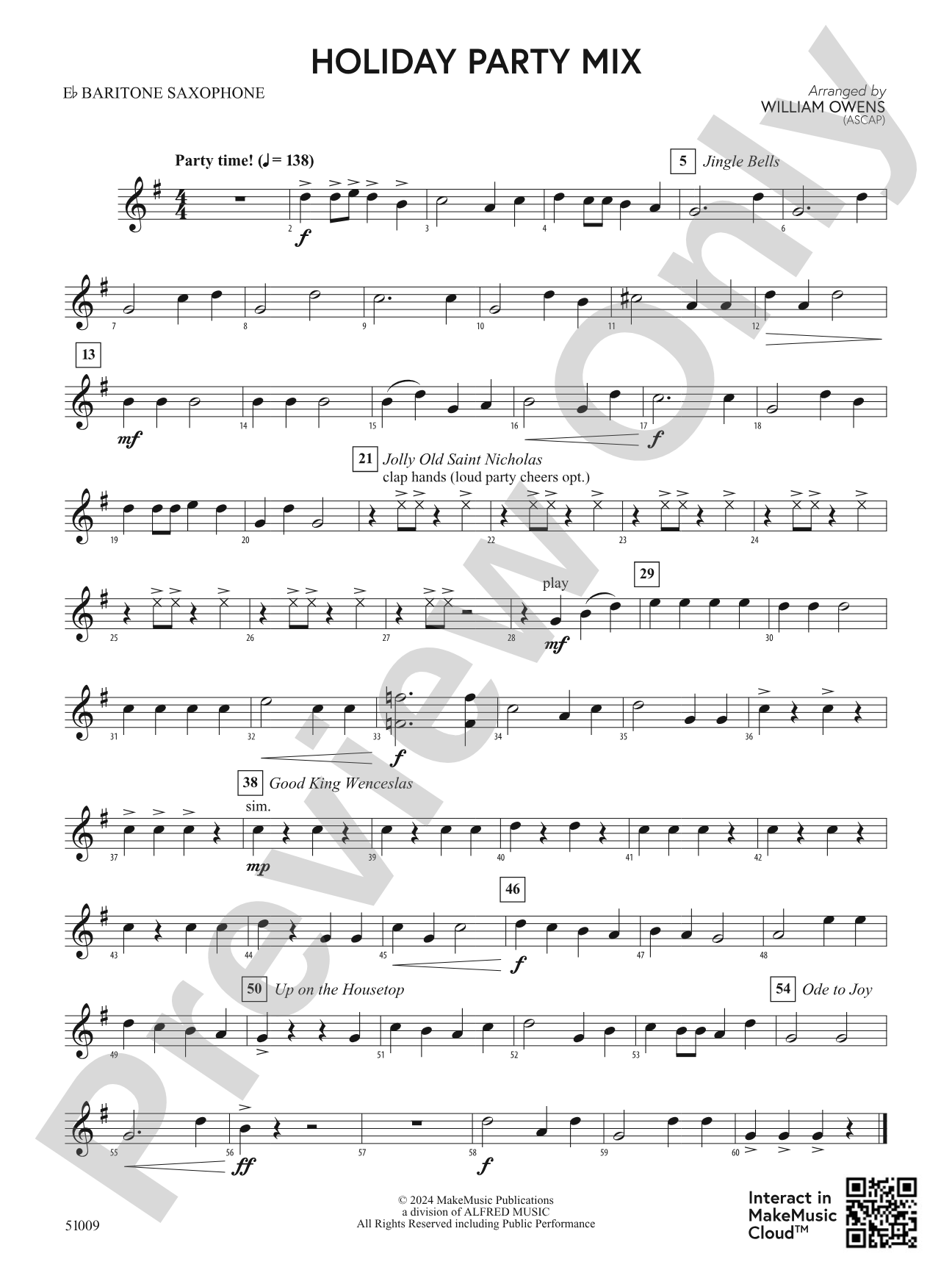

Holiday Party Mix: E-flat Baritone Saxophone
Arranged by William Owens
Grade: 0.5
Item: 00-PC-0019222_BTX
$3.00
Pickup currently not available
Description
Get the party started with this energetic, upbeat medley of holiday favorites arranged by William Owens! Featuring "Jingle Bells," "Jolly Old Saint Nicholas," "Good King Wenceslas," "Up on the Housetop," and "Ode to Joy," the music may play very easy, but it grooves really hard! (1:45)


Don't just read it, hear it, play along with it, and watch your students grow with it. In MakeMusic Cloud, Holiday Party Mix: E-flat Baritone Saxophone comes alive with professional accompaniment, adjustable tempo, and built-in practice tools that turn solo practice into real progress.
Open in the Player
Jump straight in and assign it today.
Start Your Free Trial
Open this title and explore the full library in minutes.
Sample Audio
1
Audio File
--:--
0:00
0:00
Sample Video
Additional Details
Series:
MakeMusic First Performance Band
Publisher:
MakeMusic Publications
SKU:
00-PC-0019222_BTX
More about this title
About the Arranger: William Owens

William Owens brings three decades of classroom experience to his compositional work. A VanderCook College of Music graduate and Distinguished Alumnus, he spent 30 years directing bands in Texas before retiring in 2014. His catalog of over 300 works for concert band, string orchestra, and small ensemble has become foundational repertoire in music education, with pieces regularly appearing on state music lists and in academic texts.
Owens' arranging philosophy prioritizes accessibility without sacrificing musicality. His work as a clinician and conductor across North America has shaped an instinct for what young musicians can achieve when material is both approachable and genuinely engaging. Recognized by ASCAP, TMEA, and the American Bandmasters Association, he continues to set the standard for practical, performance-ready writing for developing ensembles.
Why we love this
This medley catches what makes Owens' writing for young bands special: technically simple enough for early learners, but with enough rhythmic punch and harmonic color that it swings hard. Directors consistently report that Grade 0.5 bands play this with infectious energy rather than tentative caution. The five-tune structure keeps attention spans sharp while delivering a celebration-ready closer.
What to expect
Bright and propulsive, with the nostalgic warmth of familiar carols filtered through a modern, rhythmically energized lens. The arrangement respects the melodies but gives them swagger, landing somewhere between a concert piece and a party playlist. Listeners hear celebration; performers feel capable and confident.
Who it's for
Beginning concert bands ready for a holiday program piece that feels genuinely polished without demanding technical maturity. This works for middle school bands in their first semester or early high school bands seeking accessible but crowd-pleasing material. Directors seeking a medley that won't require extensive sectional drilling will find it refreshingly practical.
How to get the most out of it
- Keep the tempo steady and slightly energetic throughout; the arrangement's grooveability depends on consistent pulse from the rhythm section
- Balance the melody across your section in each tune rather than doubling it densely; the voicing is designed to sound crisp at this level
- Let percussionists own the rhythmic character; this is where younger students hear the "party" happening
- Resist over-shaping the phrasing; the straightforward nature of the melodies means straight delivery often lands harder than interpretive rubato
How to use it
Program this as a finale or penultimate number on a holiday concert to shift the energy toward celebration. The 1:45 duration makes it ideal padding for a program with thinner repertoire, or a strong closing statement when paired with more traditional seasonal selections. Young ensembles benefit from the confidence boost of sending an audience out smiling.
Skills your students will build
- Reading and executing straightforward rhythm patterns with consistent pulse
- Balancing melody and accompaniment in mixed ensemble textures
- Maintaining intonation across simple harmonic progressions
- Responding to ensemble dynamics and articulation cues
- Playing with stylistic awareness (energetic, driving groove rather than marching precision)