
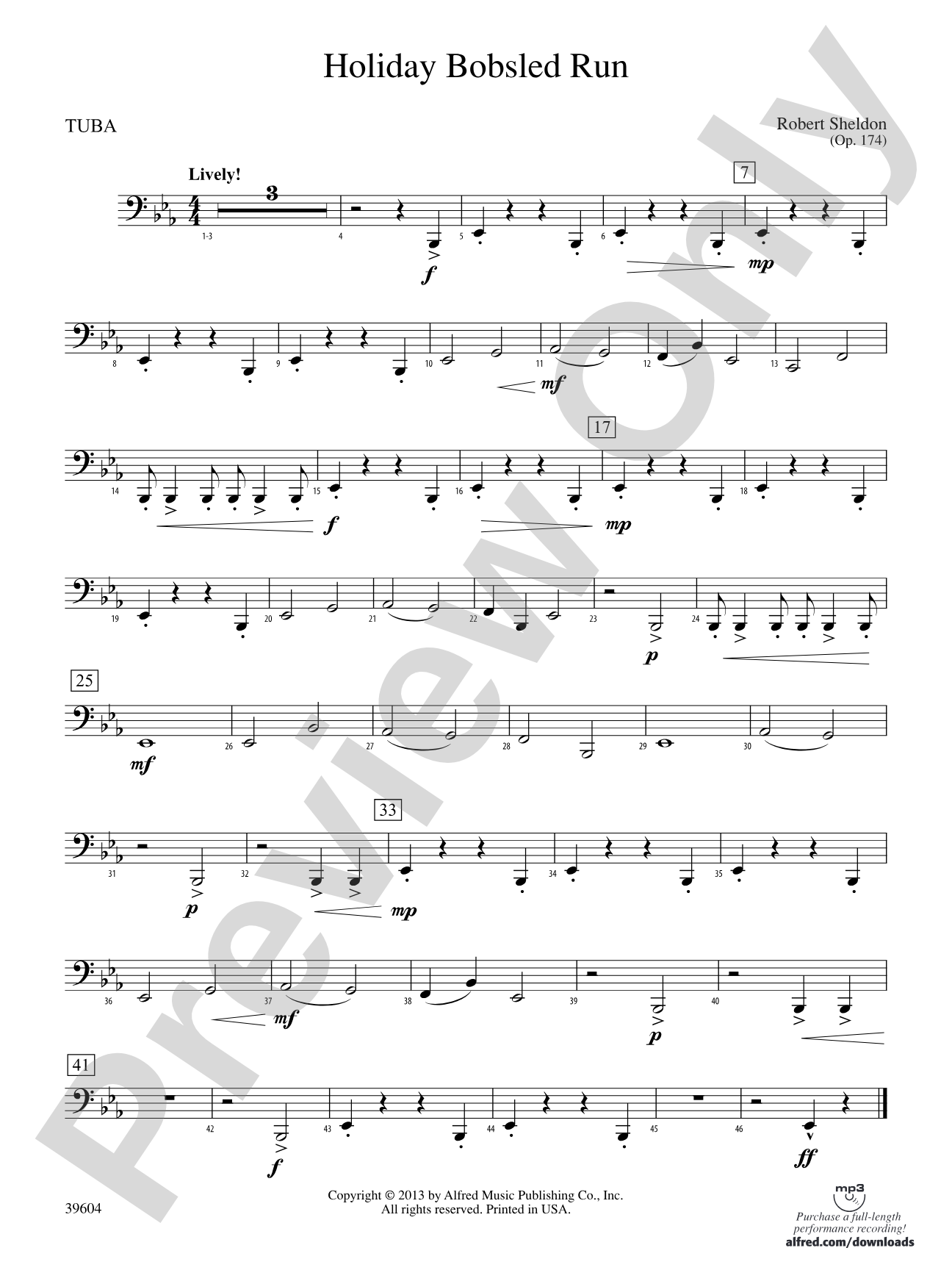

Holiday Bobsled Run: Tuba
By Robert Sheldon
Grade: 1.5 (Easy)
Item: 00-PC-0015879_TB1
$3.00
Pickup currently not available
Description
A happy and carefree day of playing in the snow is depicted in this charming holiday offering. Tuneful melodies and a cheerful rhythmic accompaniment set the mood leading to a chromatic slide down the hill that triumphantly ends the piece. (1:30) Correlates to Sound Innovations for Concert Band Book 2, Level 2.


Don't just read it, hear it, play along with it, and watch your students grow with it. In MakeMusic Cloud, Holiday Bobsled Run: Tuba comes alive with professional accompaniment, adjustable tempo, and built-in practice tools that turn solo practice into real progress.
Open in the Player
Jump straight in and assign it today.
Start Your Free Trial
Open this title and explore the full library in minutes.
Sample Audio
1
Audio File
--:--
0:00
0:00
Sample Video
Additional Details
Series:
Sound Innovations for Concert Band
Publisher:
Alfred Music
Page Count:
132
SKU:
00-PC-0015879_TB1
More about this title
About the Composer: Robert Sheldon

Robert Sheldon stands among the most frequently performed composers writing for wind band today. His catalog spans thousands of performances annually across the globe, and his works appear regularly on All-State, regional festival, and international concert lists. Beyond composing, Sheldon serves as lead author of Sound Innovations for Concert Band, the pedagogical series from which this piece draws its correlations.
His contributions to music education have earned recognition from the American School Band Directors Association, Phi Beta Mu, and ASCAP. Sheldon maintains an active schedule as guest conductor for honor bands and clinician at universities and state conferences across the United States and internationally, including appearances in Japan, Canada, Italy, Germany, Australia, and China. His works have been performed at Carnegie Hall, Orchestra Hall, Boston Symphony Hall, the Sydney Opera House, and the Kennedy Center. VanderCook College of Music awarded him an honorary doctorate in 2020.
Why we love this
Sheldon writes with a conductor's eye for what makes young ensembles sound musical without overwhelming them technically. The infectious energy of this piece captures that childlike joy of winter play, and the chromatic slide passage gives students a memorable, satisfying moment to perform. It's the kind of seasonal offering that programs memorably without feeling obligatory.
What to expect
Bright winter sunlight, cold air, and the pure delight of running downhill through fresh snow. The melodies are uncomplicated and memorable, supported by rhythmic figures that propel the piece forward with momentum. When the chromatic slide arrives, that sense of exhilaration and release feels genuine rather than contrived.
Who it's for
Bands at the early intermediate level will find this piece accessible both technically and musically. It works equally well for ensembles just beginning to explore beyond method book material or as a confidence builder alongside more challenging repertoire.
How to get the most out of it
- Balance the melodic lines against the rhythmic accompaniment; the cheerful character depends on the accompaniment sitting lightly beneath the tune rather than overwhelming it.
- Shape the chromatic descent at the end with a clear, unified ensemble approach. Practice the intonation of that passage separately to ensure the triumphant landing lands cleanly.
- Maintain steady pulse through the rhythmic figures. Young ensembles often rush during playful material, so anchor the tempo with the percussion section and check ensemble cohesion at slower practice tempos first.
- Let the melodic contour breathe naturally; avoid rigid phrasing that would undercut the carefree mood Sheldon establishes.
How to use it
This works perfectly as a concert opener on a winter or holiday program, setting an upbeat tone before moving into weightier repertoire. Its brevity (1:30) makes it ideal for filling a programming slot or pairing alongside other short seasonal pieces to create a thematic set.
Skills your students will build
- Ensemble balance between melody and accompaniment
- Chromatic tuning and passage work in a descending line
- Maintaining steady pulse through rhythmic figures
- Phrasing for character and mood in early intermediate repertoire