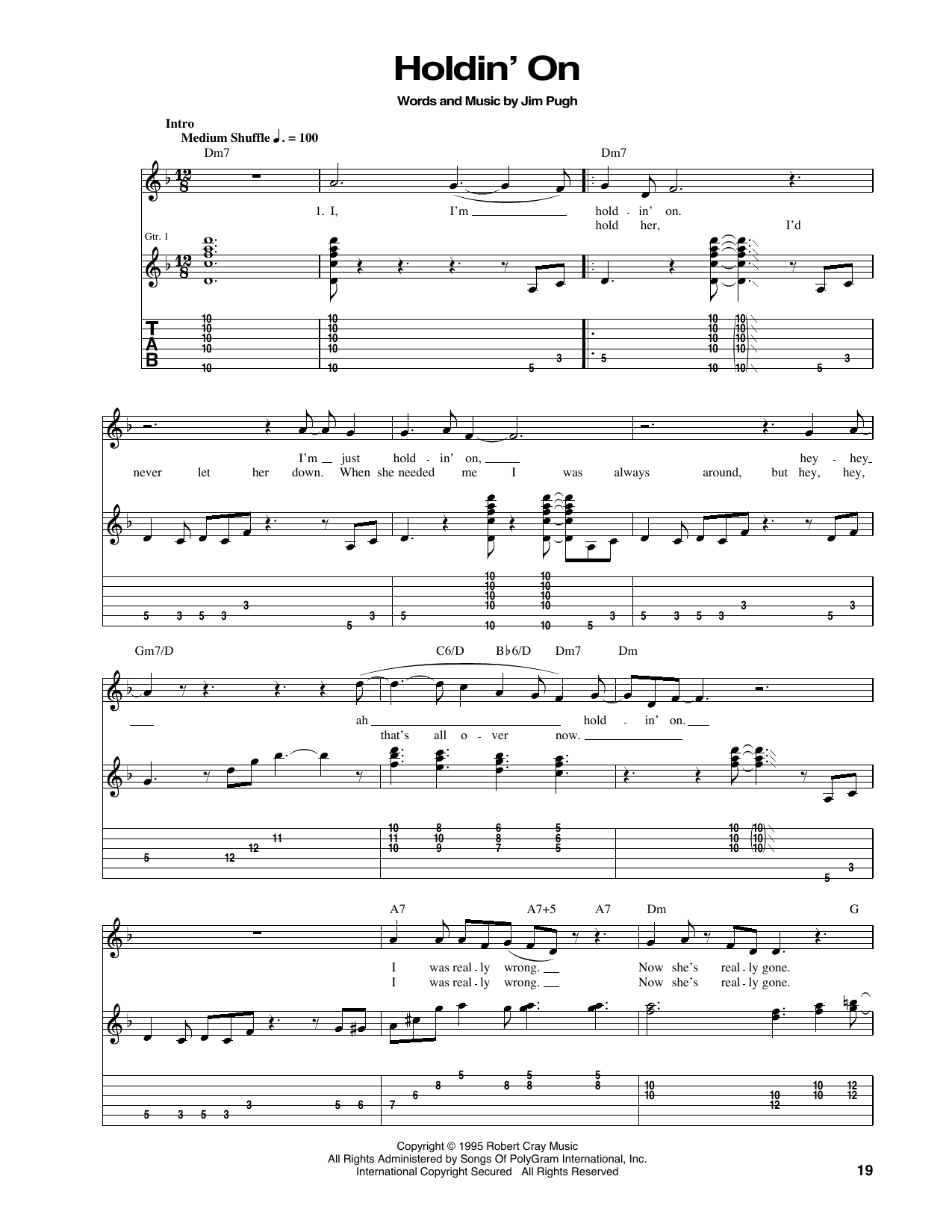
Robert Cray has spent five decades establishing himself as one of the most influential blues guitarists of the modern era. His playing combines the traditional language of Chicago blues with the sophistication of contemporary rhythm and blues, earning him a Grammy Award and widespread respect across multiple genres.
Why we love this
Cray's phrasing and tone are remarkably economical; he proves that blues mastery isn't about technical excess but about knowing exactly which notes matter. This tab captures the nuance of a working blues guitarist, making it invaluable for students who need to learn how professionals construct solos from a limited vocabulary of shapes and ideas.
What to expect
The track carries the weight of experience and restraint. Every note sits in the pocket with intention, and the interplay between guitar and rhythm section creates space that feels lived-in rather than rushed. This is blues that compels through feeling rather than flash.
Who it's for
Guitar students who have moved beyond basic pentatonic shapes and are ready to study blues phrasing in a contemporary setting. Teachers introducing students to listening and transcription as pedagogical tools will find this accessible and rewarding.
How to get the most out of it
Study the tone control Cray uses throughout. Rolling the volume knob and playing with pick angle create dynamics that tab alone cannot show; listen closely to the recording and match his touch before focusing on speed.
Lock into the groove by feeling the subdivision in your body. This track breathes with the pocket, not against it; rushing the phrases will flatten the character entirely.
Pay attention to bend accuracy and vibrato width. Cray's bends are precise and his vibrato is controlled; both contribute to the song's emotional weight far more than any single technical move.
How to use it
Assign this during a unit on blues history and stylistic evolution, pairing it with recordings of earlier Chicago blues artists to show how contemporary players reinterpreted the tradition. Solo guitarists and small ensemble directors can feature this as a showcase piece that demonstrates restraint and musicality in improvisation.
Skills your students will build
Blues phrasing and call-and-response principles
Bending accuracy and vibrato control
Pocket playing and rhythmic independence from the backbeat
Transcription and ear training from contemporary recordings
Dynamics and tone shaping using volume control and pick angle
You May Also Like
Scan to Complete Your Purchase
Use your phone's camera to scan the code below
You'll log in on your phone and the order will be added to your account