

Hold On: 2-Part Choral Octavo
Traditional Spiritual / arr. Victor C. Johnson
Item: 00-PO-0006697
$2.05
Minimum order quantity: 20 copies
Pickup currently not available
Description
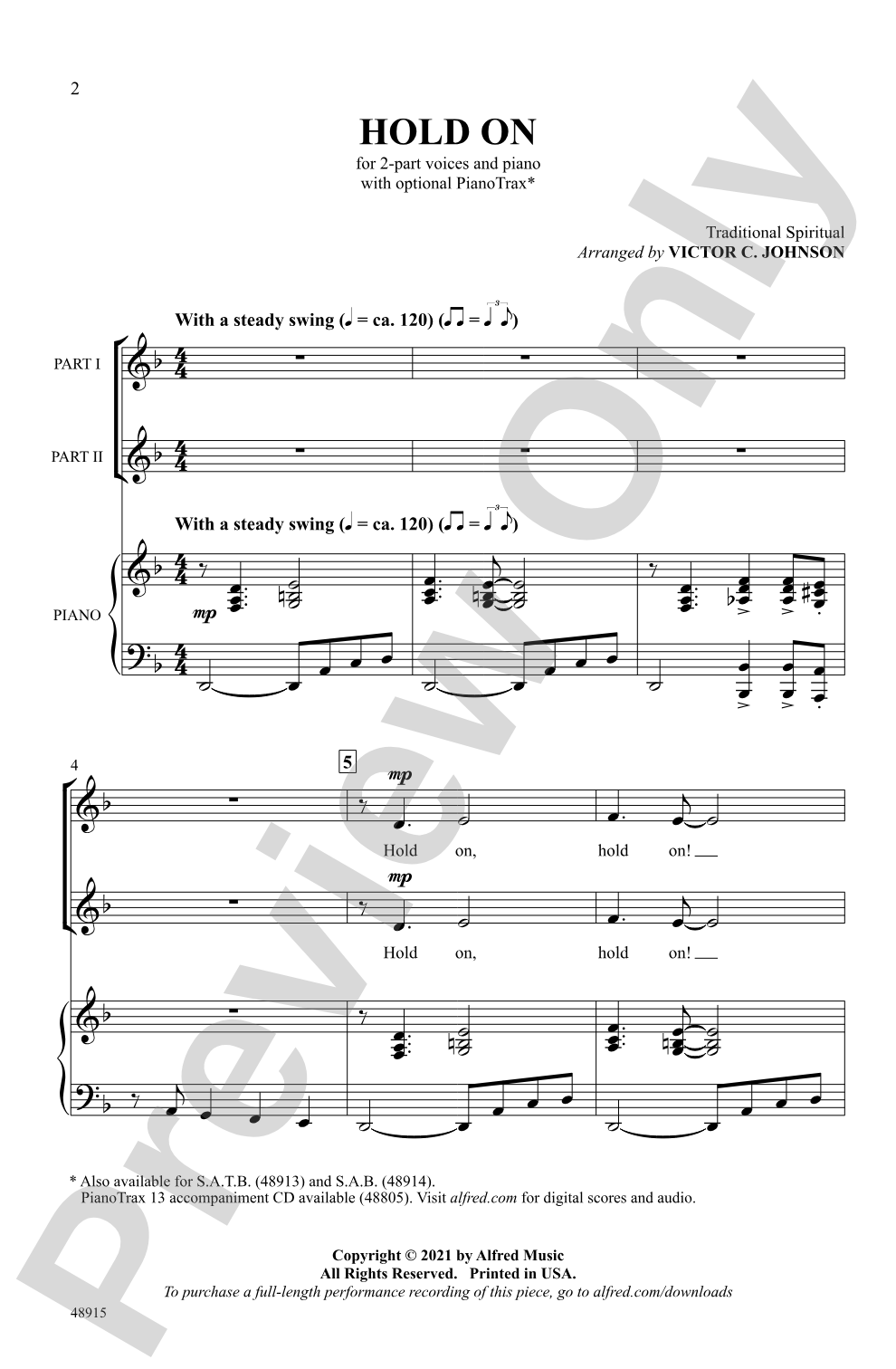
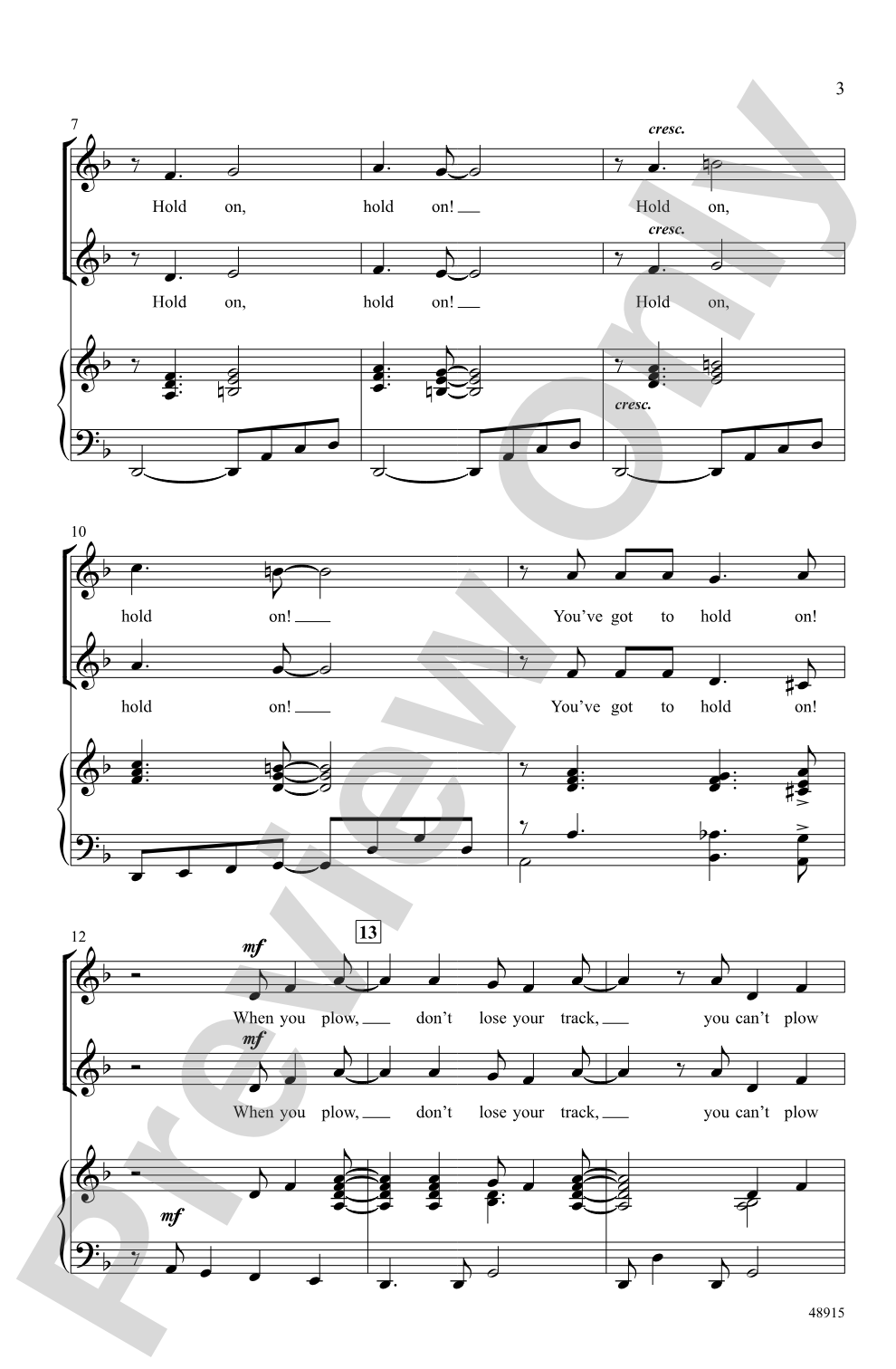
Also known as "Keep Your Hand on the Plow," here's a traditional spiritual that is appropriate for concert or contest, stage or sanctuary. Singers will easily grasp the bluesy harmonies that often flip between major and minor, and lock into the steady swing tempo. Consistent rhythmic anticipations create singable syncopation and add energy. A supportive piano accompaniment lays beautifully in the hands as well as providing a reliable groove. You simply cannot go wrong with a setting like this as prepared by top-tier choral conductor and arranger, Victor C. Johnson.


Hold On: 2-Part Choral Octavo isn't in MakeMusic Cloud just yet...but it could be. Let us know you'd like to see it, and you'll help shape what comes next. In the meantime, start a free trial and dive into thousands of interactive titles your students can play along with today.
Request This Title
Tell us you want it.
Start Your Free Trial
Explore everything that's ready to play right now.
Sample Audio
1
Audio File
--:--
0:00
0:00
Sample Video
Additional Details
Series:
Alfred Choral Designs
Publisher:
Alfred Music
Page Count:
12
SKU:
00-PO-0006697
More about this title
About the Arranger: Victor C. Johnson

Victor C. Johnson brings decades of choral leadership and arranging expertise to every piece he creates. Based in Dallas, he has directed award-winning choirs at Ft. Worth Academy of Fine Arts and currently serves as School Choral Editor for Sing!, the educational publishing division of Choristers Guild. His catalog includes over 500 published works across choral literature, vocal solos, and keyboard collections.
Beyond the page, Johnson remains deeply involved in the choral community. He conducts the Dallas Symphony Children's Chorus Mixed Ensemble, a resident ensemble for the Dallas Symphony Orchestra comprising high school singers. His professional memberships span the American Choral Directors Association, Texas Music Educators Association, National Association for Music Education, and ASCAP, reflecting his commitment to advancing choral art at every level.
Why we love this
Johnson's arrangement captures the spiritual's essence without oversimplifying it. The blues-tinged harmony that shifts between major and minor gives singers something genuinely musical to sink their teeth into, while the rhythmic syncopation feels natural rather than forced. The piano part sits beautifully under the hands and anchors the groove, making this equally rewarding whether you're preparing for concert, festival, or worship context.
What to expect
This is a setting that honors the spiritual tradition while bringing contemporary energy to it. The blues harmonies and syncopated rhythms create momentum and engagement; singers feel the swing, and audiences hear both reverence and vitality in the same breath.
Who it's for
Any choir building a concert or festival set will find this spiritual immediately accessible. The 2-part voicing works beautifully for mixed choirs of any age, from middle school through community ensembles, since it allows flexibility in how you distribute parts.
How to get the most out of it
- Let the swing tempo breathe. These rhythmic anticipations work best when they feel like they're propelling the line forward, not sitting stiffly on top of the beat.
- Balance the major-minor shifts carefully in rehearsal. Mark them in your score so singers understand when the harmonic color changes, then isolate those moments in sectional rehearsals.
- Trust the piano to hold the groove. Encourage your pianists to really dig into that steady pulse; it gives singers confidence to stretch the syncopation.
How to use it
Pair this with another spiritual or folk arrangement to create a thematic set, or use it as a concert centerpiece that bridges sacred and secular repertoire. Its contest-ready polish makes it equally strong on a competition schedule or a worship program.
Skills your students will build
- Singing major-minor harmonic shifts with tonal clarity
- Executing syncopated rhythms within a swing tempo
- Blending 2-part voices while maintaining rhythmic precision
- Responding to piano accompaniment as an ensemble foundation