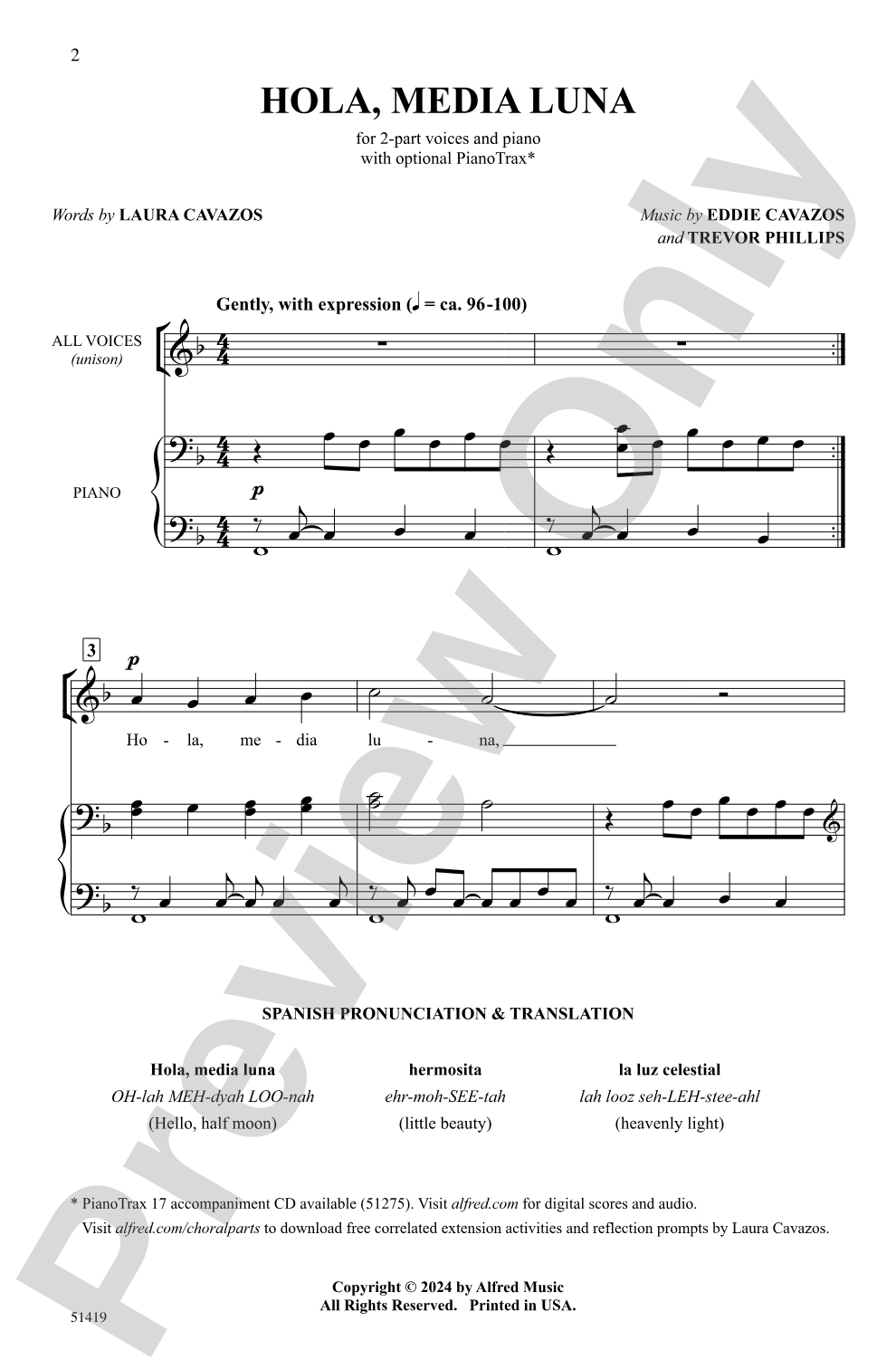
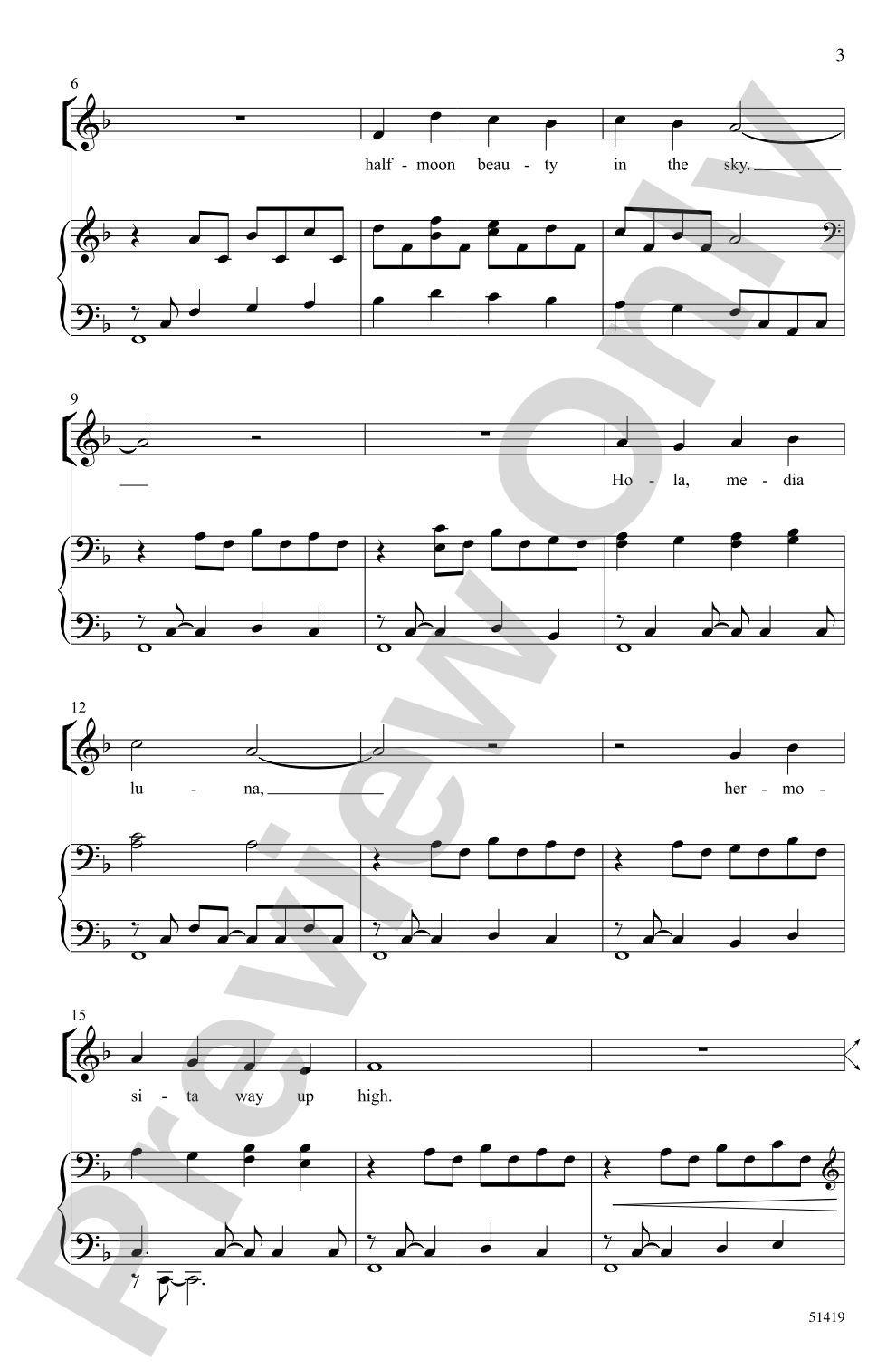
Hola, Media Luna Sheet Music Preview

Hola, Media Luna: 2-Part Choral Octavo

Words by Laura Cavazos, music by Eddie Cavazos and Trevor Phillips

Item: 00-PO-0007327

Digital Download
$2.20

Minimum order quantity: 20 copies

Description
The most lovely selection you'll program this year. Legato voices sing in both Spanish and English in this charming ode to the half-moon. Beginning harmonies shine brightly over a delicate piano part. A simple pronunciation guide is included in the publication, plus extension activities and reflection prompts are available to download.

Hola, Media Luna: 2-Part Choral Octavo isn't in MakeMusic Cloud just yet...but it could be. Let us know you'd like to see it, and you'll help shape what comes next. In the meantime, start a free trial and dive into thousands of interactive titles your students can play along with today.

Sample Audio
0:00
0:00
Sample Video
Additional Details
Series: Alfred Choral Designs
Publisher: Alfred Music
Page Count: 8
SKU: 00-PO-0007327

More about this title

About the Composer: Eddie Cavazos

Eddie Cavazos

Eddie Cavazos brings four decades of experience as both a music educator and composer to every piece he writes. His work spans elementary music curricula, full-length musicals, church anthems, and choral settings performed internationally. He holds degrees in Music Education from The University of Texas at San Antonio, including a Master's degree, and has earned Teacher of the Year recognition three times throughout his career.

As a music minister for over 40 years, Cavazos has developed a gift for writing accessible yet meaningful music that serves both liturgical and secular contexts. His compositions appear through major publishers including Alfred Music, GIA, Hal Leonard, and Walton Music. He lives in San Antonio with his wife Laura and their growing family of grandchildren.

Why we love this

Cavazos and Phillips craft something genuinely singable here, with harmonies that sit naturally in young voices while still asking for musical maturity. The bilingual text opens cultural doors without requiring fluency, and the accompanying pronunciation guide removes barriers that might otherwise slow rehearsal momentum. You'll find this works equally well as a concert opener, a festival selection, or a standalone moment of beauty in a longer program.

What to expect

There's a gentle evening quality to this piece, tender and reflective without being precious. The Spanish text lends warmth to the harmony, while the English translation keeps the imagery immediate and personal. You're left with something quietly moving, a moment of shared beauty that lingers.

Who it's for

This works beautifully in middle school and early high school choirs seeking accessible two-part writing with real substance. It's equally at home in community choirs, children's choirs, and all-state festivals where time for learning is limited but artistic impact matters.

How to get the most out of it

  • Honor the legato instruction throughout. This piece breathes as a sustained line, so train ears to hear the phrase arc rather than individual notes.
  • Work the English and Spanish text separately at first, then layer them together. Singers often rush when learning unfamiliar language; slow practice builds confidence and clarity.
  • Balance the piano part carefully in rehearsal. It supports without overwhelming; ensure accompanists understand they're coloring the choral sound, not competing for space.
  • Use the recorded accompaniment during dress rehearsal to acclimate singers to the recorded texture. Live dress before performance is ideal.

How to use it

Pair this with other global or cultural selections for a thematic concert; it creates a natural bridge between repertoire styles. Early in the year, it builds ensemble cohesion because the manageable range and harmonic demands let singers focus on blend and phrasing rather than survival.

Skills your students will build

  • Sustaining legato lines across phrase boundaries
  • Singing with accurate vowel shapes in Spanish text
  • Building two-part harmonic awareness with clear voice independence
  • Responding to recorded accompaniment while maintaining ensemble integrity

You May Also Like