
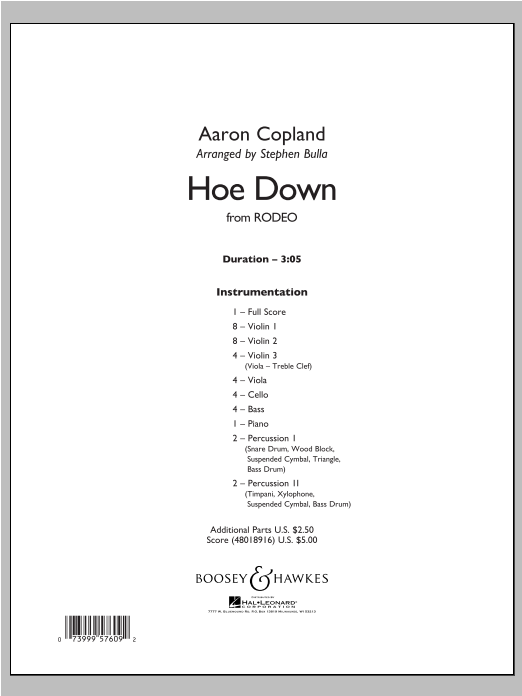

Hoe Down: String Orchestra Conductor Score & Parts
By Aaron Copland / Arranged by Stephen Bulla
Grade: 3-4
Item: 35-PK00251498
$50.00
Pickup currently not available
Buy Extra Parts (Digital PDF Download)
| Product | Price | Quantity |
|---|---|---|
| Hoe Down - Conductor Score (Full Score) | $7.50 | |
| Hoe Down - Violin 1 | $7.00 | |
| Hoe Down - Violin 2 | $7.00 | |
| Hoe Down - Violin 3 (Viola Treble Clef) | $7.00 | |
| Hoe Down - Viola | $7.00 | |
| Hoe Down - Cello | $7.00 | |
| Hoe Down - Bass | $7.00 | |
| Hoe Down - Piano | $7.00 | |
| Hoe Down - Percussion 1 | $7.00 | |
| Hoe Down - Percussion 2 | $7.00 |
Parts Added to Cart!
Description
"Hoe Down" is a classic American symphonic work and its unique sound has become a trademark of composer Aaron Copland. This new edition has been carefully crafted for string orchestra, allowing intermediate-level groups to experience the joy of performing one of the most popular works of the 20th century.
Dur: 3:00


Hoe Down: String Orchestra Conductor Score & Parts isn't in MakeMusic Cloud just yet...but it could be. Let us know you'd like to see it, and you'll help shape what comes next. In the meantime, start a free trial and dive into thousands of interactive titles your students can play along with today.
Request This Title
Tell us you want it.
Start Your Free Trial
Explore everything that's ready to play right now.
Sample Audio
No sample audio found.
Sample Video
No sample videos found.
Additional Details
Publisher:
Hal Leonard
SKU:
35-PK00251498
More about this title
About the Composer: Aaron Copland
Aaron Copland (1900-1990) shaped the sound of American concert music by drawing directly from folk traditions, hymns, and popular songs. His gift was making these vernacular materials feel both accessible and architecturally sophisticated, which is why his works remain central to string orchestra and wind ensemble repertoires at every level.
Copland's approach to orchestration emphasized clarity and directness. He understood how to write for young and intermediate musicians without compromising musical substance, making his scores invaluable teaching tools that reward careful preparation with genuinely moving performances.
Why we love this
Stephen Bulla's arrangement opens this beloved Copland movement to groups that might not have the full orchestra resources to tackle the original. The string writing sits comfortably in the intermediate range while preserving the rhythmic drive and harmonic color that make Hoe Down instantly recognizable. Your students will perform a work they already know, which builds immediate engagement and allows them to focus on ensemble precision rather than unfamiliar musical language.
What to expect
Energy and warmth animate every moment. The piece captures the spirit of frontier celebration without veneer or sentiment, built on a foundation of fiddle tunes and square dance rhythms that sit naturally in the string medium. You hear the American landscape and genuine human joy in its uncluttered lines.
Who it's for
Intermediate string orchestras looking to program a substantial work that feels both contemporary and connected to American musical identity. Directors seeking repertoire that builds ensemble cohesion while keeping performance anxiety low; students gain confidence from the tunefulness and relative directness of Copland's voice.
How to get the most out of it
- Establish a steady, forward-moving tempo from the opening; this piece thrives on momentum rather than rubato. A click track or metronome in rehearsals helps internalize the steady pulse that makes the hoedown character land.
- Balance the rhythmic figure in the lower strings so it drives without overwhelming the melody. This inner part carries the piece's skeleton and needs clarity equal to the top voice.
- Shape the melodic line with gentle dynamic inflection rather than exaggeration. Copland's melodies are strongest when they breathe naturally within a fundamentally steady dynamic framework.
- Mark and drill any double-stop passages separately. String orchestras at this level benefit from isolated work on intonation before putting those figures back into context.
How to use it
Pair this with other American works to create a concert centering on indigenous musical identity and style. At three minutes, it works perfectly as a lighter opener or closer that sends audiences away with a smile. It also serves beautifully as the centerpiece of a unit on folk melody and orchestration, where students study how Copland transformed simple material into something both enduring and instructive.
Skills your students will build
- Maintaining steady pulse and rhythmic precision in a duple meter context
- Balancing lyrical melody against accompanying figures
- Intonation accuracy in double-stop and complex chord structures
- Stylistic awareness of American folk idiom and its orchestral treatment
- Ensemble listening and dynamic control within a relatively stable tonal framework