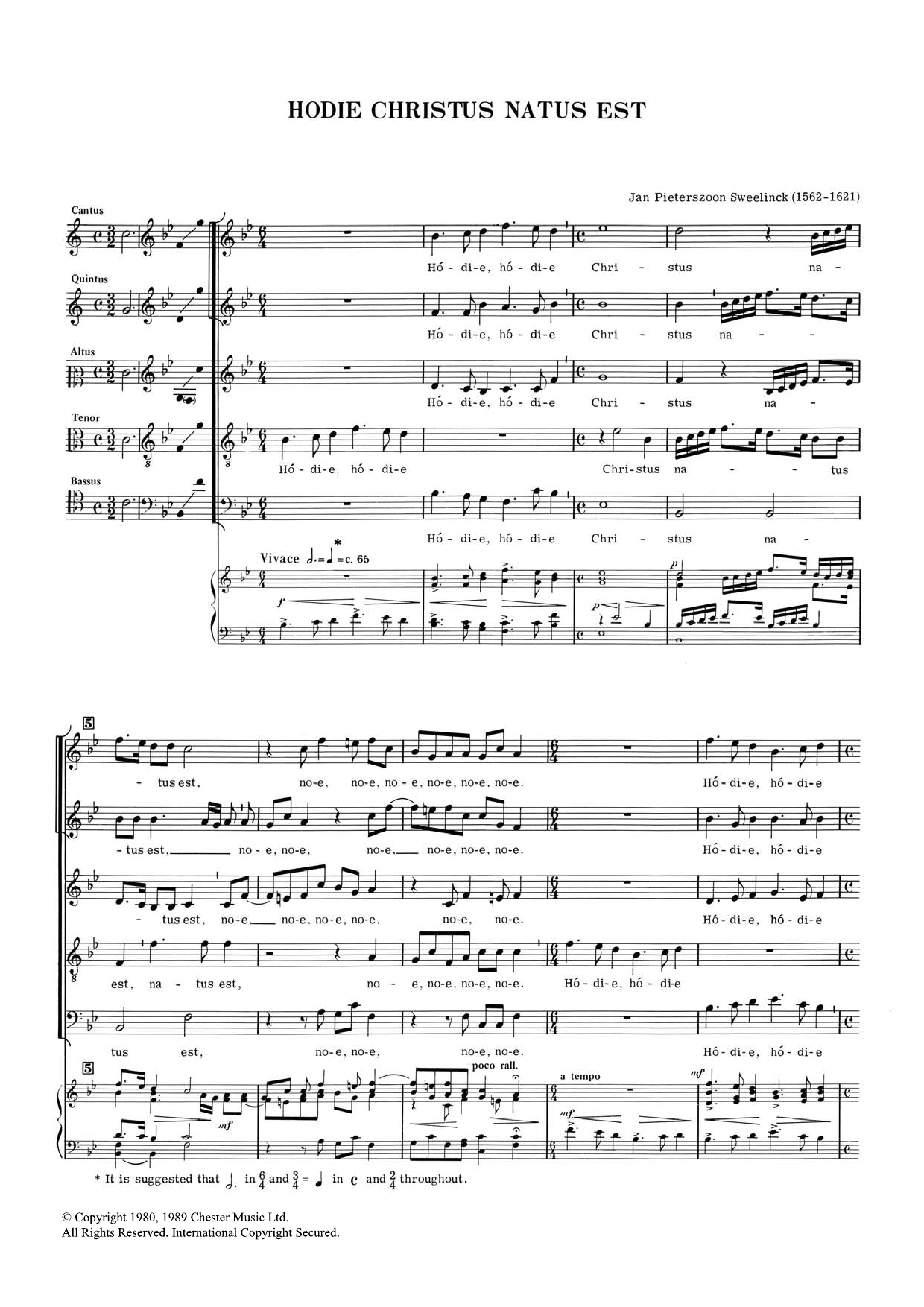
Hodie Christus Natus Est Sheet Music Preview

Hodie Christus Natus Est: SATB Choral Octavo

As performed by Jan Pieterszoon Sweelinck

Item: 35-DS00366605

Digital Download
$2.99
Description

Hodie Christus Natus Est: SATB Choral Octavo isn't in MakeMusic Cloud just yet...but it could be. Let us know you'd like to see it, and you'll help shape what comes next. In the meantime, start a free trial and dive into thousands of interactive titles your students can play along with today.

Sample Audio
No sample audio found.
Sample Video
Additional Details
Publisher: Hal Leonard
Page Count: 6
SKU: 35-DS00366605

More about this title

About the Artist: Jan Pieterszoon Sweelinck

Jan Pieterszoon Sweelinck (1562-1621) was a Dutch organist and composer whose output shaped the musical language of Northern Europe. Working primarily in Amsterdam, he synthesized Italian compositional techniques with Northern European traditions, creating motets and vocal works of remarkable sophistication. His choral music became a touchstone for generations of singers and composers, prized for its clarity of voice leading and expressive depth.

Sweelinck's sacred works were widely distributed across Europe during his lifetime and remained central to choir libraries well into the Baroque period. His skill at setting Latin texts enabled him to create pieces that balance textual clarity with polyphonic complexity, making his motets equally suitable for liturgical use and concert performance.

Why we love this

Sweelinck's setting of this Christmas text demonstrates why his music held such authority in the Renaissance and early Baroque periods. The four-part writing flows with naturalness across all voices, avoiding the bottom-heavy textures that plague many sacred pieces from this era. Directors appreciate how the harmonic language remains accessible to college and advanced high school singers while never sacrificing contrapuntal interest or emotional impact.

What to expect

Serene but not static, this motet glows with the quiet joy of Incarnation theology expressed through interlocking vocal lines. The harmonic movement feels spacious and inevitable, creating a sense of timelessness appropriate to its sacred subject matter.

Who it's for

This octavo suits college choirs, adult amateur ensembles, and advanced high school choirs comfortable with Renaissance polyphony and Latin texts. It works equally well for conductors seeking a concert piece or a liturgical motet for holiday services.

How to get the most out of it

  • Approach the piece with clarity of diction in Latin; each syllable should articulate without forcing the underlying rhythmic pulse.
  • Balance the soprano line against the lower voices carefully. This is not a soprano showpiece, and the most beautiful moments emerge when all four parts share equal presence.
  • Shape phrases through text meaning rather than breath marks alone. Let the sense of the words guide your dynamic contours and rubato.

How to use it

Pair this with other Renaissance motets for an a cappella concert program, or use it as a sophisticated alternative to more frequently heard Christmas fare. It also serves beautifully in December services where a contemplative approach to the Nativity suits your liturgical context better than festive carols.

Skills your students will build

  • Reading and performing Renaissance polyphony with proper voice independence
  • Sustaining pure vowels while maintaining textual clarity in Latin
  • Balancing vertical sonorities across four equal-voiced parts
  • Understanding harmonic language and harmonic rhythm in the Renaissance period

You May Also Like