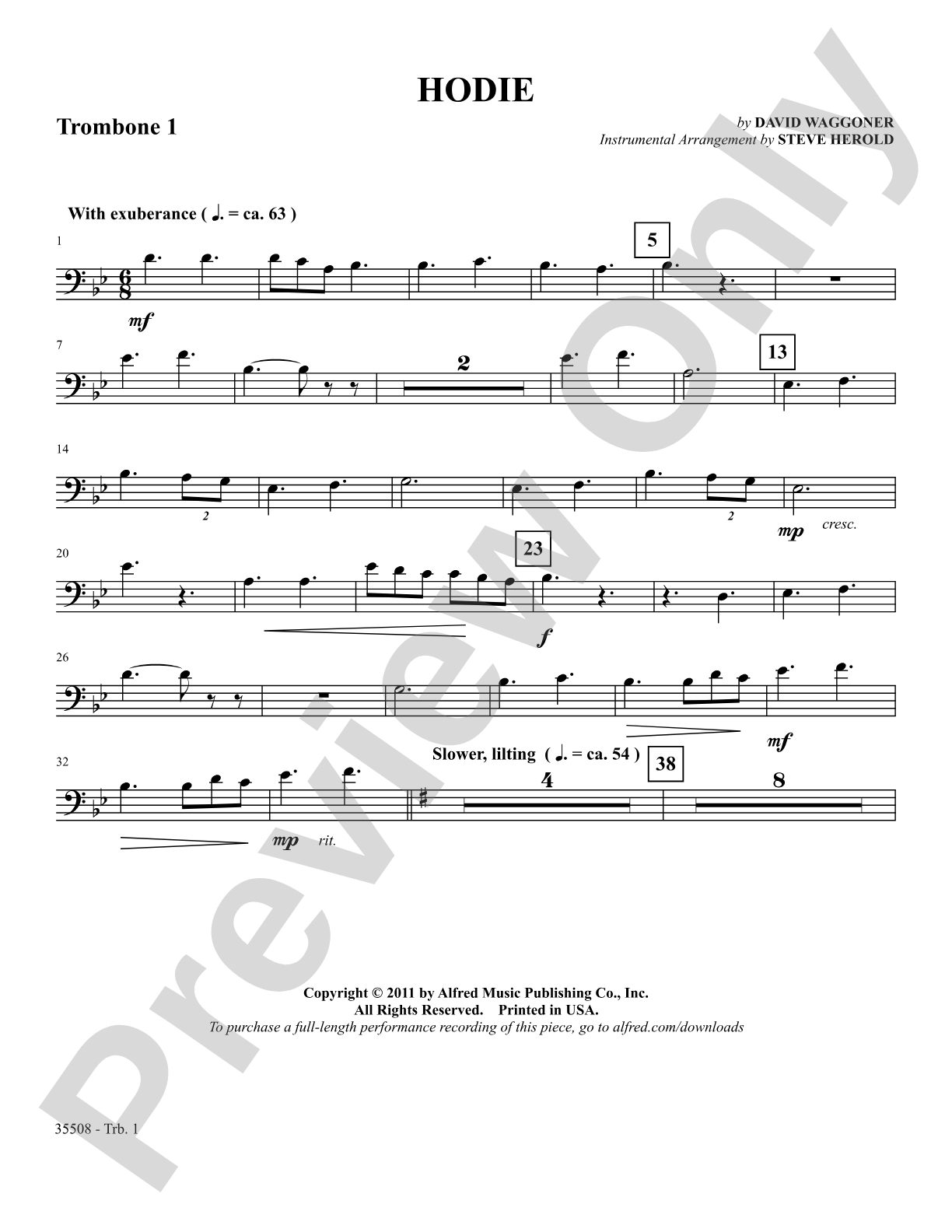
Hodie: 1st Trombone Sheet Music Preview

Hodie: 1st Trombone: Choral SoundPax

By David Waggoner

Item: 00-PC-0014955_TN1

Digital Download
$3.00
Description
Featuring a familiar and brief Latin text, this jubilant Christmas work opens and closes like a Renaissance fanfare and offers rich contrast at its core. Scattered duple eighth notes in a compound meter, several key and mode shifts, and changing tempi add interest to the joyful sound.

Don't just read it, hear it, play along with it, and watch your students grow with it. In MakeMusic Cloud, Hodie: 1st Trombone: Choral SoundPax comes alive with professional accompaniment, adjustable tempo, and built-in practice tools that turn solo practice into real progress.

Sample Audio
0:00
0:00
Sample Video
Additional Details
Series: Alfred Choral Designs
Publisher: Alfred Music
Page Count: 50
SKU: 00-PC-0014955_TN1
Instrumentation: SoundPax

More about this title

About the Composer: David Waggoner

David Waggoner

David Waggoner brings classroom experience and liturgical sensibility to his choral writing. A University of Michigan and Eastern Michigan University graduate, he has spent his career composing for choirs, handbells, and other ensembles while teaching elementary music in Woodhaven, Michigan.

Waggoner serves as Director of Music at First United Methodist Church in Wyandotte, Michigan, where his sacred compositions reflect both accessibility for developing musicians and substantive musical content. His work across multiple genres demonstrates a clear understanding of what works in educational and worship settings.

Why we love this

Waggoner structures this piece like a musical conversation: the Renaissance fanfare bookends frame a middle section that moves through key changes and rhythmic complexity without ever losing its celebratory spirit. The combination of recognizable Latin text with genuinely interesting harmonic and metric writing makes this work both accessible and rewarding for ensembles ready to move beyond simpler holiday fare. Directors get a piece that sounds polished and substantial in concert while remaining pedagogically sound.

What to expect

Jubilation meets sophistication. The opening fanfare sets a bright, festive tone that feels ceremonial and grand, then the interior unfolds with rhythmic intrigue and harmonic movement that keeps musicians engaged. The closing return to fanfare style provides satisfying arrival and closure.

Who it's for

This piece suits intermediate to advancing choirs with singers who can handle mixed meters and harmonic color. It works equally well in school choral programs and church music settings where ensembles want substantial holiday repertoire that goes beyond the perennial standards.

How to get the most out of it

  • Clarify the compound meter by feeling it in two rather than subdividing every eighth note; this gives the scattered duple figures their proper rhythmic impact and keeps the piece's forward momentum intact.
  • Honor the contrast between the fanfare sections and the lyrical middle by adjusting tempo as marked; the shift in character depends on these timing changes being intentional and audible.
  • Balance the key and mode shifts carefully in the middle section so listeners can hear the harmonic movement as purposeful rather than restless; this requires clean attacks and precise intonation at each shift.
  • Use the recorded accompaniment to lock ensemble cohesion during the modulations; the harmonic anchor keeps singers confident when the tonality is shifting.

How to use it

Position this as an anchor work in a Christmas concert, pairing it with either simpler carol arrangements or more austere sacred texts to create programming depth. Its moderate length and accessible Latin text make it a strong choice for holiday services where the congregation follows along, while its musical sophistication keeps adult audiences engaged.

Skills your students will build

  • Reading compound meter with duple subdivisions
  • Navigating key and mode shifts with secure intonation
  • Responding to tempo changes and their effect on character
  • Balancing rhythmic independence with ensemble cohesion

You May Also Like