
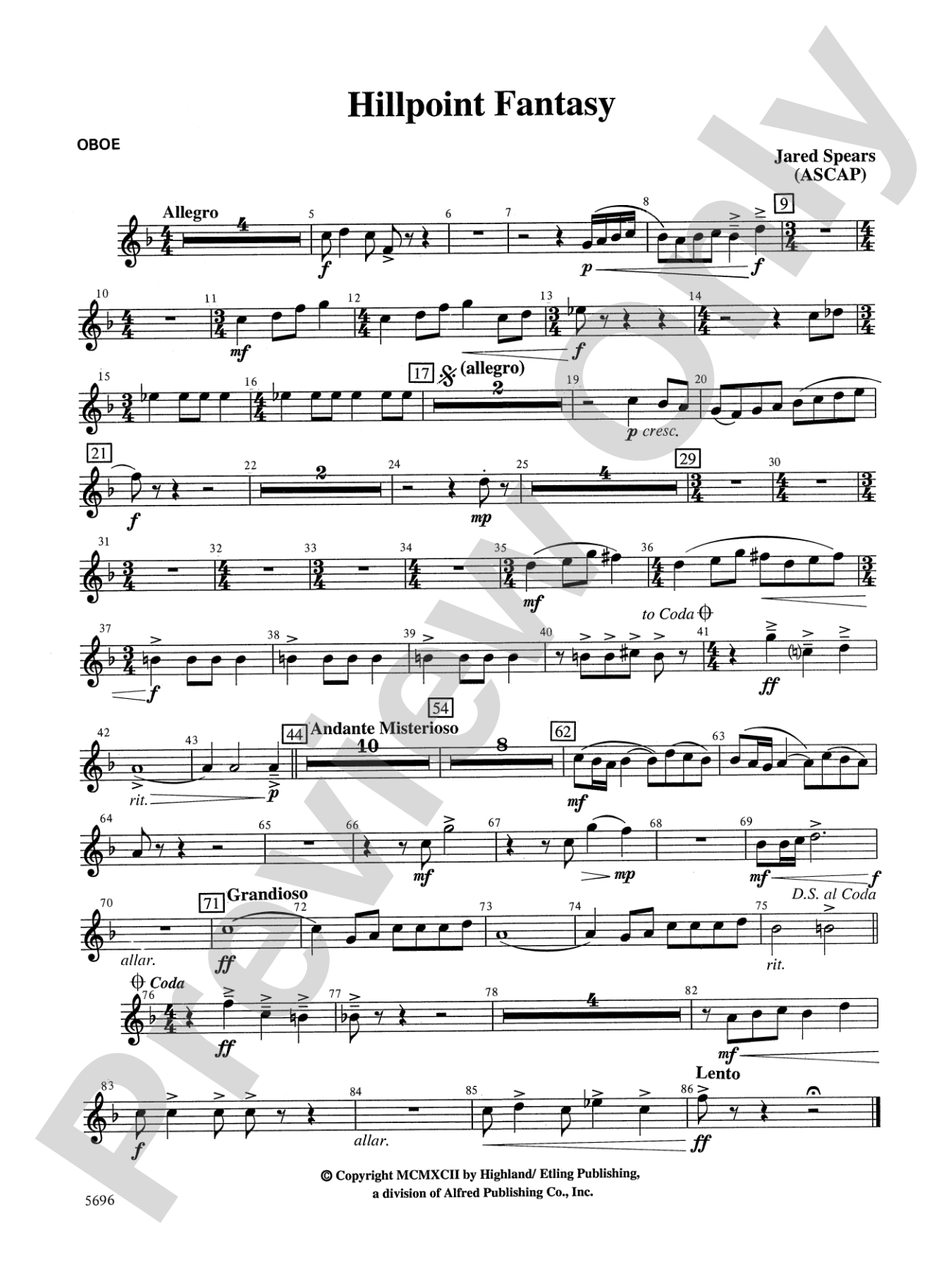

Hill Point Fantasy (Overture for Orchestra): Oboe
By Jared Spears
Grade: 3
Item: 00-PC-0001916_O1
$3.00
Pickup currently not available
Description
Your students will enjoy the lighthearted contemporary feel of this overture by Jared Spears. Syncopated rhythms, varied harmonic textures (F major) and contrasting styles and articulations will keep everyone interested and involved. The lyrical middle section (Andante misterioso) is a special opportunity for first-time wind players to learn the soloistic approach to orchestral playing. String parts are all playable in first position.


Don't just read it, hear it, play along with it, and watch your students grow with it. In MakeMusic Cloud, Hill Point Fantasy (Overture for Orchestra): Oboe comes alive with professional accompaniment, adjustable tempo, and built-in practice tools that turn solo practice into real progress.
Open in the Player
Jump straight in and assign it today.
Start Your Free Trial
Open this title and explore the full library in minutes.
Sample Audio
No sample audio found.
Sample Video
No sample videos found.
Additional Details
Series:
Highland/Etling Full Orchestra
Publisher:
Alfred Music
Page Count:
2
SKU:
00-PC-0001916_O1
More about this title
About the Composer: Jared Spears

Jared Spears is Professor of Music Emeritus at Arkansas State University, where he taught for 32 years across theory, history, composition, percussion, and band at every educational level. Born in Chicago, he earned degrees from Northern Illinois University, the Cosmopolitan School of Music, and Northwestern University, studying composition with Alan Stout and Anthony Donato among others.
Since retiring in 1999, Spears has maintained an prolific composing and conducting practice, producing over 250 original works for band, choir, orchestra, and chamber ensembles published internationally. His honors include the Faricy Award for Creative Music from Northwestern, the University President's Award at Arkansas State, multiple ASCAP awards, and citations from the National Band Association. His music has been performed and recorded worldwide, and he has guest conducted festivals and clinics across North America and Europe.
Why we love this
Spears writes with real orchestral clarity at this level, giving every section something musical to do without overcomplicating the technical demands. The contrasting sections (bright opening, introspective Andante misterioso) create genuine interest for players while the first-position string writing and accessible wind parts keep rehearsals focused on musicality rather than mechanics.
What to expect
The opening crackles with contemporary energy, syncopated rhythms bouncing over shifting harmonic colors in F major. When the Andante misterioso arrives, the mood shifts to something introspective and mysterious, giving wind players space to breathe and listen to their own voices before the piece returns to its bright, playful character.
Who it's for
Grade 3 orchestras in their first or second year of ensemble playing, especially those with beginning wind sections who need rewarding soloistic moments. Directors looking for contemporary repertoire that engages students without excessive technical difficulty will find a genuine asset here.
How to get the most out of it
- Lock the syncopation in the opening section by having the rhythm section (timpani, bass, cello) establish a steady pulse before adding the syncopated melodies; this prevents the piece from rushing.
- Shape the lyrical middle section as a feature for your soloists. Encourage wind players to listen as if in a chamber ensemble rather than a full orchestra, bringing out individual tone quality and phrasing.
- Balance the varied articulations across parts carefully; mark staccatos and legato passages clearly in parts so the contrast between sections reads distinctly to the audience.
- Keep tempo relationships clear between the opening (contemporary, rhythmically driven) and the Andante misterioso (genuinely reflective); a slight tempo drop helps the middle section feel like a real departure rather than just a slower speed.
How to use it
This works beautifully as an opening concert piece, setting a contemporary tone while demonstrating your ensemble's musicality to families. Consider pairing it with a slower choral piece or chamber work in the middle of a concert to capitalize on the emotional shift its two contrasting sections offer.
Skills your students will build
- Syncopated rhythm reading and ensemble coordination across multiple parts
- Soloistic phrasing and tone production in a full orchestra context
- Dynamic balance and articulation contrast (staccato vs. legato)
- First-position string technique with varied bow articulations
- Listening across the ensemble to maintain harmonic color in non-traditional chord progressions