
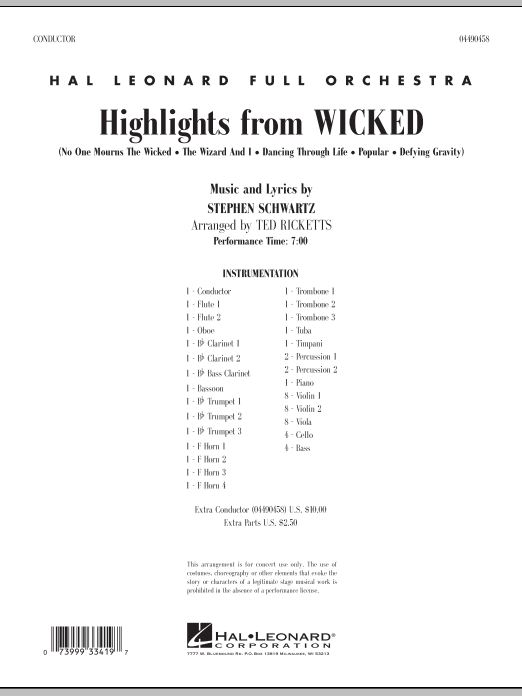

Highlights from Wicked: Full Orchestra Conductor Score & Parts
By Stephen Schwartz / Arranged by Ted Ricketts
Grade: 4
Item: 35-PK00144151
$90.00
Pickup currently not available
Buy Extra Parts (Digital PDF Download)
Parts Added to Cart!
Description
Broadway's powerful new hit is filled with engaging music and an intriguing story line based on the infamous Wicked Witch of the West. Veteran Broadway writer Stephen Schwartz's music has received critical acclaim and is skillfully adapted in this orchestra showcase by Ted Ricketts. Includes: "No One Mourns the Wicked," "The Wizard and I," "Dancing Through Life," "Popular," and "Defying Gravity." Dur: 7:00


Highlights from Wicked: Full Orchestra Conductor Score & Parts isn't in MakeMusic Cloud just yet...but it could be. Let us know you'd like to see it, and you'll help shape what comes next. In the meantime, start a free trial and dive into thousands of interactive titles your students can play along with today.
Request This Title
Tell us you want it.
Start Your Free Trial
Explore everything that's ready to play right now.
Sample Audio
No sample audio found.
Sample Video
No sample videos found.
Additional Details
Publisher:
Hal Leonard
SKU:
35-PK00144151
More about this title
About the Composer: Stephen Schwartz
Stephen Schwartz stands among Broadway's most prolific composers, with a catalog spanning five decades of musical theater. His gift for crafting memorable melodies paired with emotionally resonant lyrics has made his work a staple in both professional and educational settings. Wicked represents a pinnacle of his career, earning him Grammy and Tony recognition while demonstrating his ability to write music that connects with audiences of all ages.
For music educators, Schwartz's compositions offer accessible yet sophisticated material that engages students without sacrificing artistic integrity. His orchestrations reward careful attention to balance and phrasing, making his work ideal for teaching both technical precision and musical storytelling.
Why we love this
Ted Ricketts' orchestration of these Wicked highlights strikes the rare balance between honoring Schwartz's original Broadway conception and making the music sit naturally in the school orchestra setting. The five selections span the emotional arc of the show, from mysterious opening to triumphant finale, giving your ensemble a complete narrative arc rather than isolated moments. Students recognize these melodies instantly, which transforms rehearsal energy and gives them genuine stakes in executing the arrangement with care.
What to expect
This music carries the theatrical weight of Broadway while remaining accessible to younger players. You encounter moments of genuine vulnerability ("The Wizard and I"), infectious rhythmic energy ("Dancing Through Life"), and soaring emotional release ("Defying Gravity"), all wrapped in melodies that stick with players long after rehearsal ends.
Who it's for
Orchestras at the upper middle school and early high school level seeking repertoire with strong audience appeal and genuine musical substance. Directors programming pops concerts, end-of-year celebrations, or shows with a theatrical component will find these selections immediately engaging for performers and audiences alike.
How to get the most out of it
- Balance the melody across sections carefully in "No One Mourns the Wicked"; the opening has a haunting quality that disappears if any voice overwhelms the texture. Blend woodwinds and violas as the foundation while allowing the haunting solo line to breathe.
- Lock the tempo in "Dancing Through Life" by establishing the groove in the rhythm section first, then layering in the more syncopated figures once that foundation feels secure.
- Shape the dynamics in "Popular" to highlight its theatrical humor; the piece can fall flat if played evenly. Let the shifts in dynamics underscore the character's personality shifts.
- Take time with the final buildup into "Defying Gravity." The power of this ending comes from the architecture of the phrase, not from simply playing louder at the end.
How to use it
These selections work beautifully on a full orchestra concert where you want to break up heavier classical or contemporary concert music with material that showcases your ensemble's range. Alternatively, string them together as a medley within a larger program, or pair them with a student matinee performance where theatrical presentation and audience connection matter as much as technical polish.
Skills your students will build
- Balancing melody and accompaniment across multiple instrumental families
- Executing clear phrase shapes and dynamic architecture
- Maintaining rhythmic independence while supporting an ensemble groove
- Reading and responding to theatrical cues in pacing and expression
- Sectional independence within a dense orchestral texture