
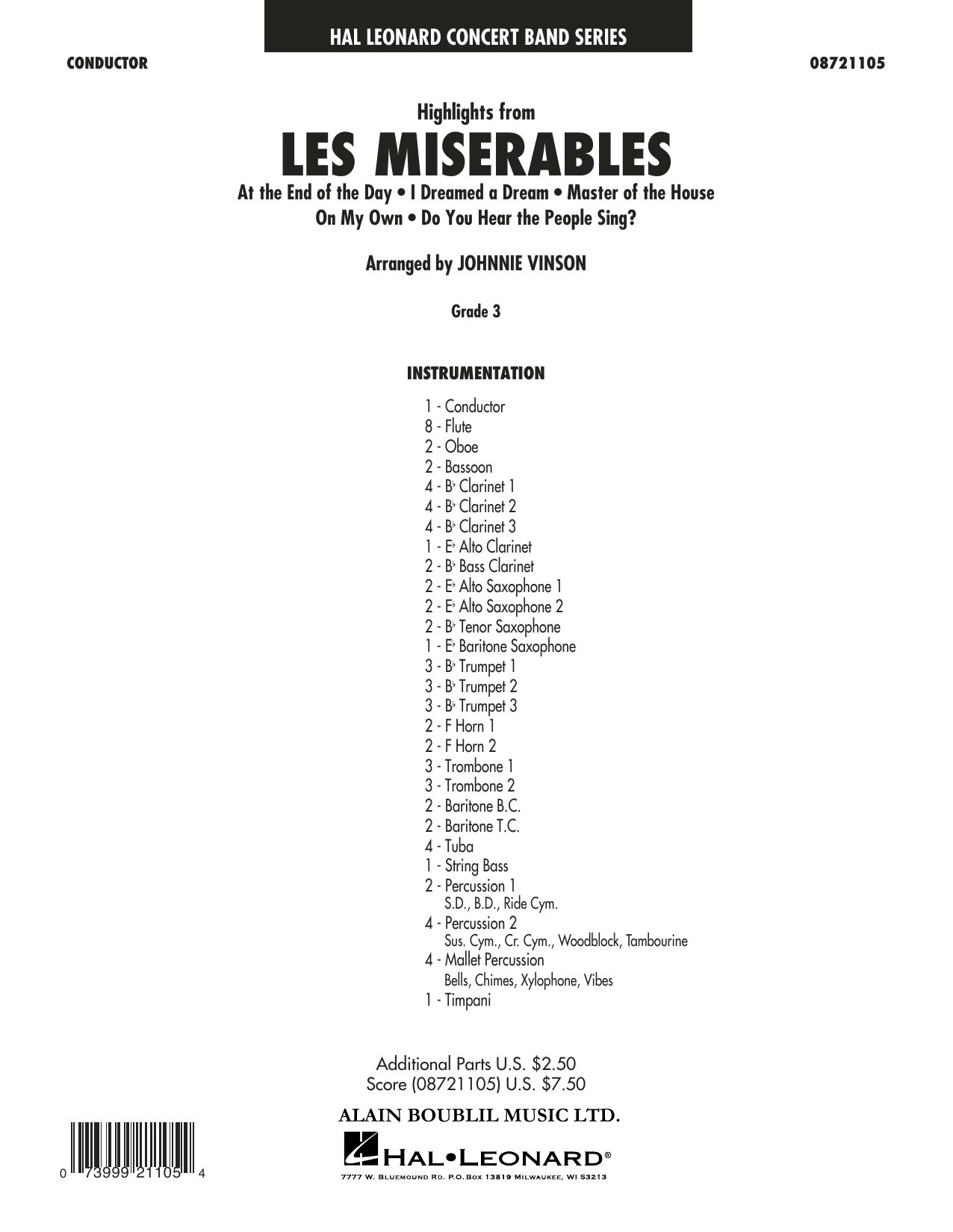

Highlights from Les Miserables (arr. Johnnie Vinson): Concert Band Conductor Score & Parts
By Claude-Michel Schönberg / By Alain Boublil / By Jean-Marc Natel / By Herbert Kretzmer / Arranged by Johnnie Vinson
Grade: 3
Item: 35-PK00436130
$80.00
Pickup currently not available
Buy Extra Parts (Digital PDF Download)
Parts Added to Cart!
Description
Some of the most memorable songs ever written for the stage come from the musical sensation, "Les Miserables." Now in a blockbuster 2012 motion picture, Johnnie Vinson's beautiful medley includes: "At the End of the Day, I Dreamed a Dream, Master of the House, Do You Hear the People Sing?", and "On My Own".


Highlights from Les Miserables (arr. Johnnie Vinson): Concert Band Conductor Score & Parts isn't in MakeMusic Cloud just yet...but it could be. Let us know you'd like to see it, and you'll help shape what comes next. In the meantime, start a free trial and dive into thousands of interactive titles your students can play along with today.
Request This Title
Tell us you want it.
Start Your Free Trial
Explore everything that's ready to play right now.
Sample Audio
No sample audio found.
Sample Video
No sample videos found.
Additional Details
Publisher:
Hal Leonard
SKU:
35-PK00436130
More about this title
About the Composer: Claude-Michel Schönberg
Claude-Michel Schönberg shaped modern musical theater by composing some of the most performed stage scores of the last fifty years. His work on Les Misérables, created in collaboration with lyricist Alain Boublil, became a cultural phenomenon that redefined what audiences expected from musical drama. The score's emotional depth and structural sophistication have made it a staple in concert halls and theaters worldwide.
Schönberg's compositional voice balances sweeping melodic lines with harmonic richness that allows for innovative arrangements across ensemble types. His melodies transcend their original theatrical context, which is why they translate so effectively to concert band literature. For music educators, his work offers students access to sophisticated material that doesn't require operatic vocal training to perform meaningfully.
Why we love this
Johnnie Vinson's medley taps into genuine audience recognition while maintaining musical substance. Five unforgettable songs flow together without feeling stitched; the arrangement respects both the emotional arc of each number and the concert band medium itself, creating something that sounds inevitable rather than compromised.
What to expect
The medley captures Les Misérables' emotional spectrum in compressed form: intimate introspection, comic relief, and collective hope all live side by side. Your band will experience the satisfying arc of a complete musical narrative within a single piece, moving from personal struggle to shared triumph.
Who it's for
Concert bands at the intermediate to advancing level who want accessible Broadway literature with genuine musical substance. This works for groups building their audience appeal without sacrificing rehearsal value, and for students ready to explore material beyond traditional concert band composers.
How to get the most out of it
- Balance the sectional solos carefully. "I Dreamed a Dream" deserves a clear melodic voice from your lead horn or woodwind; resist doubling too heavily in the early phrases so the vulnerability carries through.
- Shape phrase endings with precision in the medley transitions. Each song needs to land fully before the next begins, so mark those arrival points in your sectional rehearsals and clarify the exact cutoff and breath timing.
- Lean into the rhythmic energy of "Master of the House" without letting it feel rushed. This section contrasts sharply with the ballad material, so use tempo clarity and crisp articulation to make the character shift work.
- Bring out the full orchestration in "Do You Hear the People Sing." This is your moment for unity and power; make sure every section understands they're essential to the impact, not supporting a melody.
How to use it
Reserve this for a concert where you're building toward a strong close. The final anthem creates a natural climax that leaves audiences energized, making it ideal as your penultimate or final selection. It also pairs well on programs celebrating musical theater or popular culture, offering students a bridge between classical training and the music that shaped their listening lives.
Skills your students will build
- Conducting and performing through extended medley form with distinct sectional characters
- Balancing melodic prominence with harmonic support across changing textures
- Shaping dramatic transitions between contrasting tempos and emotional states
- Clarity in rhythmic ensemble playing, especially in syncopated or Latin-influenced passages
- Sustaining melodic line integrity when doubling is used for color rather than strength