Highland Variations: 1st Violin Sheet Music Preview

Highland Variations: 1st Violin

Arr. Richard Meyer

Grade: 3

Item: 00-PC-0001853_VN1

Digital Download
$5.99
Description
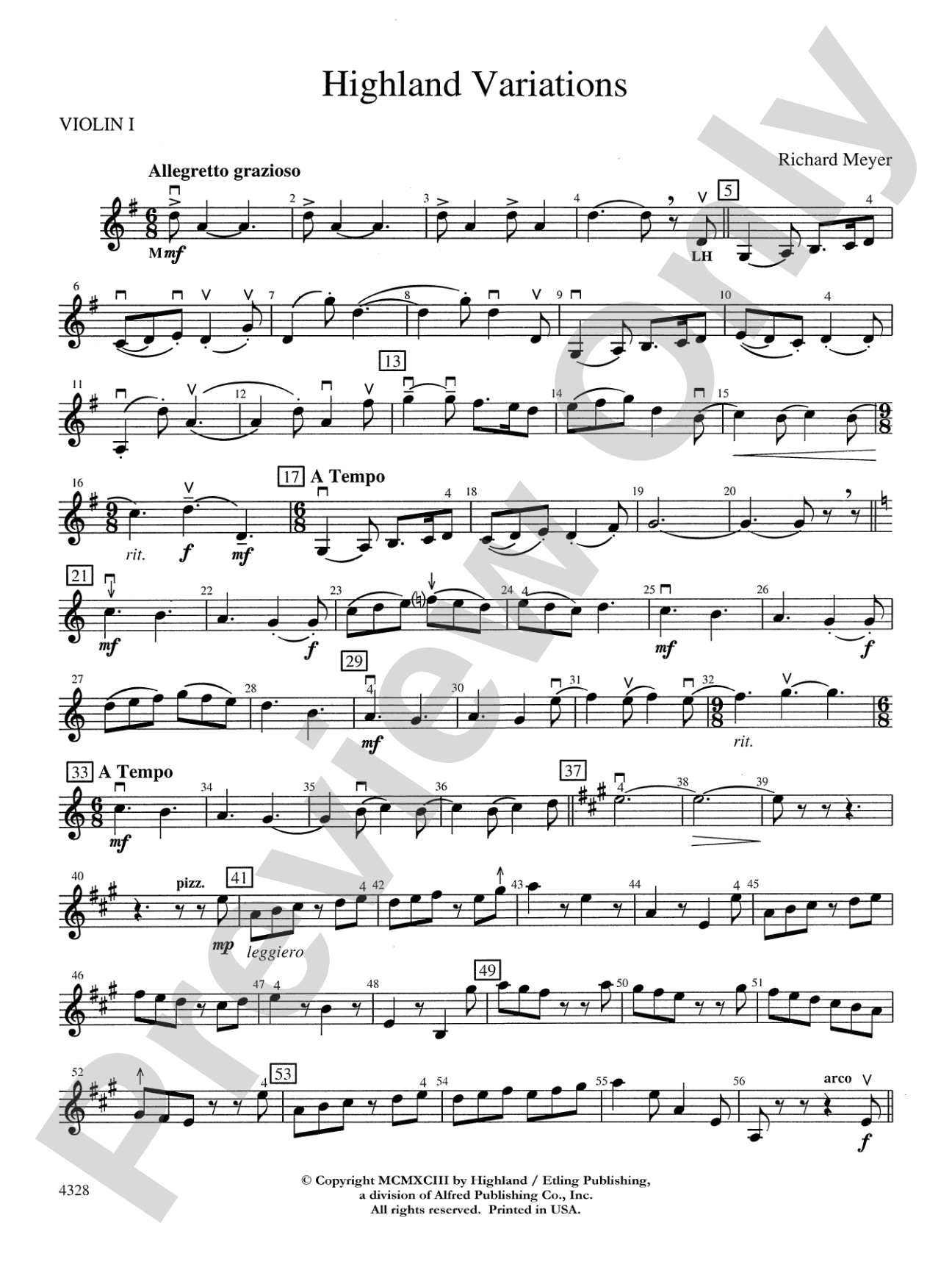
Richard Meyer has created a charming work that blends rhythmic (6/8, 4/4) and stylistic (grazioso, leggiero) contrast into a Scottish-flavored treat. Colorful modulation keys of G, C, A and D major and limited position work (for violin l) make this a rewarding musical hit with your students.

Don't just read it, hear it, play along with it, and watch your students grow with it. In MakeMusic Cloud, Highland Variations: 1st Violin comes alive with professional accompaniment, adjustable tempo, and built-in practice tools that turn solo practice into real progress.

Sample Audio
0:00
0:00
Sample Video
Additional Details
Series: Highland/Etling String Orchestra
Publisher: Alfred Music
Page Count: 2
SKU: 00-PC-0001853_VN1

More about this title

About the Arranger: Richard Meyer

Richard Meyer

Richard Meyer spent 35 years teaching strings across elementary, middle, and high school levels in Southern California public schools. He directed orchestras at Oak Avenue Intermediate School for 22 years, building the program from 29 students to 200, and led the Pasadena Youth Symphony Orchestra for 16 years in performances across North America, Europe, and Australia.

Beyond the classroom, Meyer has established himself as a prolific composer and arranger with nearly 200 published works and served as string editor for Alfred Publishing Company. He created the "Giving Bach" program, which uses interactive concerts to reach special needs and underserved students throughout Southern California. His clinician credits include the A.S.T.A. National Conference, Texas Orchestra Directors' Association Conference, and honor orchestras in multiple states.

Why we love this

Meyer balances genuine musical substance with accessibility here. The rhythmic play between 6/8 and 4/4 keeps players engaged without overwhelming Grade 3 readers, while the modulation through G, C, A, and D major gives the piece harmonic movement that feels intentional rather than arbitrary. String directors will appreciate writing that respects bow technique and position readiness while delivering a performance that sounds polished and spirited.

What to expect

Scottish warmth wrapped in Classical form. The piece dances between lyrical grazioso passages and sprightly leggiero moments, with modulations that shift the emotional landscape without disrupting the work's cheerful momentum. You hear echo of folk melody treated with compositional care, not novelty.

Who it's for

Grade 3 string orchestras ready to explore metric and tonal variety within a compact, concert-ready format. Students benefit from Meyer's writing, which challenges their rhythmic flexibility and ear for harmonic color without demanding extended position work or technical virtuosity.

How to get the most out of it

  • Establish the 6/8 grazioso section with a lilting bow stroke that follows the dance-like character; think of the rhythm as rolling rather than metrically rigid.
  • When the meter shifts to 4/4, anchor the pulse clearly so the leggiero passages sit comfortably on top of a stable harmonic foundation.
  • Shape the modulations by listening for the shift in tonal center; each key change should feel like a fresh entrance into new musical territory, not a stumble.
  • Keep second violin lines equally voiced with the melody so the counterpoint reads clearly to the audience.

How to use it

Program this as a concert opener or early-in-set piece to establish your orchestra's musicality and rhythmic precision in front of an audience. Its Scottish character and brief duration (2 pages) make it ideal for family concerts, school assemblies, or mixed repertoire programs where you want to bridge classical and accessible.

Skills your students will build

  • Reading mixed meters (6/8 and 4/4 time signatures)
  • Playing across multiple keys (G, C, A, and D major) with secure intonation
  • Contrasting articulation and tone (grazioso versus leggiero)
  • Tracking harmonic movement and modulation
  • Position security in limited range with confident bow control

You May Also Like