
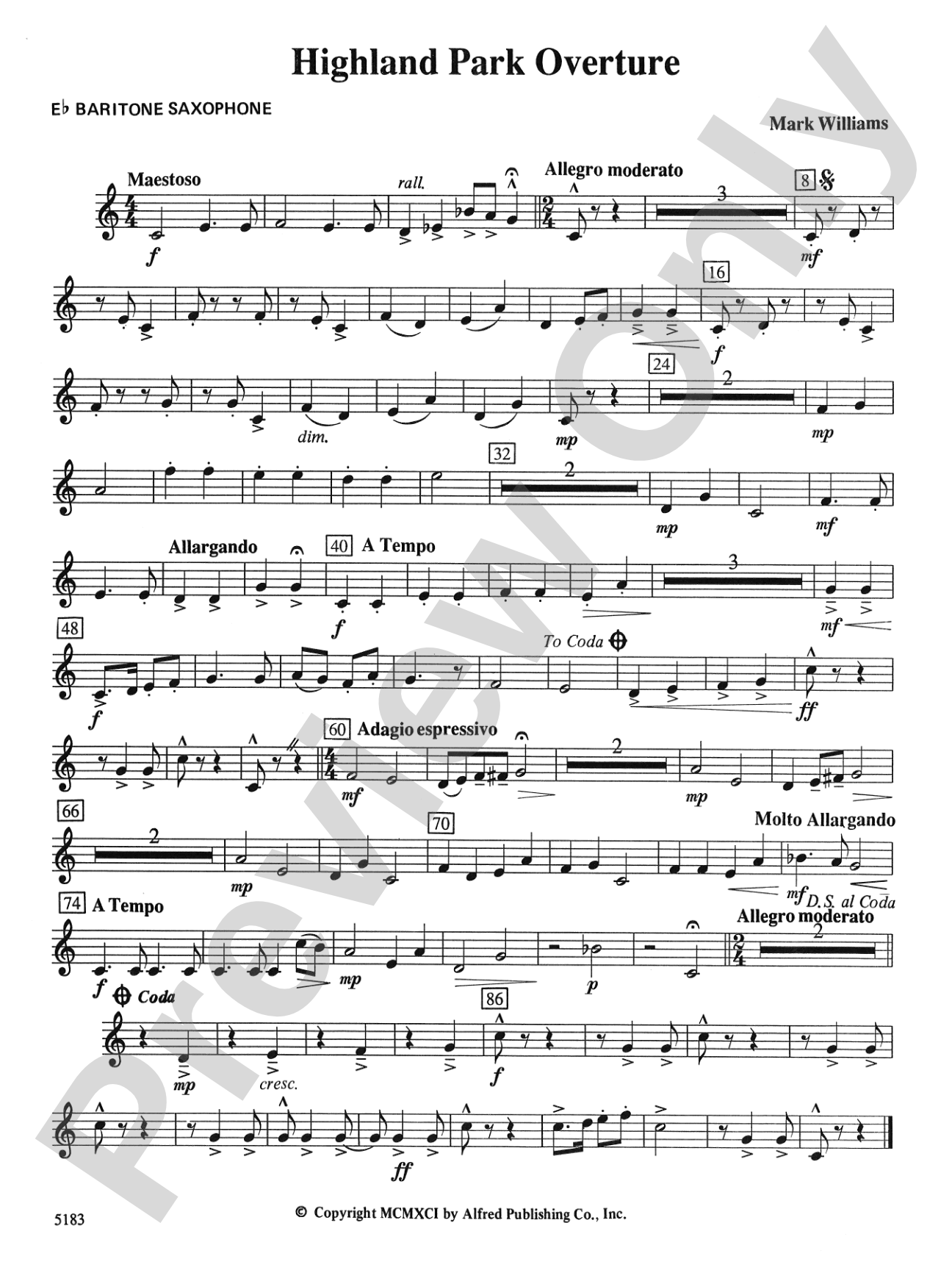

Highland Park Overture: E-flat Baritone Saxophone
Music by Mark Williams
Grade: 2 (Medium Easy)
Item: 00-PC-0001882_BTX
$3.00
Pickup currently not available
Description
All sections of your band will shine in this exciting overture in AABA form---from the bold, maestoso brass opening . . . to the jaunty melody in 2/4 time played by flutes, clarinets and cornets . . . to the expressive B section in 4/4 time that features a cornet solo with contrasting alto sax and french horn parts, and an effective trombone soli section. An impressive ending makes this work ideal for contests, festivals or any concert program. (Grade 2)


Highland Park Overture: E-flat Baritone Saxophone isn't in MakeMusic Cloud just yet...but it could be. Let us know you'd like to see it, and you'll help shape what comes next. In the meantime, start a free trial and dive into thousands of interactive titles your students can play along with today.
Request This Title
Tell us you want it.
Start Your Free Trial
Explore everything that's ready to play right now.
Sample Audio
1
Audio File
--:--
0:00
0:00
Sample Video
No sample videos found.
Additional Details
Series:
Young Symphonic
Publisher:
Alfred Music
Page Count:
1
SKU:
00-PC-0001882_BTX
More about this title
About the Composer: Mark Williams

Mark Williams built his reputation as a prolific composer who understood the needs and capabilities of school band programs across North America and beyond. His output exceeded 200 published works for band, orchestra, and choir, and his influence extended through his co-authorship of the Accent on Achievement Band Method, a foundational resource for countless elementary band programs. Williams held degrees from Eastern Washington University and served as woodwind performer and arranger for the 560th Air Force Band, grounding his compositional voice in both educational practice and professional musicianship.
Throughout his career, Williams traveled as clinician and guest conductor to 34 states, five Canadian provinces, and Australia, bringing his expertise directly to music educators. His awards included recognition from the Western International Band Clinic's Gralia Competition and multiple ASCAP Special Awards. Beyond the page, Williams remained an active performer on bassoon and served as Conductor and Artistic Director for the Spokane British Brass Band, embodying the musician-educator ideal he championed in his writing.
Why we love this
This overture gives every section of your band genuine musical responsibility without requiring advanced technical facility. The AABA structure is instantly recognizable to students, and the bold brass opening immediately establishes confidence while the contrasting B section (with its cornet solo, alto sax countermelody, and trombone soli) rewards your middle voices with real moment-to-moment musicality. The piece has both the immediate appeal and the structural clarity that earns strong adjudications.
What to expect
Highland Park Overture captures the ceremonial confidence of a brass-driven opening before shifting into something lighter and more playful. The B section deepens the emotional palette with its lyrical cornet line and colorful harmonic support, then builds toward a finish that feels earned rather than tacked on. It's the kind of piece that leaves audiences smiling and your students feeling like they've accomplished something real.
Who it's for
Grade 2 bands with solid fundamentals in place and enough personnel to cover all four to five written parts comfortably. This works equally well for groups preparing for their first festival experience or for established bands looking for a crowd-pleasing opener that lets every section contribute meaningfully.
How to get the most out of it
- Balance the maestoso brass opening so the melody emerges clearly; this isn't about raw volume but about weight and precision in the articulation.
- Shape the 2/4 A section with light, forward articulation in the flutes and clarinets to match the jaunty character; keep the tempo steady and resist the urge to rush.
- Bring out the cornet solo in the B section as the primary voice while keeping the alto sax and french horn parts supportive; the trombone soli that follows should feel like a natural response rather than a sudden shift.
- Give the ending time and space to build; the composers wrote it to be impressive, so let the dynamics and rhythmic energy carry you to the final cadence without hurrying.
How to use it
Program this as an opening selection on a concert to establish energy and goodwill from the first notes, or place it on a festival schedule where you want to showcase the full band's versatility across multiple moods within a single piece. Its Grade 2 accessibility also makes it an effective choice for a mixed-level program where you're balancing repertoire demands.
Skills your students will build
- AABA form recognition and sectional coherence
- Meter changes between 2/4 and 4/4 time signatures
- Balanced brass section sonority in the opening
- Solo and ensemble interplay in the B section
- Sustaining phrase direction and dynamics across moderate ranges
- Contributing as a section voice rather than as unison players