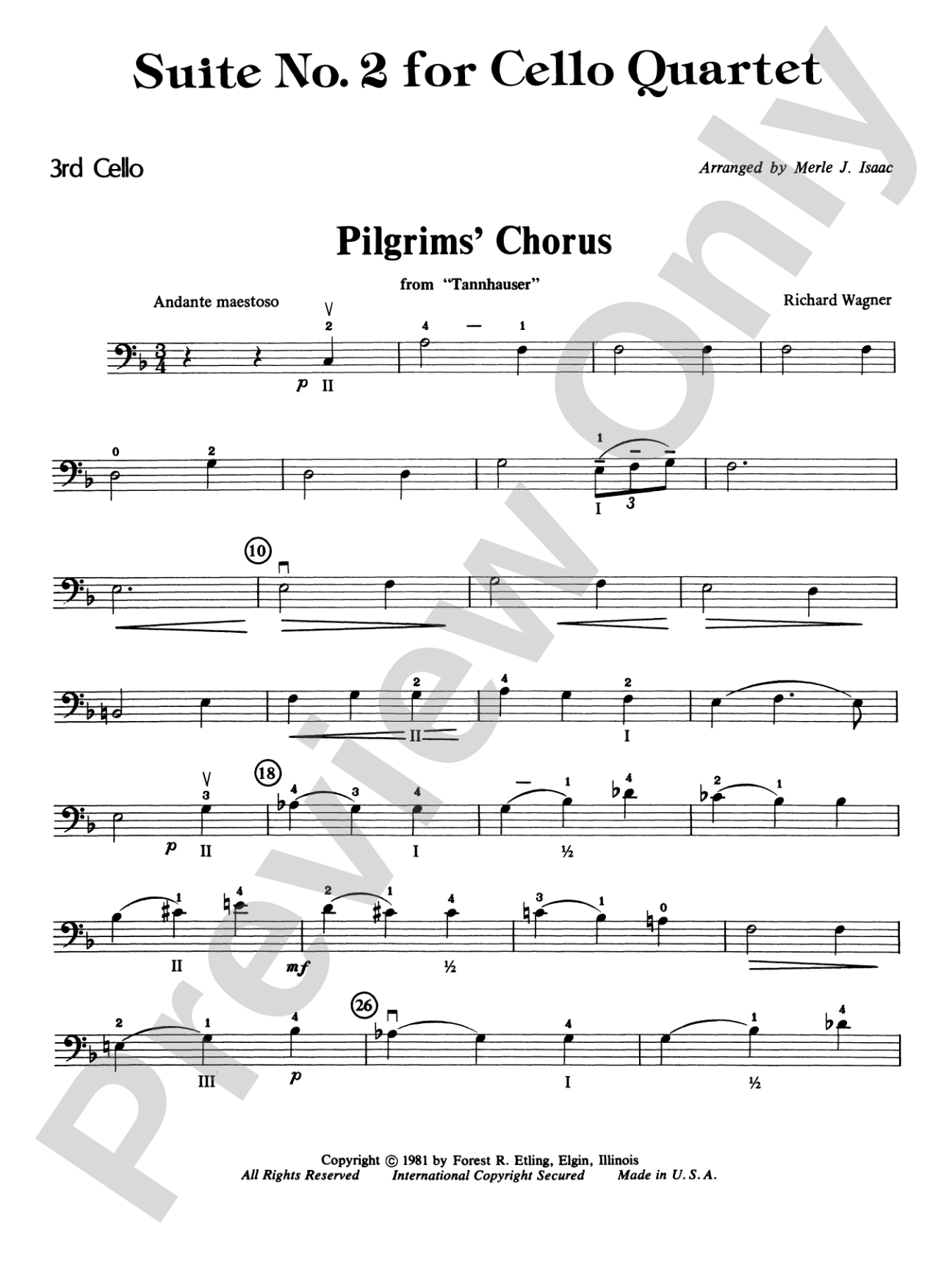
Highland/Etling Cello Quartet Series: Suite No. 2: 3rd Cello Sheet Music Preview

Highland/Etling Cello Quartet Series: Suite No. 2: 3rd Cello

Arr. Merle J. Isaac

Item: 00-PC-0014242_VC3

Digital Download
$3.00
Description

Don't just read it, hear it, play along with it, and watch your students grow with it. In MakeMusic Cloud, Highland/Etling Cello Quartet Series: Suite No. 2: 3rd Cello comes alive with professional accompaniment, adjustable tempo, and built-in practice tools that turn solo practice into real progress.

Sample Audio
No sample audio found.
Sample Video
Additional Details
Series: Highland/Etling Cello Quartet Series
Publisher: Alfred Music
Page Count: 16
SKU: 00-PC-0014242_VC3

More about this title

Why we love this

Isaac's arrangements for cello quartet open up repertoire that's often locked away in larger ensembles or piano reductions. The writing balances accessibility with musical substance, giving intermediate cellists a genuine chamber music experience rather than a dumbed-down adaptation.

What to expect

A suite for four cellos carries an inherent warmth and mellow richness. Isaac's arrangements preserve that character while giving each part room to breathe, creating conversations among voices rather than a single melodic line supported by accompaniment.

Who it's for

Intermediate to advanced cellists ready for small ensemble playing. This quartet works well for chamber groups in high school or college settings, or for adult amateur quartets looking for substantial but accessible repertoire.

How to get the most out of it

  • Establish a clear hierarchy among the four voices from the first rehearsal. The cello quartet texture can blur easily, so decide early which part carries the melody and which provide harmonic support or rhythmic anchor.
  • Record yourselves regularly. Hearing playback helps cellists balance tone and intonation across four individual voices in a way that's hard to assess in the moment.
  • Check for rhythmic conflicts in the inner parts. Suite movements often hide countermelodic lines in the second and third cello parts that can throw off ensemble cohesion if not brought out with intention.

How to use it

Program this as a chamber music feature in a solo and ensemble concert, or pair it with other small ensemble works to build a recital around string chamber groups. It also works as a satisfying vehicle for mid-year student performances when the group is ready to move beyond unison playing.

Skills your students will build

  • Voice independence in ensemble context
  • Balance and blend across four individual lines
  • Intonation adjustment within a homogeneous timbre
  • Reading quartet texture and harmonic function
  • Collaborative listening and communication without a conductor

You May Also Like