
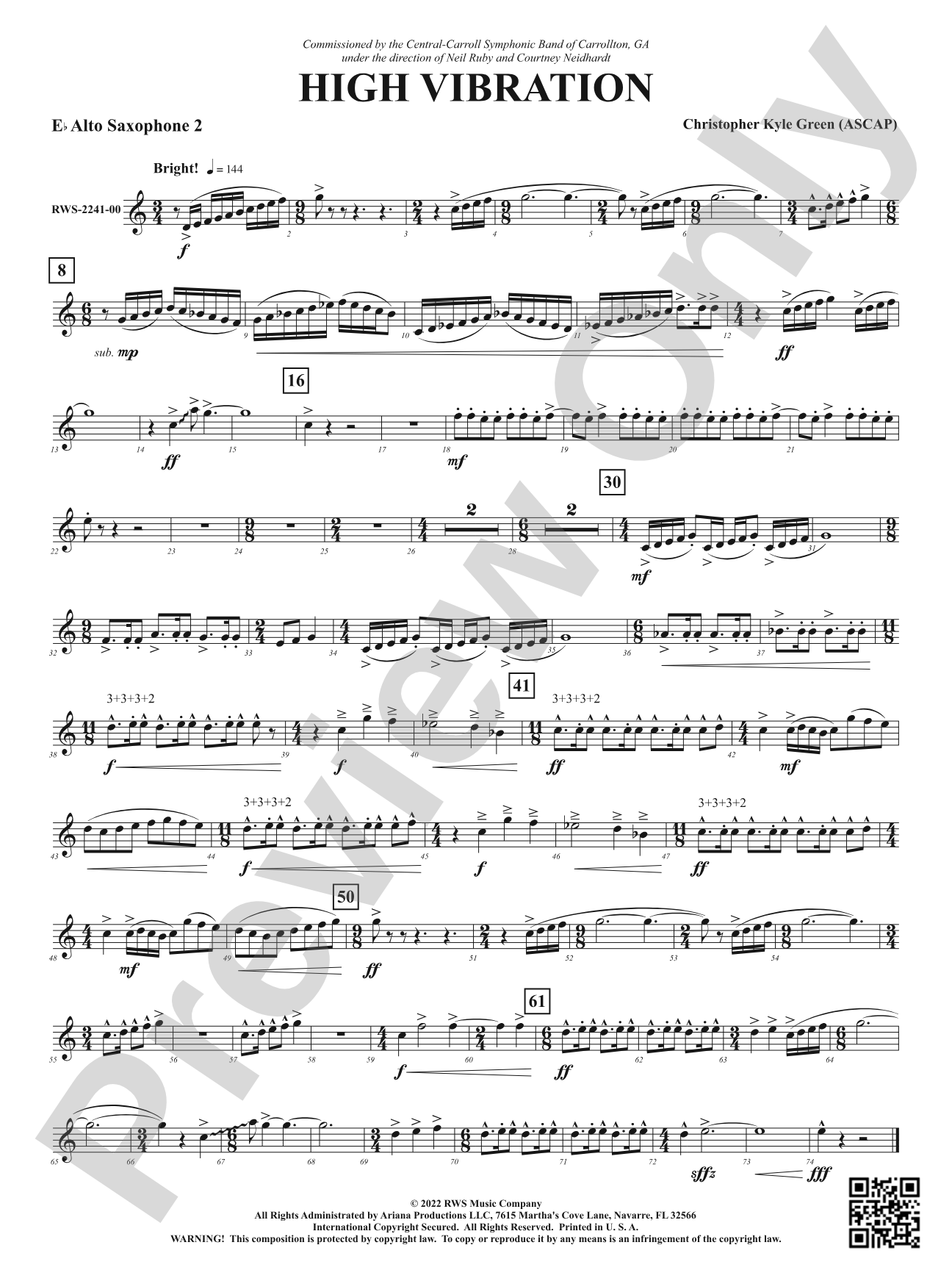

High Vibration: 2nd E-flat Alto Saxophone
By Christopher Kyle Green
Grade: 4.5
Item: 98-PC-RWS2241_AX2
$3.99
Pickup currently not available
Description
A highly energetic concert opener, "High Vibration" is a bright and fast fanfare that will leave your audience in awe. This brilliantly scored fanfare will showcase the intensity of the brass section, the sweeping flourishes of the woodwind section, and the metallic nature of keyboard and auxiliary percussion. "High Vibration" emphasizes consistent transitioning from compound meter to simple meter exposing the ensemble to multiple time signatures and metric modulation.
Original Item#: RWS-2241-00


Original Item#: RWS-2241-00
High Vibration: 2nd E-flat Alto Saxophone isn't in MakeMusic Cloud just yet...but it could be. Let us know you'd like to see it, and you'll help shape what comes next. In the meantime, start a free trial and dive into thousands of interactive titles your students can play along with today.
Request This Title
Tell us you want it.
Start Your Free Trial
Explore everything that's ready to play right now.
Sample Audio
1
Audio File
--:--
0:00
0:00
Sample Video
No sample videos found.
Additional Details
Series:
RWS - Symphony Band
Publisher:
RWS Music Company
SKU:
98-PC-RWS2241_AX2
More about this title
Why we love this
Green writes with genuine understanding of what concert bands can do at the intermediate-advanced level. The metric modulation from compound to simple meter isn't window dressing here; it's the architectural spine of the piece, which means your students won't just play it, they'll understand why the transitions matter. For directors seeking an opener that demands something from the ensemble beyond raw enthusiasm, this delivers.
What to expect
Bright, propulsive, and unapologetically celebratory. The fanfare styling gives it ceremonial weight, while the compound-to-simple meter shifts create a sense of forward momentum and transformation. When the brass peaks and the woodwinds sweep across, the whole ensemble feels like it's moving as one precision instrument.
Who it's for
Grade 4.5 concert bands with solid fundamentals and enough sectional strength to handle the metric complexity without losing ensemble cohesion. Directors programming a concert opener need something that grabs attention and sets a polished, professional tone. This piece does exactly that while teaching rhythm and meter in a musical context that actually excites students.
How to get the most out of it
- Establish the compound meter groove firmly before the transition to simple meter arrives. Your ensemble needs to feel the pulse shift as a natural evolution, not a jarring accident. Rehearse those metric modulation moments in isolation until the pivot feels inevitable.
- Balance the brass section's showiness against the woodwind flourishes. Both are scored to shine, but clarity comes from letting each voice breathe. Mark entrances in the parts so players know exactly when the spotlight rotates.
- Treat the keyboard and auxiliary percussion as conversation partners with the full band, not as garnish. Their metallic accents define the piece's brightness. Make sure they lock with the conductor's beat at all times.
- Use the fanfare style to your advantage. This isn't introspection; it's declaration. Push the tempo appropriately and let the energy build through the transitions rather than dissipate.
How to use it
Reserve this for the opening spot on a concert program where you need to command immediate attention and establish that your ensemble is prepared and polished. Its compact form and high energy make it an ideal anchor for a program built around longer concert works, or it can anchor a themed concert about rhythm and metric innovation. Program it early in the season once students have internalized the meter transitions in rehearsal.
Skills your students will build
- Reading and performing metric modulation from compound to simple meter
- Ensemble precision during complex meter transitions
- Sectional balance and independence (brass intensity against woodwind passages)
- Interpretation of fanfare style and ceremonial pacing
- Rhythmic clarity in a high-energy context