
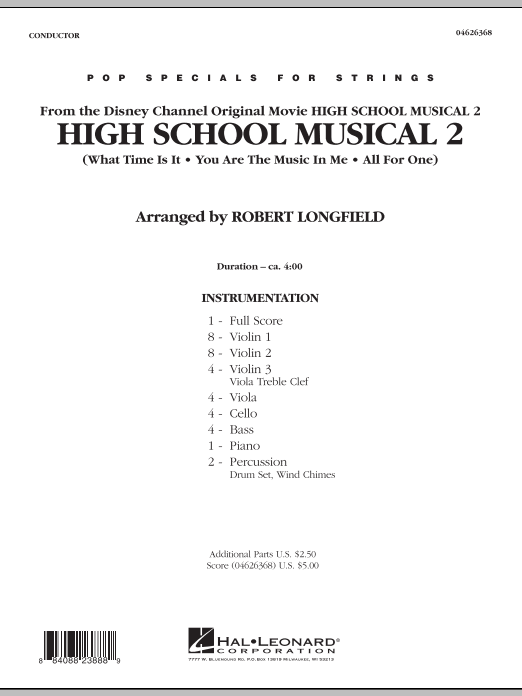

High School Musical 2: String Orchestra Conductor Score & Parts
By Robbie Nevil / By Jamie Houston / By Matthew Gerrard / Arranged by Robert Longfield
Grade: 3-4
Item: 35-PK00117120
$50.00
Pickup currently not available
Buy Extra Parts (Digital PDF Download)
| Product | Price | Quantity |
|---|---|---|
| High School Musical 2 - Full Score | $6.00 | |
| High School Musical 2 - Violin 1 | $7.00 | |
| High School Musical 2 - Violin 2 | $7.00 | |
| High School Musical 2 - Violin 3 (Viola Treble Clef) | $7.00 | |
| High School Musical 2 - Viola | $7.00 | |
| High School Musical 2 - Cello | $7.00 | |
| High School Musical 2 - Bass | $7.00 | |
| High School Musical 2 - Piano | $7.00 | |
| High School Musical 2 - Percussion | $7.00 |
Parts Added to Cart!
Description
Once again Disney has hit the mark with a production that is filled with energy, memorable songs, and great appeal to student players. Robert's well-paced medley includes four of the show's best musical moments: "All for One," "I Don't Dance," "What Time Is It," and "You Are the Music in Me." Dur: 4:00


High School Musical 2: String Orchestra Conductor Score & Parts isn't in MakeMusic Cloud just yet...but it could be. Let us know you'd like to see it, and you'll help shape what comes next. In the meantime, start a free trial and dive into thousands of interactive titles your students can play along with today.
Request This Title
Tell us you want it.
Start Your Free Trial
Explore everything that's ready to play right now.
Sample Audio
No sample audio found.
Sample Video
No sample videos found.
Additional Details
Publisher:
Hal Leonard
SKU:
35-PK00117120
More about this title
About the Composer: Robbie Nevil
Robbie Nevil is a songwriter and composer who has shaped the sound of contemporary Disney productions. His work on High School Musical 2 demonstrates his gift for crafting songs that resonate with young performers and audiences alike, combining accessibility with genuine musical substance.
Nevil's compositional voice balances melodic memorability with harmonic sophistication, making his music equally engaging for students learning the material and audiences hearing it performed. His contributions to Disney's theatrical catalog have established him as a key figure in creating music that serves both entertainment and educational purposes.
Why we love this
Longfield's arrangement captures exactly what makes this score infectious: the melodic hooks land cleanly in the string writing, the energy builds naturally across the medley, and the four-minute span never loses momentum. Your students will actually want to practice this one, and your audience will leave humming.
What to expect
The medley pulses with youthful optimism and theatrical flair, moving from rousing ensemble moments to tender melodic passages without losing its essential energy. You'll hear the familiar Disney magic translated into string terms: bright, infectious, and unapologetically joyful.
Who it's for
String orchestras at the middle-to-upper high school level will find this medley sits perfectly in their sweet spot: technically accessible without feeling simple, and genuinely fun to perform. Directors programming pops concerts, spring shows, or end-of-year celebrations will appreciate having a crowd-pleaser that doesn't require additional musicians or special arrangements.
How to get the most out of it
- Balance the melody line between first and second violins in the opening phrases of 'All for One' to establish the unison strength before the arrangement expands.
- Keep the rhythmic accompaniment figures in violas and cellos locked together during 'I Don't Dance'; any slippage there makes the groove fall apart.
- Shape the transition into 'What Time Is It' by pulling back slightly in the previous measures, then hitting the tempo with fresh energy and clean articulation.
- Let the final section of 'You Are the Music in Me' breathe in its slower, more lyrical moments; resist rushing even as the students feel the impulse to drive forward.
How to use it
This works beautifully as a centerpiece for a pops or popular music concert, where it can anchor a set of film and television music. It also serves as an excellent finale for a spring concert when you want to end on an upbeat note that leaves audiences smiling, or as a fun, high-energy opener to reset the room's energy midway through a longer program.
Skills your students will build
- Executing rapid string articulations and rhythmic precision across an ensemble
- Maintaining rhythmic integrity in syncopated accompaniment figures
- Balancing melody and harmony within a densely scored arrangement
- Shaping lyrical phrases across sustained notes without losing energy
- Responding to tempo and mood changes within a continuous medley structure