
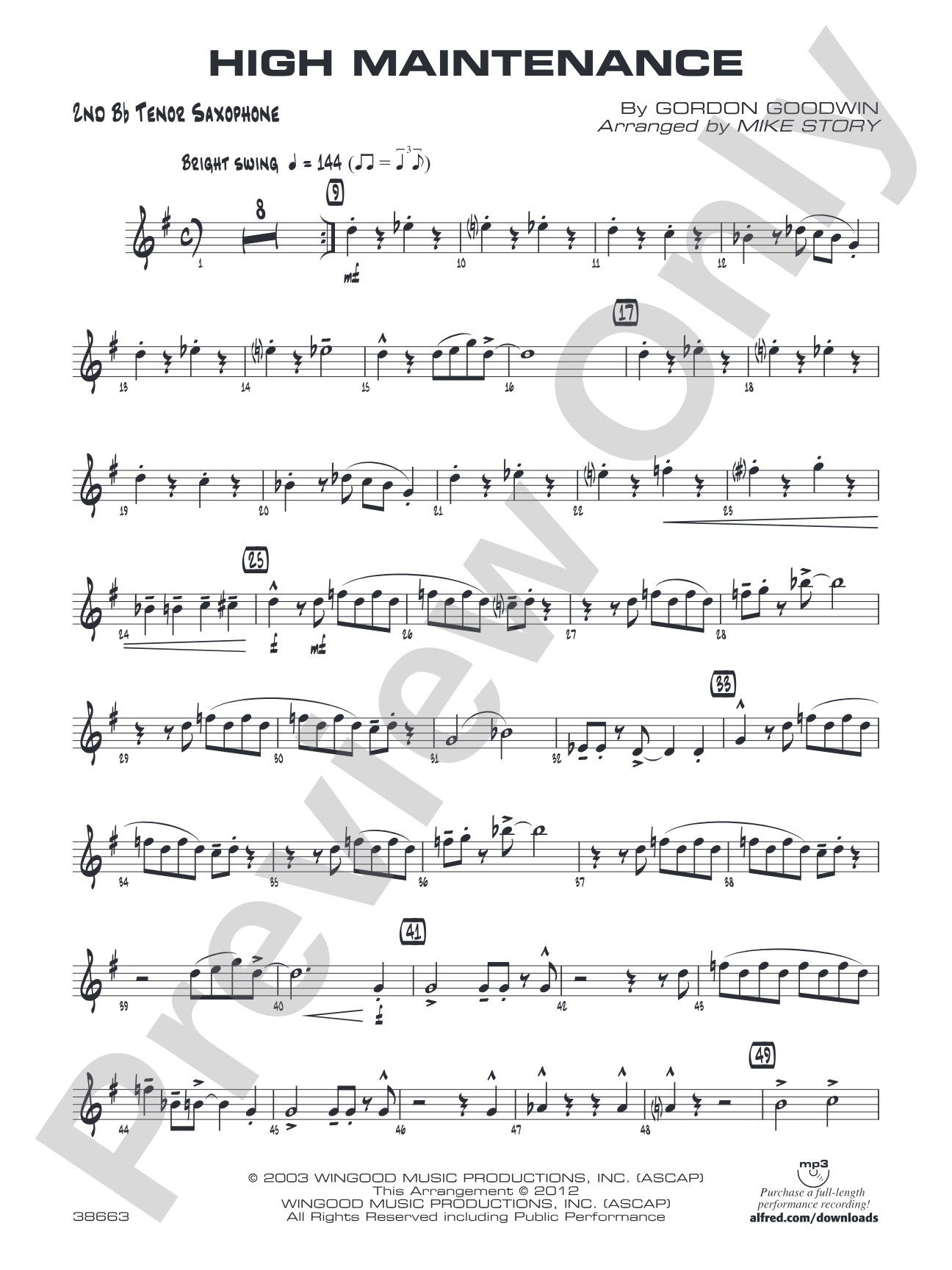

High Maintenance: 2nd B-flat Tenor Saxophone
By Gordon Goodwin / arr. Mike Story
Grade: 1 (Easy)
Item: 00-PC-0016698_TX2
$5.99
Pickup currently not available
Description
So you want to play Gordon Goodwin charts but they're way too challenging for young players, well, problem solved. Check out Mike Story's adaptation of this swingin' Big Phat Band hit---it's still hip, it still has all the Goodwin ingredients, yet it's very accessible. Written-out solos available for alto, tenor, trumpet and trombone, trumpet 1 range is to written E, top space. This chart deserves a big spot in your program! This title is available in MakeMusic Cloud.


Don't just read it, hear it, play along with it, and watch your students grow with it. In MakeMusic Cloud, High Maintenance: 2nd B-flat Tenor Saxophone comes alive with professional accompaniment, adjustable tempo, and built-in practice tools that turn solo practice into real progress.
Open in the Player
Jump straight in and assign it today.
Start Your Free Trial
Open this title and explore the full library in minutes.
Sample Audio
1
Audio File
--:--
0:00
0:00
Sample Video
Additional Details
Series:
First Year Charts for Jazz Ensemble
Publisher:
Alfred Music
Page Count:
76
SKU:
00-PC-0016698_TX2
More about this title
About the Composer: Gordon Goodwin

Gordon Goodwin began composing full orchestrations in his mind at age five, a gift that manifested in his first big band chart, Hang Loose, written at thirteen. His work has earned three Emmy Awards and multiple Grammy nominations, with film scores appearing in Bad Boys II, Con Air, Remember the Titans, and Star Trek: Nemesis, alongside collaborations with artists including Christina Aguilera, Quincy Jones, and Ray Charles.
Since founding Gordon Goodwin's Big Phat Band in 2000, he has established himself as one of contemporary jazz's most prolific voices. His albums have consistently garnered Grammy recognition, and he has conducted major symphony orchestras across North America and Europe. His writing combines technical sophistication with infectious energy, qualities that make his charts sought after by ensembles at every level.
Why we love this
This is one of those rare adaptations that preserves the swagger and modern groove of the original while actually remaining playable by first-year jazz musicians. Mike Story has kept the Goodwin signature intact, including written-out solos that give soloists real material to sink their teeth into rather than generic chord changes. Your students get the satisfaction of sounding contemporary and polished without drowning in technical demands.
What to expect
High Maintenance swings with contemporary attitude. The groove is immediately engaging and hip, with that Big Phat Band energy captured in a form young musicians can actually execute. Rhythmic precision and ensemble blend matter here, but the payoff is a sound that feels genuinely modern and fun to play.
Who it's for
Jazz ensembles in their first or second year of playing together, including middle school and beginning high school groups. Directors looking to program music that sounds mature and current without sacrificing accessibility will find this a reliable choice.
How to get the most out of it
- Balance the written solos carefully. With alto, tenor, trumpet, and trombone soloing opportunities, establish which voices carry the melody and which fill out the texture so the soloists can be heard clearly over the ensemble.
- Lock the rhythm section early. The chart lives or dies on whether the walk bass, comping, and drums establish a solid foundation. Rehearse these parts separately before bringing in the full ensemble.
- Manage the trumpet section register. With trumpet 1 reaching written E (top space), make sure your lead trumpet player is comfortable in that range and that section balance doesn't tip up into the stratosphere.
How to use it
Program this as a statement piece on a jazz concert or pops concert where you want to showcase young players tackling serious, recognizable big band repertoire. It pairs well with both straightforward swing standards and more experimental contemporary pieces, working equally well as an opener that catches the audience's attention or a feature number for your soloists.
Skills your students will build
- Reading and executing syncopated rhythms in swing time
- Improvising over changes and responding to written solo frameworks
- Balancing ensemble blend while keeping rhythmic independence
- Listening for and responding to the rhythm section foundation
- Interpreting swing articulation and phrasing distinctly from classical contexts