
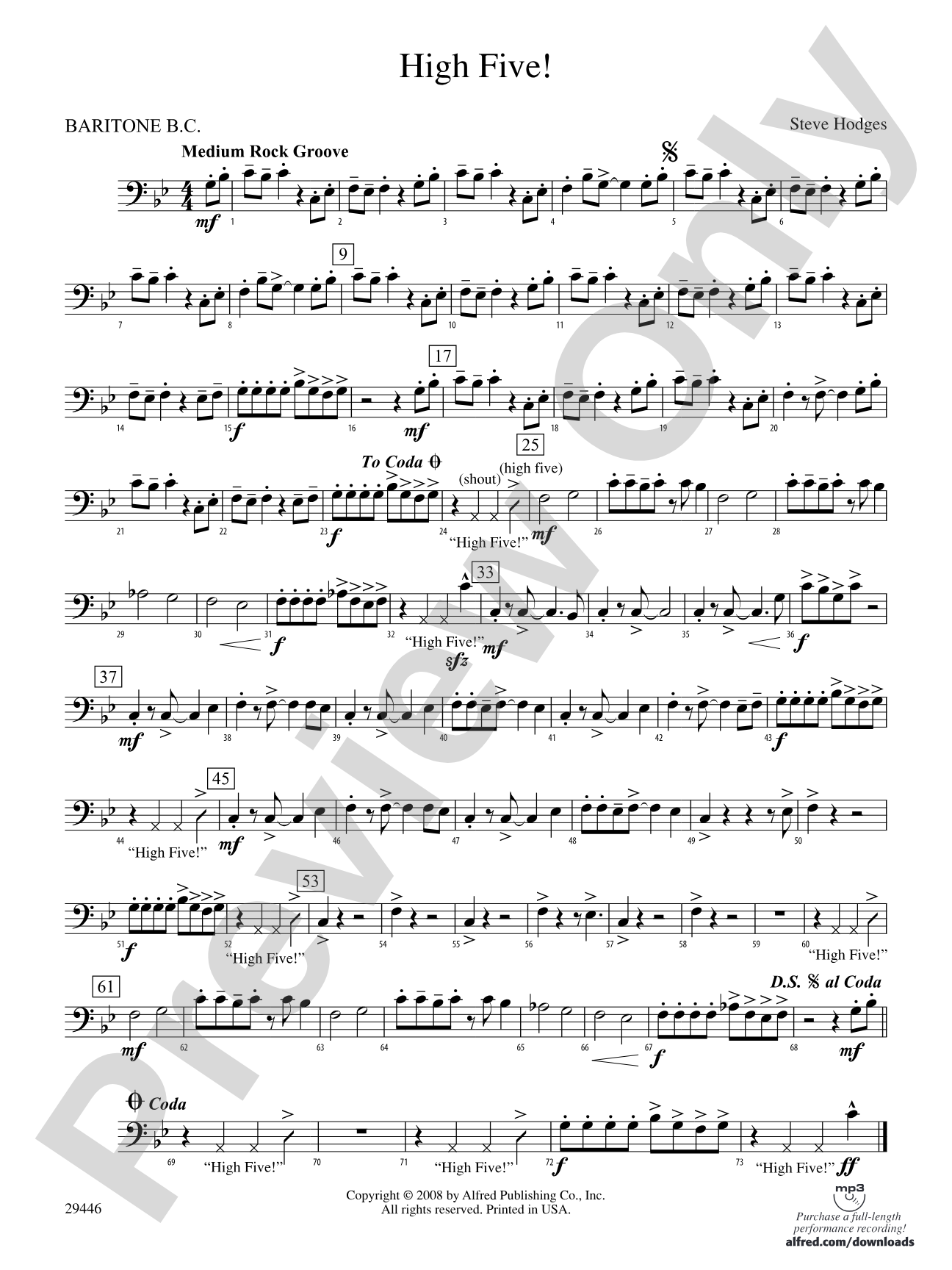

High Five!: Baritone B.C.
By Steve Hodges
Grade: 1.5 (Easy)
Item: 00-PC-0001403_BBC1
$3.00
Pickup currently not available
Description
Looking for some music to get the audience more involved in your concert? Here it is! A medium-rock groove sets the stage for an eighth-note motive that signals the band and audience to give "high fives" throughout the piece. Soloists on the flute, saxophone, trumpet, trombone and clarinet are featured on two-measure phrases that lead to an exciting "drum-off" between the snare and tom players. Band members and directors are encouraged to use their creativity in the solo section as well as in giving "high fives" to each other and to the audience. A really fun piece! (3:05)


Don't just read it, hear it, play along with it, and watch your students grow with it. In MakeMusic Cloud, High Five!: Baritone B.C. comes alive with professional accompaniment, adjustable tempo, and built-in practice tools that turn solo practice into real progress.
Open in the Player
Jump straight in and assign it today.
Start Your Free Trial
Open this title and explore the full library in minutes.
Sample Audio
1
Audio File
--:--
0:00
0:00
Sample Video
No sample videos found.
Additional Details
Series:
Challenger Band Series
Publisher:
Alfred Music
Page Count:
128
SKU:
00-PC-0001403_BBC1
More about this title
About the Composer: Steve Hodges

Steve Hodges holds degrees from Western Oregon University (Bachelor of Science) and Central Washington University (Master of Music Education). Over forty years in public school music education, he directed concert bands, choirs, and chamber ensembles at all levels before retiring from full-time teaching.
Since 1986, Hodges has composed and published more than 120 concert band works through Alfred Music, along with choral arrangements through Staff Music and Shawnee Press. His music has been performed internationally at festivals and state conventions, commissioned by honor bands and schools across North America, and featured on TBS and ESPN programming. He holds membership in the American Society of Composers, Authors and Publishers (ASCAP) and has received multiple standard awards. Hodges resides in The Dalles, Oregon, where he remains active in community music and watches his grandchildren perform his compositions in their school bands.
Why we love this
This piece solves the real challenge of finding novelty material with genuine musicality and engagement value. The medium-rock groove keeps energy high while the featured solos on five different instruments give your section leaders meaningful moments, and the snare versus tom battle gives your percussion section a chance to shine without overshadowing the rest of the band. The built-in flexibility for improvisation and audience interaction makes every performance feel fresh.
What to expect
A laid-back, contemporary groove with infectious energy that builds momentum through the piece. The medium-rock setting feels modern and approachable, while the highlighted solos and percussion battle add layers of excitement that keep both performers and audience invested.
Who it's for
This is built for bands at the Grade 1.5 level, making it accessible to middle school or early high school ensembles. It works equally well for concert groups looking to include an audience-friendly finale or for any director seeking material that builds ensemble spirit while keeping players engaged.
How to get the most out of it
- Establish the eighth-note motive early in rehearsal as your rhythmic anchor; have the entire band tap it on their laps before playing to internalize the groove.
- Let your soloists know they own their two-measure phrases. Encourage them to add personal flair through dynamics or slight rhythmic variations within the established groove.
- Stage the drum-off so the snare and tom players are clearly visible to the audience; the visual component matters as much as the sound here.
- Plan your high-five moments in advance with the audience (perhaps at specific key changes or when the energy peaks) so they know when to participate rather than fumbling through it in the moment.
How to use it
Reserve this for your concert finale or as a bridge piece between a formal first half and a lighter second half. The novelty factor and audience participation make it an ideal closer that leaves the audience smiling and energized, or position it mid-concert to reset attention and rebuild momentum after heavier repertoire.
Skills your students will build
- Maintaining a consistent eighth-note groove while balancing featured solos
- Solo performance within an ensemble context (flute, saxophone, trumpet, trombone, clarinet)
- Rhythmic precision in unison passages that anchor the groove
- Improvisation and stylistic interpretation within a rock-based idiom
- Percussion soloists developing call-and-response conversation between snare and toms