High Five Cover Image

High Five: String Orchestra Conductor Score

$7.00 USD
Sale price  $7.00 USD Regular price 
Skip to product information
High Five Cover Image

High Five: String Orchestra Conductor Score

By Loreta Fin

Grade: 2

Item: 76-46176S

$7.00
Shipped

One moment…

Description
There are not many opportunities for young string orchestras to perform repertoire in 5/8. Often, it is not encountered until much later. This piece introduces a 3+2, as well as a 2+3 feel, with splashes of 3/4 time thrown in to really make the students think. It sounds harder than it is; many of the rhythms are supported by eighth-note subdivisions. This piece is sure to be both a challenge and a favorite!

High Five: String Orchestra Conductor Score isn't in MakeMusic Cloud just yet...but it could be. Let us know you'd like to see it, and you'll help shape what comes next. In the meantime, start a free trial and dive into thousands of interactive titles your students can play along with today.

Sample Pages

Sample Audio
No sample audio found.
Sample Video
Additional Details
Series: Wilfin String Orchestra: Young String Ensemble Series
Publisher: Wilfin Music
Page Count: 8
UPC: 038081540290
SKU: 76-46176S

More about this title

About the Composer: Loreta Fin
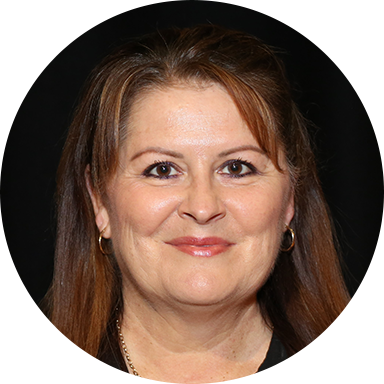
Loreta Fin

Loreta Fin is an accomplished violinist, violist, and educator based in Brisbane, Australia. She studied at the Sydney Conservatorium of Music and served as principal violist with the Queensland Pops Orchestra for over 25 years while maintaining an active chamber music career. Since 1993, she has directed strings at Somerville House School and has become a respected adjudicator at major Australian competitions and conferences, as well as at two American National String Teachers' Conferences.

Fin has composed more than 100 works for string orchestra published worldwide by Alfred Music, and her expertise in string pedagogy is reflected in her 2017 Beginner String Ensemble Series. She has served the Australian Strings Association in leadership roles for over 25 years, including terms as State and National President, and received the National Award for Services to Music and String Teaching. Since 2015, she has conducted the State and National Honours Ensembles Programs in Brisbane.

Why we love this

Loreta Fin understands exactly what young orchestras need: music that sounds sophisticated without overwhelming them technically. By introducing 5/8 meter early through clear subdivisions and alternating between 3+2 and 2+3 groupings, she gives students a genuine early exposure to mixed meter that builds confidence rather than anxiety. The piece rewards careful ensemble listening and will generate real satisfaction in both rehearsal and performance.

What to expect

The piece has an energetic, contemporary character shaped by its asymmetrical phrasing. The alternating 3+2 and 2+3 cells create a subtle forward momentum that keeps listeners engaged, while brief excursions into 3/4 feel like moments of relative stability. It sounds modern and purposeful without sacrificing the lyricism young string players can bring to their lines.

Who it's for

Young string orchestras ready to tackle mixed meter without the language barrier. This piece suits Grade 2 ensembles that have solid rhythmic fundamentals and want to grow beyond standard 4/4 and 3/4 repertoire. Conductors will appreciate a composer who understands how to scaffold asymmetrical meter so students succeed.

How to get the most out of it

  • Emphasize the eighth-note pulse during early rehearsals. Once students feel the subdivisions underneath the 5/8 measures, the meter becomes intuitive rather than abstract.
  • Conduct the 3+2 and 2+3 patterns distinctly so players can see where the downbeat accent changes. Your clarity at the podium becomes their anchor.
  • Highlight the 3/4 sections as rhythmic breathers. They contrast with the 5/8 material and give students a moment to reset before returning to the asymmetrical meter.
  • Balance the technical demands with the musical shape. This piece sounds harder than it plays, so encourage the strings to sing through the complexity rather than grinding through it mechanically.

How to use it

Feature this as a centerpiece work on a concert exploring rhythm and form across styles. It pairs well with Grade 2 repertoire in traditional meters as a concrete demonstration of how composers extend rhythmic language. It also makes an excellent showcase for a conductor who wants the ensemble to demonstrate ensemble listening and metric independence.

Skills your students will build

  • Reading and performing 5/8 meter with 3+2 and 2+3 subdivisions
  • Maintaining pulse within asymmetrical rhythmic groupings
  • Switching between mixed meters (5/8 and 3/4) within a single piece
  • Understanding how eighth-note subdivisions support larger rhythmic structures
  • Ensemble alignment and listening across changing metric patterns

You May Also Like