
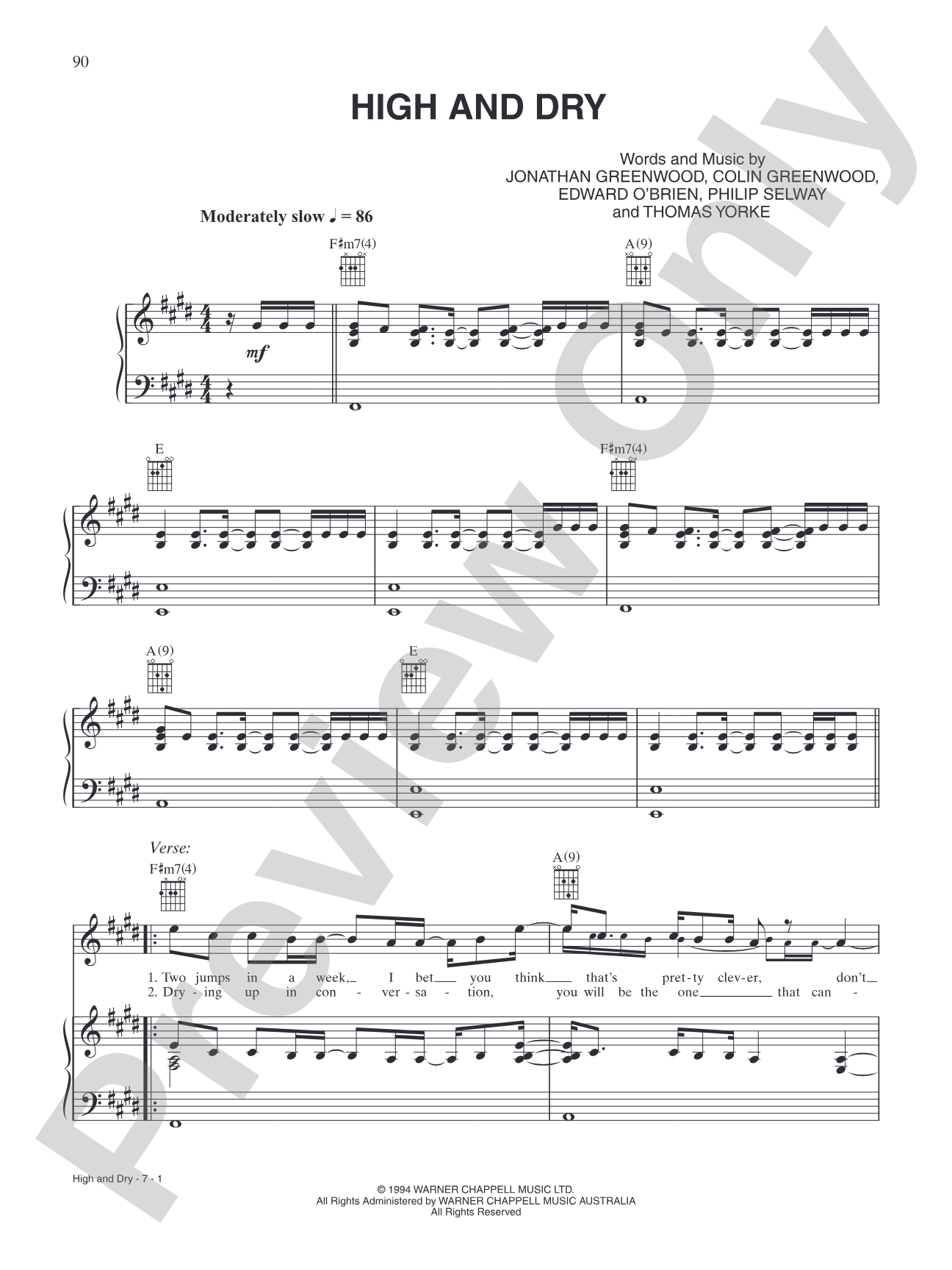
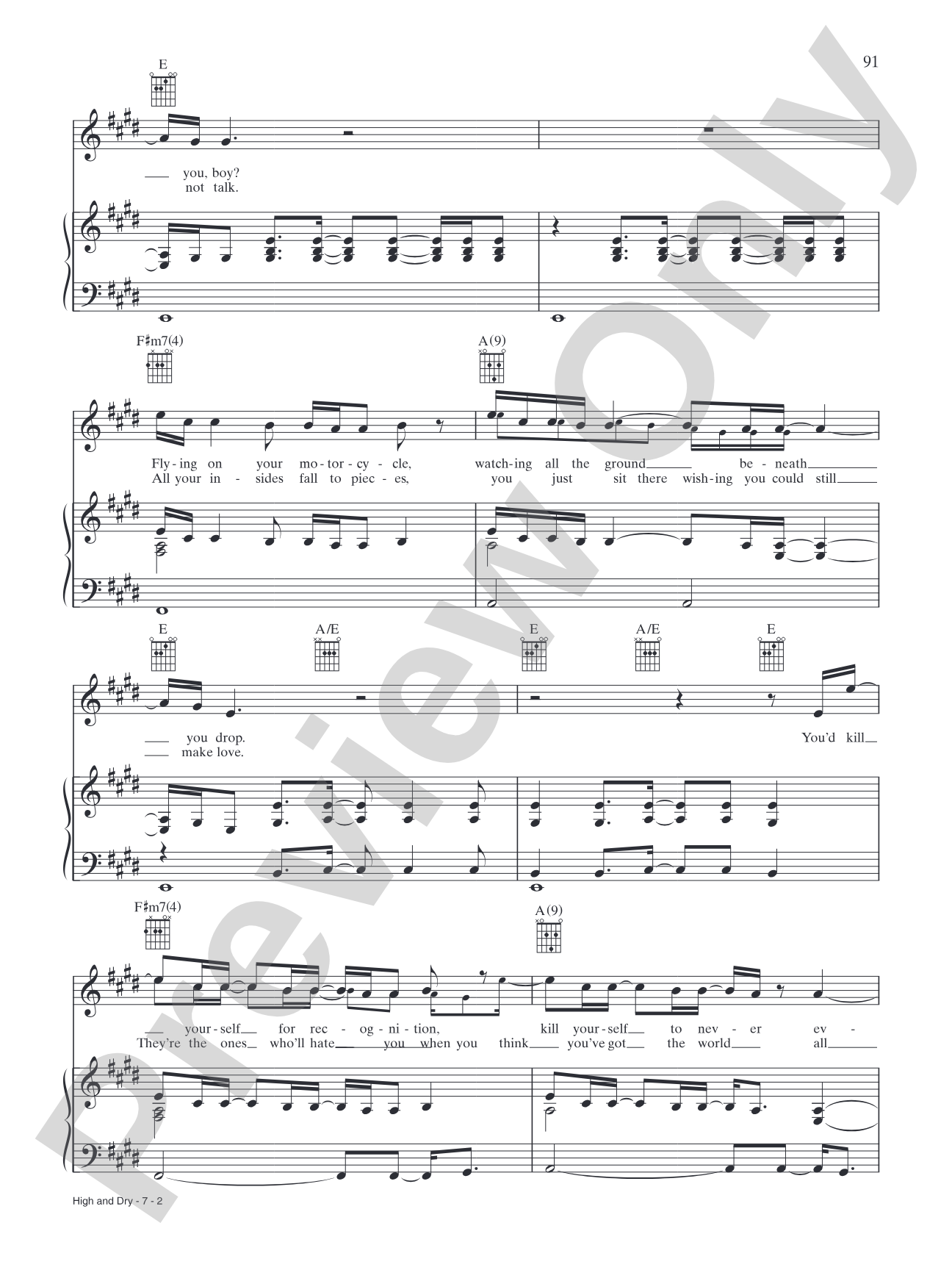

High and Dry: Piano/Vocal/Chords
Ten Years of Popular Sheet Music Bestsellers
Item: 00-PS-0010886
$5.99
One moment…
Description
This songbook contains more than 40 of the most biggest hits of the '90s. Each song is sure to spark a memory or create a new one for pianists or vocalists of all ages. For practice, performance, or pleasure, play and sing your way through your favorite decade in pop music history! Titles: All I Wanna Do (Sheryl Crow) * All My Life (K-Ci & Jo-Jo) * Amazed (Lonestar) * Angel Eyes (Jim Brickman) * Basket Case (Green Day) * Beauty and the Beast (Celine Dion and Peabo Bryson) * Because You Loved Me (Celine Dion) * Bittersweet Symphony (The Verve) * Can You Feel the Love Tonight (Elton John) * Creep (Radiohead) * Feels Like Home (Randy Newman) * From a Distance (Bette Midler) * Get Here (Oleta Adams) * Good Riddance (Time of Your Life) (Green Day) * Hedwig's Theme (from Harry Potter) (John Williams) * Hero (Mariah Carey) * High and Dry (Radiohead) * How Do I Live (LeAnn Rimes) * I Can See Clearly Now (Jimmy Cliff) * I Do It for You (Everything I Do) (Bryan Adams) * I Don't Want to Miss a Thing (Aerosmith) * I Swear (All-4-One) * I'll Be There for You (Theme from Friends) (Rembrandts) * I'll Stand by You (Pretenders) * Karma Police (Radiohead) * Kiss from a Rose (Seal) * Livin' la Vida Loca (Ricky Martin) * Losing My Religion (R.E.M.) * Love Will Lead You Back (Taylor Dayne) * Macarena (Los del Rio) * Nightswimming (R.E.M.) * One of Us (Joan Osborne) * Over the Rainbow (Israel "IZ" Kamakawiwo'ole) * Right Now (Van Halen) * She Talks to Angels (Black Crowes) * Smooth (Santana featuring Rob Thomas) * Strong Enough (Sheryl Crow) * Thank You (Dido) * This Kiss (Faith Hill) * Truly, Madly, Deeply (Savage Garden) * Un-Break My Heart (Toni Braxton) * A Whole New World (Regina Belle and Peabo Bryson).


High and Dry: Piano/Vocal/Chords isn't in MakeMusic Cloud just yet...but it could be. Let us know you'd like to see it, and you'll help shape what comes next. In the meantime, start a free trial and dive into thousands of interactive titles your students can play along with today.
Request This Title
Tell us you want it.
Start Your Free Trial
Explore everything that's ready to play right now.
Sample Audio
No sample audio found.
Sample Video
No sample videos found.
Additional Details
Series:
Decade by Decade
Publisher:
Alfred Music
Page Count:
224
SKU:
00-PS-0010886
More about this title
About the Composer: Jonathan Greenwood
Radiohead emerged from Oxford in the early 1990s and became one of the defining bands of the decade, reshaping alternative rock through innovative production, intricate arrangements, and emotionally complex songwriting. The band's core members—Thom Yorke (vocals), Jonny Greenwood (guitar, keyboards), Colin Greenwood (bass), Ed O'Brien (guitar), and Phil Selway (drums)—collaborated on material that ranged from radio-friendly alt-rock to experimental soundscapes, influencing generations of musicians and producers.
Why we love this
This collection captures the genuine diversity of '90s pop and rock in one volume, giving pianists and singers access to everything from arena ballads to indie rock staples without hunting through separate books. The breadth means you can program a full recital spanning Celine Dion to Green Day, Radiohead to Ricky Martin, all at the same accessible level. Singers especially benefit from the variety of vocal ranges and styles, while pianists get to explore different accompaniment textures across genres.
What to expect
Flipping through this collection feels like a curated time capsule of the decade: one moment you're in a soaring Aerosmith power ballad, the next you're grounded in the angular guitar work and introspective vocals of Radiohead or R.E.M. The mix of earnest '90s sincerity (boy bands, movie soundtrack ballads) alongside ironic alternative rock creates a genuinely eclectic mood that shifts constantly. There's something both nostalgic and fresh about encountering these songs on the page rather than streaming them.
Who it's for
Pianists and singers preparing for recitals, open mics, or casual performance will find repertoire that connects with audiences across multiple generations. This book serves students who grew up in or studied the '90s and want to perform the songs that shaped them, as well as younger musicians discovering these classics for the first time. It's equally suited for practice and pleasure, whether you're rebuilding your playing after a break or simply exploring music you love.
How to get the most out of it
- Study the chord symbols carefully; many '90s pop songs use unconventional progressions that won't always resolve where you expect, particularly in the Radiohead and R.E.M. selections.
- Balance the vocal line with sensitive accompaniment in the ballads (Celine Dion, LeAnn Rimes, Bryan Adams); these songs demand space for the voice rather than rhythmic drive.
- Lock into the groove early in uptempo tracks like "Macarena" and "Livin' la Vida Loca" so you establish the infectious pocket before the vocal enters.
- Use dynamics and arrangement details from the original recordings as your guide; '90s production was precise, and small variations in texture can enhance authenticity without straying from the printed part.
How to use it
Program this collection as a thematic concert or recital series celebrating '90s popular music, or select individual songs to intersperse among classical repertoire and show contemporary relevance. For a variety show or benefit concert, draw from multiple songs across the book to create genre-hopping programs that appeal to listeners of different ages. Piano students can assign specific selections as supplementary repertoire that builds skills while remaining highly motivating.
Skills your students will build
- Reading and interpreting lead sheet notation with chord symbols
- Adapting vocal melodies to different vocal ranges and tessituras
- Playing piano accompaniments that support rather than compete with the voice
- Understanding harmonic language of '90s pop and rock (extended chords, unexpected progressions)
- Balancing melody, harmony, and rhythm across diverse musical styles
- Working with syncopated rhythms and groove-based accompaniment patterns