
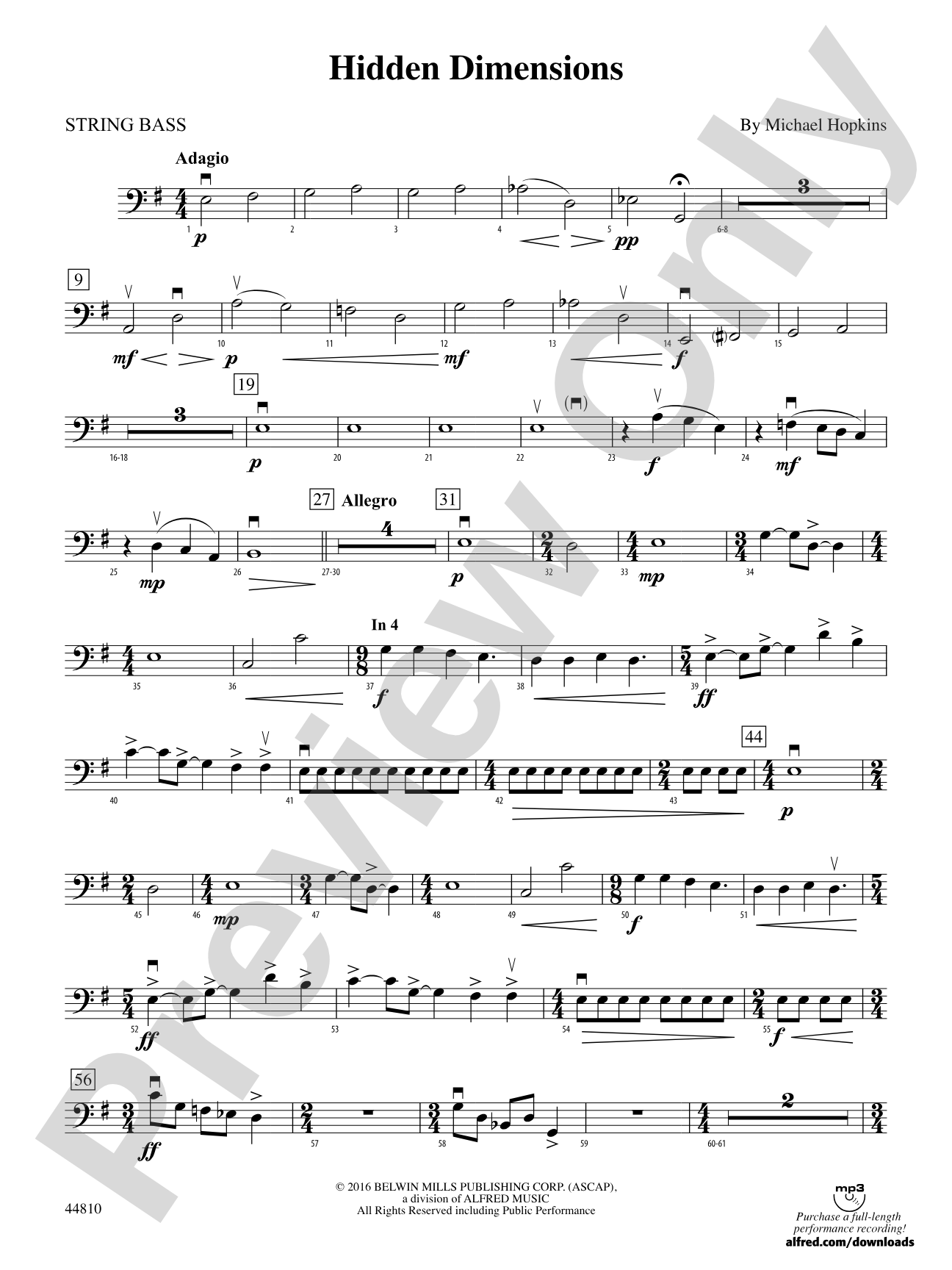

Hidden Dimensions: String Bass
By Michael Hopkins
Grade: 3
Item: 00-PC-0017327_SB
$5.99
Pickup currently not available
Description
Explore the hidden dimensions of spacetime and string theory with multiple meters! Great for a cross-curricular experience with the science class. There is a string theory in physics named M-Theory that suggests spacetime contains eleven dimensions. Most of these dimensions are compacted, hidden, and undetectable by human experiments. Composer Michael Hopkins creates a musical exploration of these hidden dimensions---a journey through spacetime! Through the use of multiple meters, the phrases are of lengths that represent all the different dimensions.


Don't just read it, hear it, play along with it, and watch your students grow with it. In MakeMusic Cloud, Hidden Dimensions: String Bass comes alive with professional accompaniment, adjustable tempo, and built-in practice tools that turn solo practice into real progress.
Open in the Player
Jump straight in and assign it today.
Start Your Free Trial
Open this title and explore the full library in minutes.
Sample Audio
1
Audio File
--:--
0:00
0:00
Sample Video
Additional Details
Series:
Belwin Concert String Orchestra
Publisher:
Alfred Music
Page Count:
124
SKU:
00-PC-0017327_SB
More about this title
About the Composer: Michael Hopkins

Michael Hopkins leads the music education program at the University of Michigan, where he teaches string techniques, orchestra methods, and music psychology. His career spans conducting university and secondary orchestras across Colorado, Michigan, and Vermont, along with founding and directing the Burlington Chamber Orchestra.
Hopkins has presented research on string pedagogy and music technology at over 60 national and state conferences, published extensively in peer-reviewed journals including the Journal of Research in Music Education and American String Teacher, and composed and arranged more than 70 works for orchestra. He authored The Art of String Teaching (GIA Publications), a foundational text for string educators at all levels.
Why we love this
Hopkins grounds this piece in genuine pedagogical thinking about metric variety. Rather than using multiple meters as a novelty, he constructs phrases where the meter itself becomes the compositional idea, making the mathematical concept audible and memorable for young players. The cross-curricular connection to physics is substantive, not superficial.
What to expect
A sense of discovery unfolds as familiar phrase lengths dissolve and reshape themselves. The music feels propulsive yet measured, inviting players to hear how small metric shifts create large expressive changes without ever losing musical coherence.
Who it's for
Grade 3 string orchestras looking for intellectually engaging repertoire that works equally well in concert and festival settings. This piece serves conductors who want their students exploring rhythm and structure as serious compositional tools, not decorative effects.
How to get the most out of it
- Prepare your students for metric shifts by isolating one meter change at a time in rehearsal rather than running the full progression. This builds confidence and prevents rhythm from becoming a memory game.
- Use a clear beat pattern for each meter and establish it aurally with a full rehearsal count-off before moving through the transition. Young orchestras thrive with this kind of predictability.
- Conduct the written meter clearly throughout. Your gesture communicates the underlying mathematical structure Hopkins is exploring, which reinforces the piece's conceptual spine.
- Ask your strings to listen across sections during meter changes. The ensemble sound shifts with the meter, and that collective adjustment is part of what makes the piece effective.
How to use it
Program this as the centerpiece of a science-themed concert or festival appearance where the program notes can establish the physics context. Alternatively, use it mid-season as a rhythm and metric literacy builder before tackling more complex contemporary repertoire.
Skills your students will build
- Reading and performing multiple meters (3/4, 4/4, 5/4, 7/8, and others) in sequence
- Recognizing metric patterns and phrase structures as compositional elements
- Maintaining ensemble cohesion during meter changes
- Understanding how mathematical concepts translate to musical form
- Sight-reading flexible, non-traditional phrase lengths