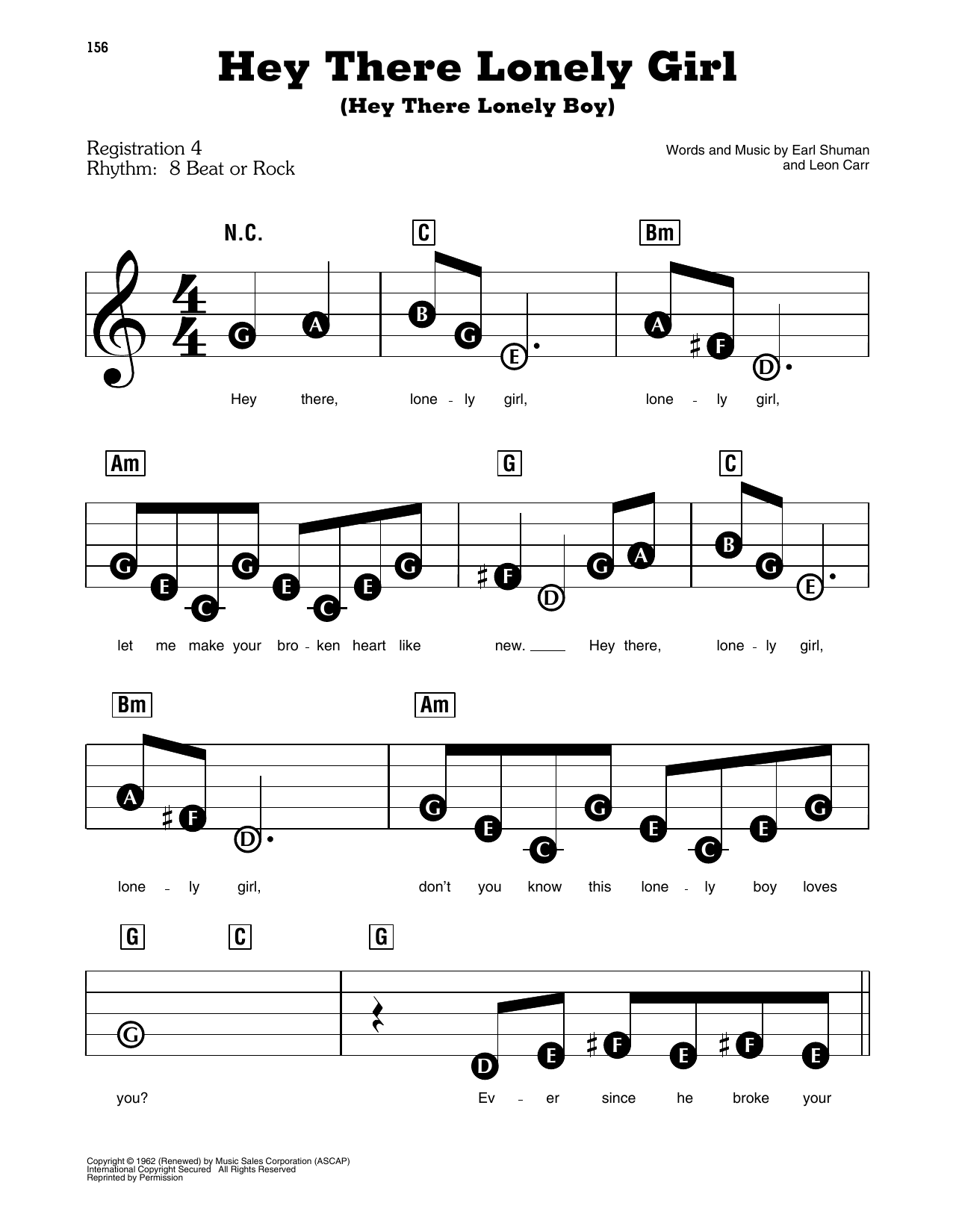
Hey There Lonely Girl (Hey There Lonely Boy) Sheet Music Preview

Hey There Lonely Girl (Hey There Lonely Boy): E-Z Play Today

As performed by Eddie Holman / As performed by Ruby & The Romantics

Item: 35-DS01239006

Digital Download
$4.99
Description

Hey There Lonely Girl (Hey There Lonely Boy): E-Z Play Today isn't in MakeMusic Cloud just yet...but it could be. Let us know you'd like to see it, and you'll help shape what comes next. In the meantime, start a free trial and dive into thousands of interactive titles your students can play along with today.

Sample Audio
No sample audio found.
Sample Video
Additional Details
Publisher: Hal Leonard
Page Count: 3
SKU: 35-DS01239006

More about this title

About the Artist: Eddie Holman

Eddie Holman emerged from Philadelphia's R&B scene in the late 1960s with a gift for rendering emotional vulnerability through his voice. His 1970 recording of "Hey There Lonely Girl" became a crossover hit, climbing the pop charts and establishing him as a reliable interpreter of soul-inflected pop material. Holman's career demonstrates the power of a single well-chosen song to define an artist's legacy.

Why we love this

This track lives in that sweet spot where pop accessibility meets genuine emotional depth. Students gravitate toward the straightforward melody and relatable lyrics, while the arrangement rewards attention to dynamics and phrasing that separates a competent reading from a compelling one.

What to expect

The song carries a bittersweet warmth, balancing romantic longing with conversational intimacy. Harmonically straightforward but emotionally direct, it invites the player to inhabit the emotional narrative rather than merely execute the notes.

Who it's for

Piano students transitioning from classical to popular repertoire will find this song immediately rewarding. It suits intermediate players ready to explore expressive choices beyond strict note accuracy, and it works well for students building confidence in jazz or pop idioms.

How to get the most out of it

  • Shape the melody with intentional rubato in the verses; Holman's original interpretation hinges on a conversational delivery rather than metronomic precision.
  • Balance the vocal line against the accompaniment by keeping the left hand supportive but not subordinate. This piece works best when both hands feel equally present.
  • Treat the repeated melodic phrases as opportunities to explore different colorings and intensities. Each iteration can evolve slightly without losing coherence.
  • Pay attention to the harmonic rhythm in the chorus; subtle changes in voicing can heighten the emotional arc.

How to use it

Consider this for recitals or casual performance settings where repertoire diversity matters. It pairs naturally with other 1970s pop standards or as a bridge piece between classical and contemporary programming, and it works especially well when student pianists are building out a mixed-genre recital.

Skills your students will build

  • Vocal-line interpretation and phrasing in popular music idioms
  • Dynamic control and shaping within repetitive melodic structures
  • Left-hand accompaniment that supports without overwhelming
  • Harmonic listening and voicing awareness
  • Expressive flexibility within a fixed form

You May Also Like