
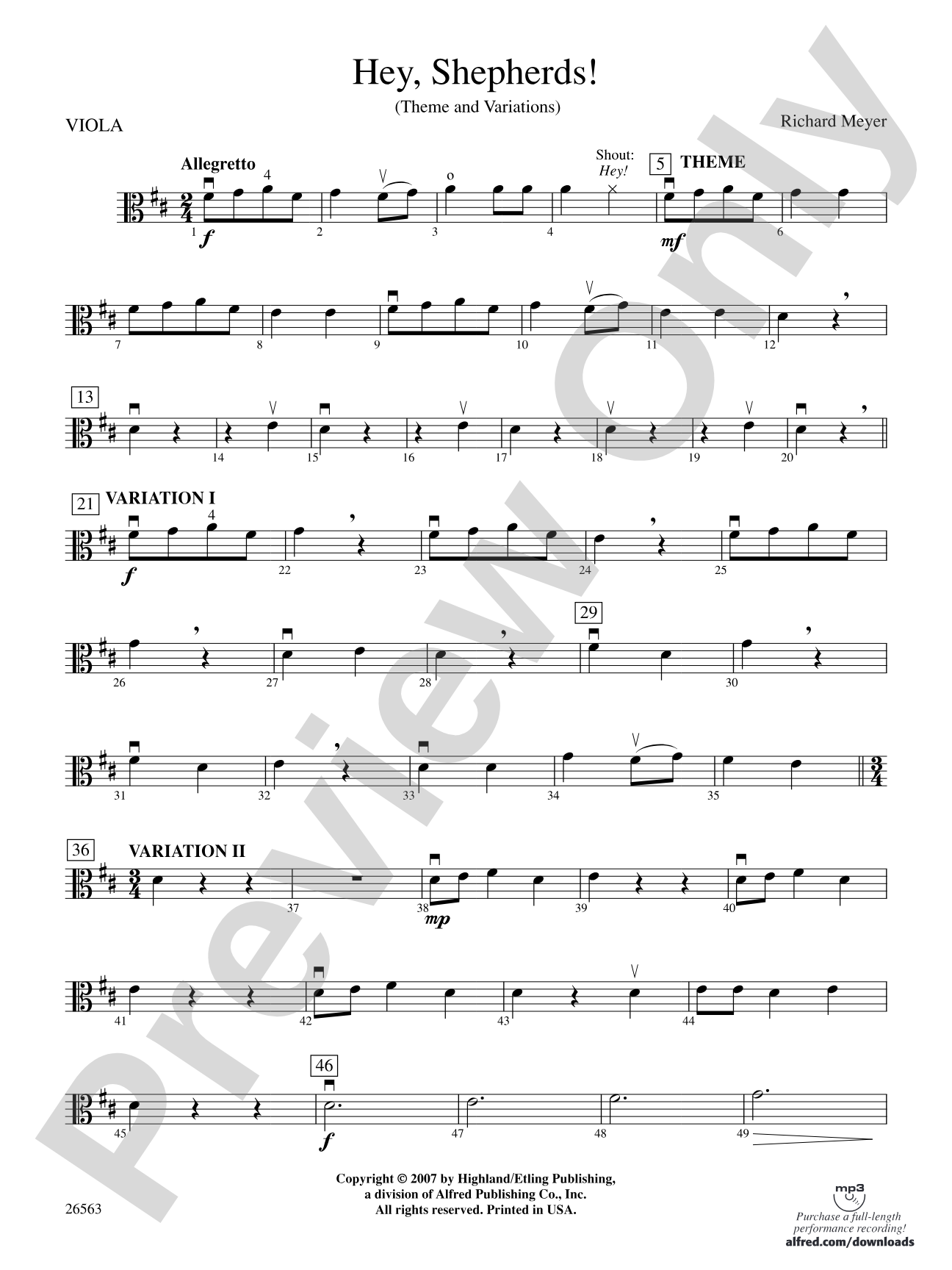

Hey, Shepherds!: Viola
By Richard Meyer
Grade: 1
Item: 00-PC-0001079_VA1
$5.99
Pickup currently not available
Description
These simple, yet clever variants on the Shepherd's Hey use only the notes of the D-Major Scale and are a great way to teach your first year string students about the Theme and Variations form. The theme is followed by four variations featuring different sections and skills. This perfect selection for your young orchestra's first festival or contest experience correlates with String Explorer Book 1, Unit 9. This title is available in MakeMusic Cloud.


Don't just read it, hear it, play along with it, and watch your students grow with it. In MakeMusic Cloud, Hey, Shepherds!: Viola comes alive with professional accompaniment, adjustable tempo, and built-in practice tools that turn solo practice into real progress.
Open in the Player
Jump straight in and assign it today.
Start Your Free Trial
Open this title and explore the full library in minutes.
Sample Audio
1
Audio File
--:--
0:00
0:00
Sample Video
No sample videos found.
Additional Details
Series:
Highland/Etling String Explorer
Publisher:
Alfred Music
Page Count:
72
SKU:
00-PC-0001079_VA1
More about this title
About the Composer: Richard Meyer

Richard Meyer spent 35 years teaching strings in public schools, including 22 years directing the orchestras at Oak Avenue Intermediate School in Temple City, California, where he expanded the program from 29 students to 200. He also directed the Pasadena Youth Symphony Orchestra for 16 years, leading ensembles in performances across New York, Washington D.C., Vienna, Australia, and Canada.
Beyond the classroom and podium, Meyer has established himself as a prolific composer with over 190 works published and served as string editor for Alfred Publishing Company for 16 years. He co-authored the String Explorer series and Sight-read It for Strings, and in 2009 created the "Giving Bach" program at his school, an initiative that has received national recognition for using interactive concerts to bring music to special needs and underserved students throughout Southern California. He has been a featured clinician at the A.S.T.A. National Conference, Texas Orchestra Directors' Association Conference, and string workshops at Ohio State University.
Why we love this
Meyer's gift for accessible writing shines here: he crafts variations that teach form without sacrificing musicality. Grade 1 students get genuine artistic engagement rather than dry pedagogy, and the D-major restriction keeps everything playable while the theme-and-variations structure builds structural listening skills naturally. This is exactly the kind of contest piece that gives young orchestras confidence.
What to expect
Warm and approachable, with a folk melody that feels instantly familiar. The variations unfold with gentle invention: each one reveals a new facet of the theme without demanding anything technically unreasonable, creating a satisfying sense of discovery for both players and listeners.
Who it's for
First-year string orchestras ready to tackle their first festival or contest. Students need secure reading in D major and comfort with quarter notes, eighths, and basic rhythms, but no advanced technique. This is ideal for orchestras looking to build ensemble confidence on stage.
How to get the most out of it
- Balance the sections during each variation so that the newly featured instruments remain audible without covering the harmonic foundation. Listen especially carefully when a new group enters to ensure clarity.
- Since the theme repeats across variations, use the rehearsal time to refine articulation and intonation on the familiar material, allowing students to focus on executing their variation's specific character.
- Mark a clear conductor beat for section changes within each variation so students understand where their moment begins and maintain ensemble cohesion as parts shift.
- Record a rehearsal performance after learning the notes and listen back with the full orchestra, asking students to identify which variation is playing and what makes each one distinct.
How to use it
Program this as your young orchestra's contest selection, where its clear structure and manageable length work perfectly for first-time festival experience. It also pairs well mid-concert as a bridge between simpler opening pieces and more challenging repertoire, giving the audience a moment to appreciate how much your students have learned.
Skills your students will build
- Understanding theme and variations form through direct musical experience
- Reading and performing in D major with consistent intonation
- Balancing melody, harmony, and counter-melody across changing orchestrations
- Maintaining ensemble alignment during section transitions
- Articulation control to distinguish character differences between variations