
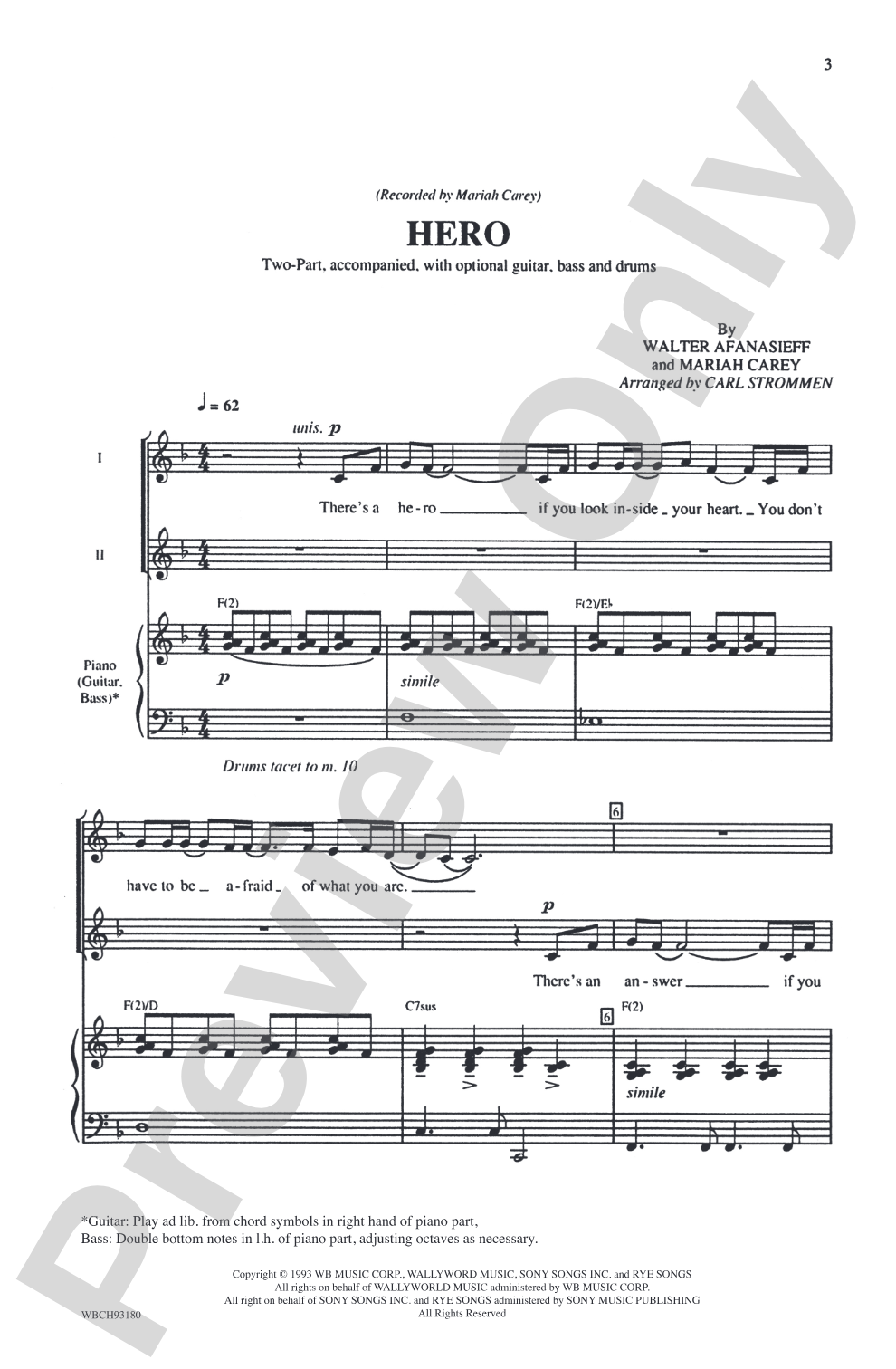
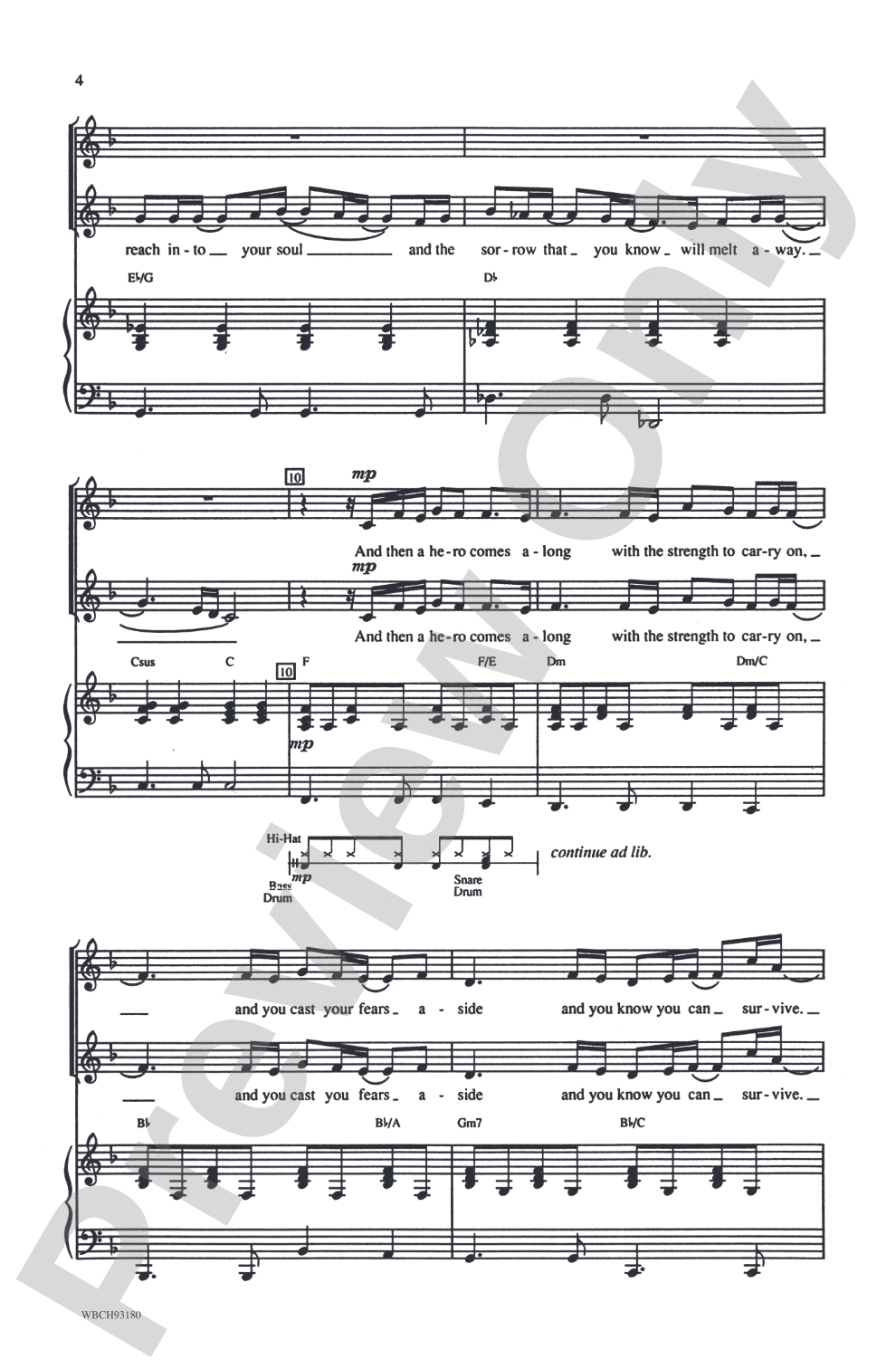

Hero: 2-Part Choral Octavo
(Recorded by Mariah Carey)
By Walter Afanasieff and Mariah Carey / arr. Carl Strommen
Level: Moderate
Item: 00-PO-0006821
$2.25
Minimum order quantity: 20 copies
One moment…
Description
'There's a hero if you look inside your heart. You don't have to be afraid of what you are...' The strength of this message is fully supported by Carl's superb arrangement of Mariah Carey's blockbuster hit. The accompaniment cassette is exceptional. Magnificent!


Hero: 2-Part Choral Octavo isn't in MakeMusic Cloud just yet...but it could be. Let us know you'd like to see it, and you'll help shape what comes next. In the meantime, start a free trial and dive into thousands of interactive titles your students can play along with today.
Request This Title
Tell us you want it.
Start Your Free Trial
Explore everything that's ready to play right now.
Sample Audio
No sample audio found.
Sample Video
No sample videos found.
Additional Details
Series:
Warner Bros. Chartbuster Series
Publisher:
Alfred Music
Page Count:
12
SKU:
00-PO-0006821
More about this title
About the Composer: Walter Afanasieff
Walter Afanasieff is a Grammy Award-winning producer and composer who shaped the sound of 1990s pop music through his work with artists including Mariah Carey, Boyz II Men, and TLC. His production sensibility balances commercial appeal with genuine musicality, crafting songs that resonate across decades without sacrificing artistic integrity.
In educational contexts, Afanasieff's compositions are valued for their emotional directness and memorable melodic content. His ability to write hooks that stick with listeners while maintaining musical substance makes his work especially effective for building student confidence and engagement in choral performance.
Why we love this
Carl Strommen's arrangement captures everything that makes "Hero" powerful while making it genuinely singable for young choirs. The 2-part voicing respects the song's emotional core rather than simplifying it into something forgettable, and the recorded accompaniment tracks are genuinely musical supports, not just backing tracks. Your students will recognize this song, connect to its message about inner strength, and feel accomplished singing something this well-crafted.
What to expect
The arrangement opens quietly and builds with conviction, mirroring the song's arc from introspection to declaration. There's accessibility here, but no condescension; the music feels earned rather than handed to the listener. Young singers often describe performing this piece as genuinely moving, partly because the melody invites real emotional expression rather than technical display.
Who it's for
This arrangement works for middle school and high school choirs of moderate ability, particularly groups looking to perform contemporary music that actually resonates with their singers. It's equally effective for treble choirs and mixed ensembles comfortable with unison or simple two-part writing.
How to get the most out of it
- Treat the lyrics as narrative rather than performance. Have students internalize the message about finding courage before worrying about style or dynamics; the text will guide authentic phrasing naturally.
- Balance the melodic line so it remains prominent even when the accompaniment swells. This isn't a song where the choir blends into background; your students' voices need to be heard clearly.
- Shape phrases through sustained vowels rather than relying on dynamic shifts alone. Afanasieff's melodies are built on long lines, and students will maintain better intonation and vocal health by thinking in complete phrases rather than note-by-note.
How to use it
Program this in a concert celebrating contemporary voices or during a unit on song structure and melody writing. It works exceptionally well alongside other pop-influenced choral literature or as a bridge piece that introduces singers to repertoire they actually want to sing. Consider using it as a springboard for discussing how arrangements serve both the original song and new performance contexts.
Skills your students will build
- Maintaining clarity and pitch control over sustained melodic lines
- Singing with emotional intention rather than technical mechanics
- Balancing ensemble blend with individual voice projection
- Interpreting contemporary popular music with musical integrity
- Following recorded accompaniment while maintaining independence