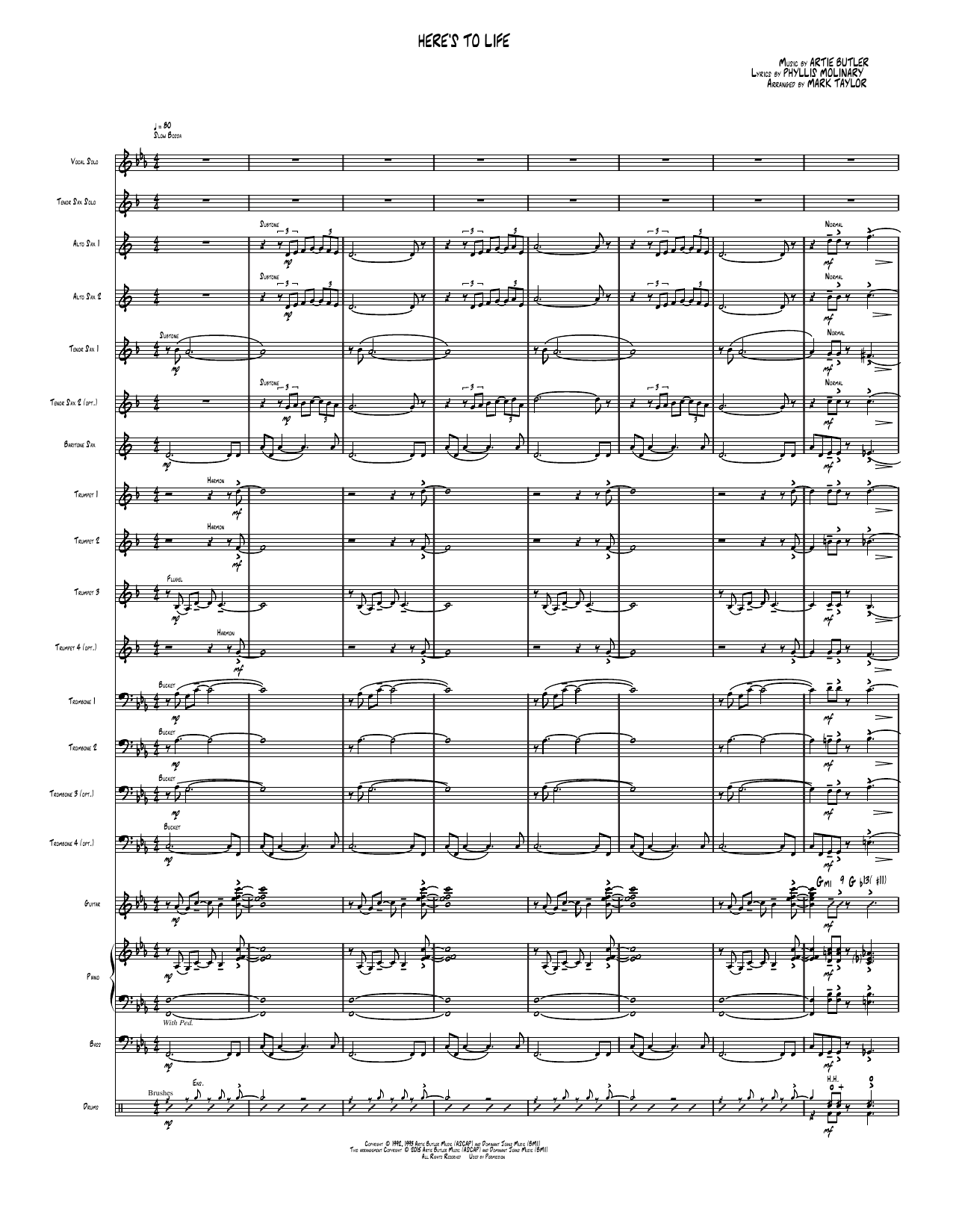
Here's to Life Sheet Music Preview

Here's to Life: Jazz Ensemble Conductor Score & Parts

By Artie Butler / By Phyllis Molinary / As performed by Shirley Horn / Arranged by Mark Taylor

Grade: 3

Item: 35-PK00426965

Digital Download
$50.00

One moment…

Description
Here's To Life

Here's to Life: Jazz Ensemble Conductor Score & Parts isn't in MakeMusic Cloud just yet...but it could be. Let us know you'd like to see it, and you'll help shape what comes next. In the meantime, start a free trial and dive into thousands of interactive titles your students can play along with today.

Sample Audio
No sample audio found.
Sample Video
Additional Details
Publisher: Hal Leonard
SKU: 35-PK00426965

More about this title

About the Composer: Artie Butler

Artie Butler is a composer and lyricist whose work spans Broadway, film, and popular standards. His gift for crafting memorable melodies and sophisticated harmonic progressions made him a sought-after voice in mid-century American songwriting. "Here's to Life" stands as one of his most enduring compositions, recorded by jazz vocalists and instrumentalists for decades.

Butler's influence on jazz and popular music education comes through arrangements like this one, which preserve the elegance of his original writing while remaining accessible to student ensembles. His melodic clarity and harmonic logic make his standards particularly effective teaching tools.

Why we love this

Mark Taylor's arrangement captures the sophisticated simplicity that makes this tune so rewarding to play. The Grade 3 scoring opens the melody to multiple voices without sacrificing the song's inherent warmth, and the harmonic support sits comfortably under student fingers while preserving genuine jazz voicings.

What to expect

A quiet toast at the end of an evening. The melody floats with unhurried grace over walking harmonies, and despite its sophistication, the arrangement feels intimate rather than showy. Students play with restraint and intention, letting space matter as much as sound.

Who it's for

Jazz ensembles at the Grade 3 level looking for a standard that teaches both jazz language and ballad sensibility. Directors who want to program a tune their students already know from recordings, which accelerates learning and deepens musical investment.

How to get the most out of it

  • Lean into the rubato and phrasing of the melody line; this standard breathes best when players listen to how Shirley Horn approaches it rather than metronomically executing the written notes.
  • Balance the ensemble so the lead voice projects clearly through the harmony. Many student ensembles bury the melody in thick chords here.
  • Establish a conversational feel in the rhythm section. The pulse should feel inevitable, not pushed, to give soloists room to phrase around it.
  • Pay attention to dynamics as structural markers. Subtle shifts in volume can deepen the emotional arc across the form rather than playing at one level throughout.

How to use it

Anchor a concert's second half with this ballad to shift the energy and give your audience a moment of reflection. It also pairs naturally with uptempo swing standards in a mini-set format, allowing you to explore contrasting moods while staying in one era.

Skills your students will build

  • Jazz ballad phrasing and rubato interpretation
  • Reading and executing realistic jazz voicings at the intermediate level
  • Supporting a solo voice within an ensemble texture
  • Responding to dynamic nuance as a form-building tool
  • Understanding jazz standards from the player's perspective

You May Also Like