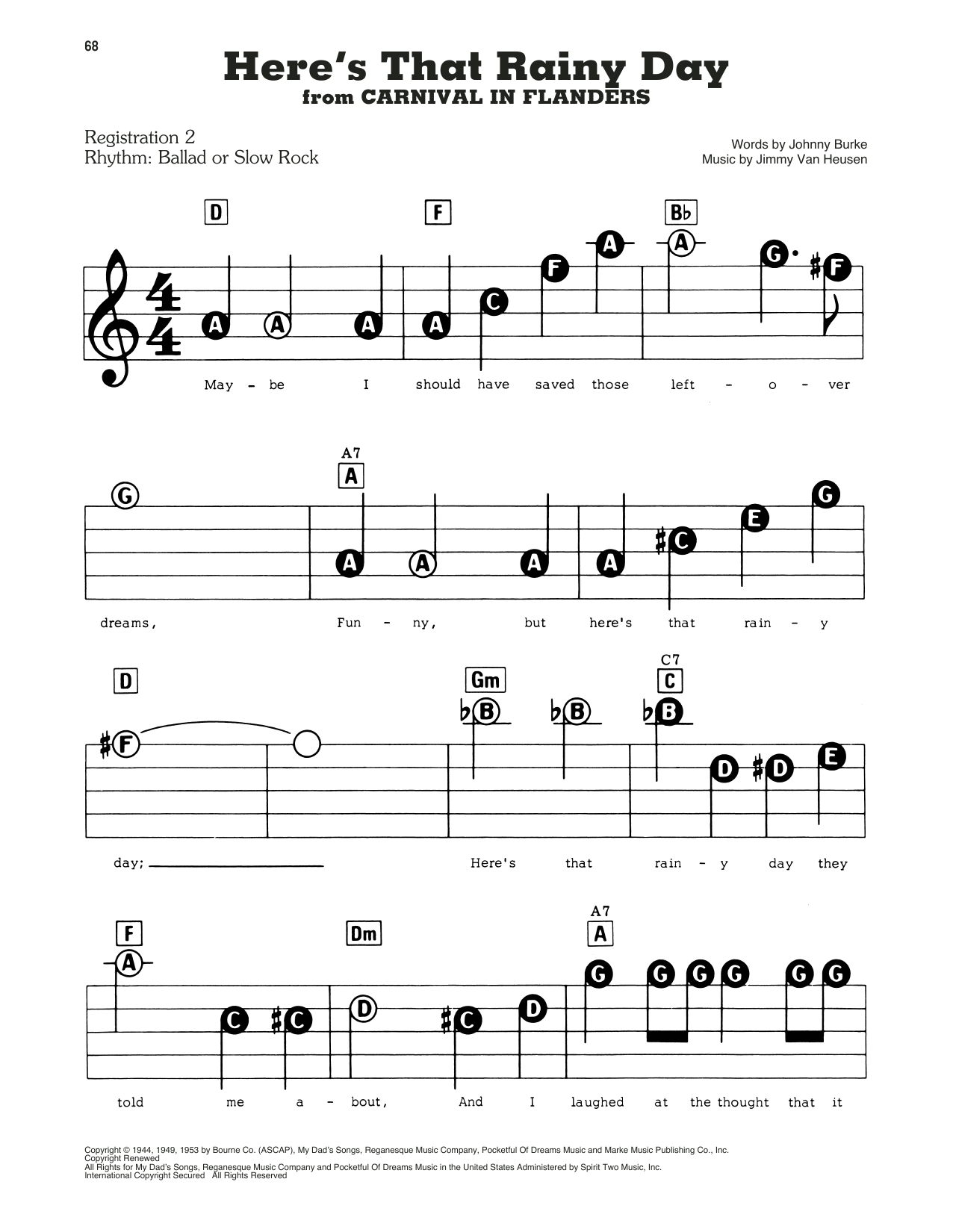
Here's That Rainy Day (from Carnival In Flanders) Sheet Music Preview

Here's That Rainy Day (from Carnival In Flanders): E-Z Play Today

Item: 35-DS00458683

Digital Download
$4.99
Description

Here's That Rainy Day (from Carnival In Flanders): E-Z Play Today isn't in MakeMusic Cloud just yet...but it could be. Let us know you'd like to see it, and you'll help shape what comes next. In the meantime, start a free trial and dive into thousands of interactive titles your students can play along with today.

Sample Audio
No sample audio found.
Sample Video
Additional Details
Publisher: Hal Leonard
Page Count: 2
SKU: 35-DS00458683

More about this title

About the Creator: Jimmy Van Heusen

Jimmy Van Heusen composed "Here's That Rainy Day" for the 1953 film Carnival in Flanders, collaborating with lyricist Johnny Burke. The song became a jazz standard within months of its release, recorded by artists spanning Billie Holiday to Bill Evans. Van Heusen's gift for crafting memorable melodies with sophisticated harmonic movement made him one of the most recorded composers of the mid-twentieth century.

This particular arrangement presents the standard in the accessible E-Z Play Today format, allowing pianists at various levels to explore the song's elegant structure without overwhelming technical demands.

Why we love this

The E-Z Play Today series strips away unnecessary complexity while preserving the harmonic and melodic identity that made this tune endure. Students encounter a genuine jazz standard in a format that lets them focus on phrasing, swing feel, and the interpretive choices that separate competent playing from musical performance.

What to expect

Melancholic and introspective, the song captures a quiet moment of longing with grace rather than despair. The harmonic movement pulls the listener gently through shifts in emotional color, landing finally in a place of acceptance.

Who it's for

Pianists working toward fluency with jazz standards and those building comfort with swing interpretation belong here. The two-page format suits students ready to engage serious repertoire but still developing the sight-reading speed and harmonic vocabulary demanded by more complex jazz arrangements.

How to get the most out of it

  • Allow the melody to breathe; resist the urge to rush phrases even in faster tempos. The song rewards a singer's approach to phrasing.
  • Listen closely to recordings by Evans or Oscar Peterson to internalize how the changes move. Your comping choices will respond naturally once the harmonic language feels familiar.
  • Experiment with your touch during the bridge. A slightly different weight or dynamic can signal the shift in emotional territory that Van Heusen built into the form.
  • Pay attention to voice leading in your left hand. Small adjustments in how you move between chords can reveal the sophistication hiding beneath the melody.

How to use it

This pairs well in a jazz history or standards unit, giving students a direct connection to the golden age of American popular song and film composition. Its accessibility makes it suitable for recitals where you want to represent jazz repertoire without the notation density of harder standards, or as a solo spotlight in an ensemble concert.

Skills your students will build

  • Recognizing and playing ii-V-I progressions in multiple keys
  • Swing feel and triplet-based rhythmic interpretation
  • Chord substitution recognition in jazz contexts
  • Melody-focused playing with expressive control
  • Harmonic analysis of bridge construction and tonal movement

You May Also Like