Helplessly Hoping (arr. Philip Lawson) Sheet Music Preview

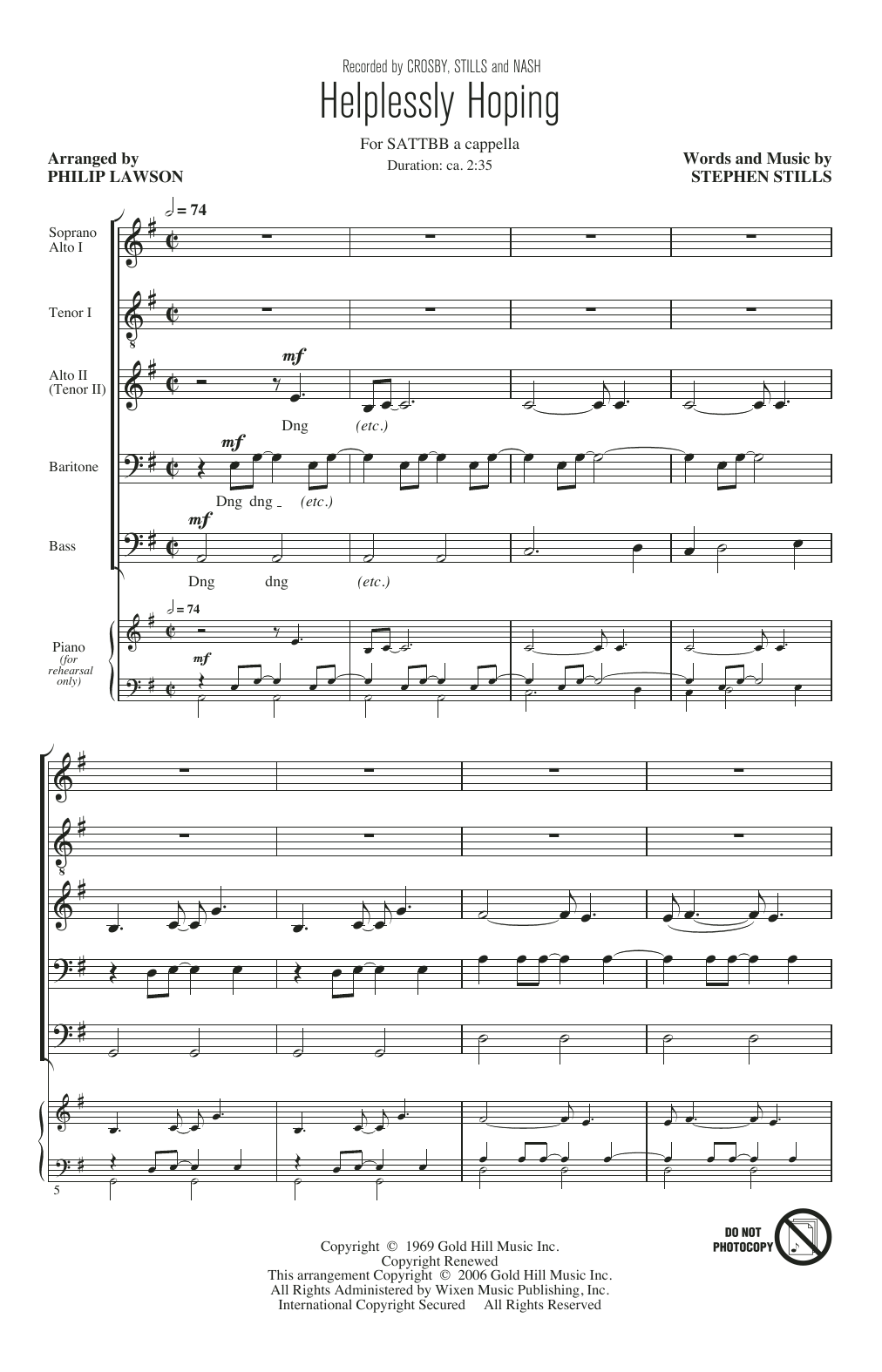
Helplessly Hoping (arr. Philip Lawson): SATTBB Choral Octavo

As performed by Crosby, Stills Nash / Arranged by Philip Lawson

Item: 35-DS01861206

Digital Download
$2.65
Description

Helplessly Hoping (arr. Philip Lawson): SATTBB Choral Octavo isn't in MakeMusic Cloud just yet...but it could be. Let us know you'd like to see it, and you'll help shape what comes next. In the meantime, start a free trial and dive into thousands of interactive titles your students can play along with today.

Sample Audio
No sample audio found.
Sample Video
Additional Details
Publisher: Hal Leonard
Page Count: 11
SKU: 35-DS01861206

More about this title

About the Artist: Crosby, Stills Nash

Crosby, Stills & Nash emerged from the late 1960s folk-rock scene with a gift for intricate vocal harmonies and introspective songwriting. The trio's work balanced acoustic intimacy with studio sophistication, creating songs that rewarded close listening and meticulous arranging. Their catalog remains a cornerstone of American popular music, valued by educators for its harmonic richness and lyrical depth.

Their influence on contemporary choral arranging is significant. The complexity of their vocal textures naturally translates to ensemble settings, making their songs ideal vehicles for teaching harmonic awareness and blend. Arrangers like Philip Lawson have spent decades mining their catalog for arrangements that challenge singers while honoring the original artistry.

Why we love this

Philip Lawson has crafted an arrangement that captures the song's contemplative beauty while giving SATTBB choirs genuine parts to sing. Rather than doubling voices or padding with static harmony, Lawson distributes the melodic and harmonic interest across all six parts, making this work as rewarding for second sopranos and bass singers as for the leads. The arrangement respects the original's folk sensibility while unlocking textures that only ensemble singing can achieve.

What to expect

The arrangement unfolds with a quiet intensity, the six voices weaving in and out of focus like a conversation between old friends. There's an unhurried quality that rewards patience; the beauty emerges not from dramatic gestures but from the clarity and precision of the harmonic relationships. Singers experience the vulnerability of the original lyric deepened by the intimacy of ensemble blend.

Who it's for

This arrangement suits intermediate to advanced choirs with secure intonation and part-reading skills. Mixed ensembles seeking folk-influenced material that goes beyond traditional pop arrangements will find sophisticated writing here. It works equally well for college groups, community choruses, and advanced high school programs.

How to get the most out of it

  • Balance the entrance of each voice part carefully. The overlapping entries that define this arrangement only work when audiences hear the specific voices entering, not a wash of sound.
  • Attend to vowel uniformity across the voicing. The extended harmonic phrases demand precision tuning, and vowel drift will expose unison or near-unison lines.
  • Let the text shape your phrasing rather than fighting against the harmonic rhythm. This arrangement sits comfortably when singers breathe where the lyrics suggest, not where the written measures might indicate.
  • Record rehearsals in sections to identify which voices carry the emotional weight at each moment. That awareness helps singers adjust their dynamics and color appropriately.

How to use it

Consider pairing this with other folk-influenced contemporary choral works to build a concert section exploring the intersection of popular songwriting and ensemble voicing. The song's introspective mood makes it an effective program closer or opening statement, depending on what surrounds it. At roughly 11 pages, it anchors a concert without demanding an entire evening's focus.

Skills your students will build

  • Balancing individual voice parts within dense six-part harmony
  • Reading and maintaining accuracy in overlapping entrances
  • Tuning adjustments required by chromatic voice leading
  • Sustaining vocal color and phrasing across extended harmonic passages
  • Blending as an individual responsibility rather than a section function

You May Also Like