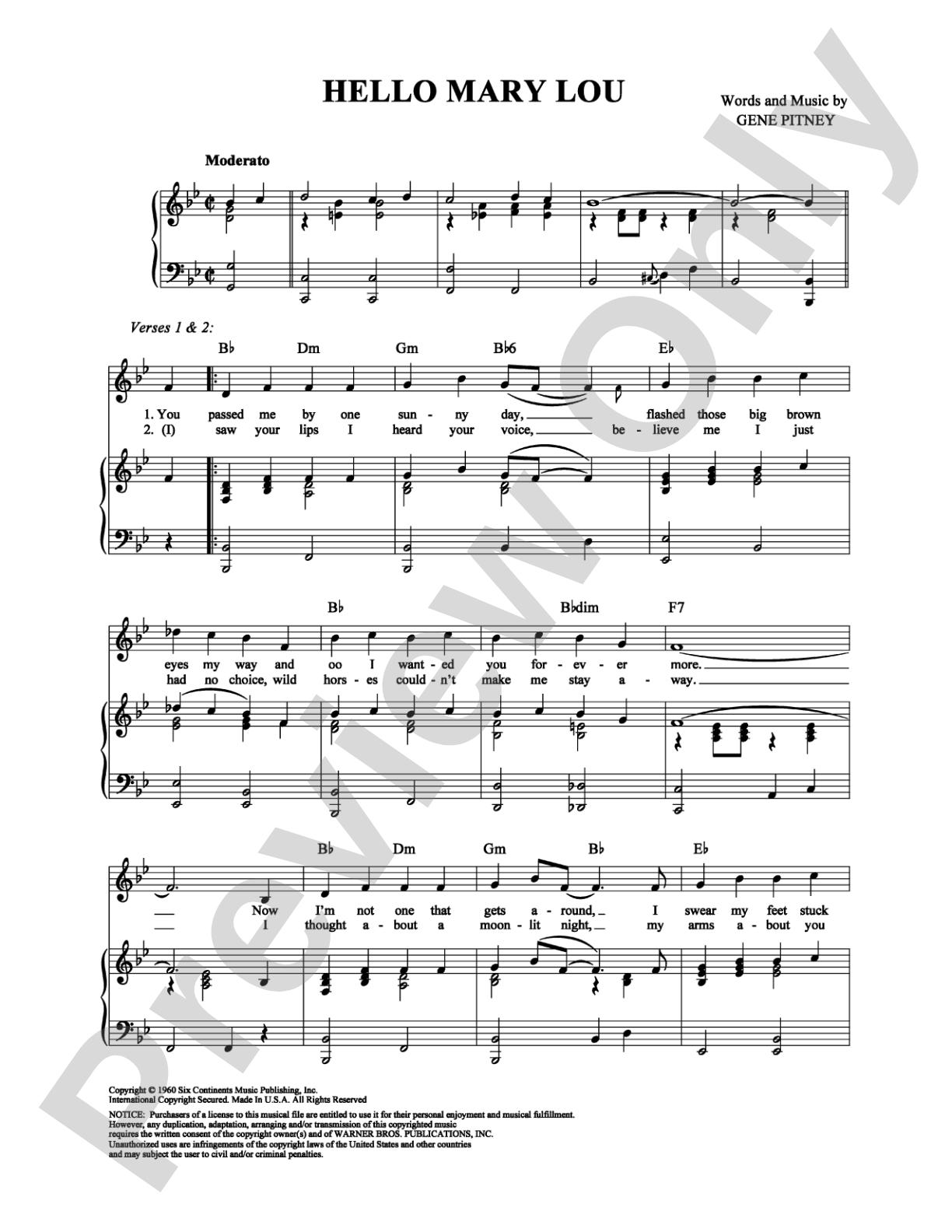
Hello Mary Lou: Piano/Vocal/Chords Digital Sheet Music

Hello Mary Lou: Piano/Vocal/Chords Digital Sheet Music

Gene Pitney, Creedence Clearwater Revival

Item: 00-PS-0007462

Digital Download
$3.99
Description

Hello Mary Lou: Piano/Vocal/Chords Digital Sheet Music isn't in MakeMusic Cloud just yet...but it could be. Let us know you'd like to see it, and you'll help shape what comes next. In the meantime, start a free trial and dive into thousands of interactive titles your students can play along with today.

Sample Audio
No sample audio found.
Sample Video
Additional Details
SKU: 00-PS-0007462

More about this title

About the Artist: Creedence Clearwater Revival

Creedence Clearwater Revival emerged from El Sobrante, California in 1967 as one of the era's most prolific and commercially successful rock bands. Led by John Fogerty's distinctive vocals and songwriting, the group built a catalog of instantly recognizable hits that blended rock, country, and blues influences into a sound that felt both timeless and urgently of-the-moment. Their influence on popular music pedagogy remains significant; their songs appear regularly in educational settings because they reward serious musical study while remaining accessible to students across skill levels.

The band's output between 1968 and 1970 stands as a remarkable achievement in rock composition and arrangement. Songs like "Hello Mary Lou" showcase the group's gift for memorable melodies, tight vocal harmonies, and the kind of infectious rhythm that makes them ideal for exploring rock arranging techniques in educational contexts. Though the band disbanded in 1972, their music continues to serve music teachers as a bridge between contemporary repertoire and fundamental musical principles.

Why we love this

This is a rock standard that singers and pianists recognize immediately, which means students arrive with genuine enthusiasm for learning it. The piano/vocal/chords format works beautifully for exploring how chord symbols guide improvisation and reharmonization, giving students practical experience with a real song rather than a constructed exercise. The rhythm section and vocal melody sit in ranges that suit most high school singers, making it accessible for mixed ability ensembles or solo performance.

What to expect

"Hello Mary Lou" radiates the confident swagger of 1960s rock and roll with an undertone of genuine musical sophistication. The melody floats over changes that feel both anchoring and fresh, and the rhythm propels forward with a lightness that rewards clean articulation. It's the sound of a band operating at peak capability: assured without being showy, singable without being simple.

Who it's for

Singers developing rock repertoire and pianists building skills with contemporary song accompaniment will find this arrangement straightforward and rewarding. It works equally well for jazz choir students learning to interpret chord charts and for solo vocalists preparing audition or recital material. Secondary ensemble singers and adult community choir members drawn to the music of Creedence Clearwater Revival will appreciate the accessibility and immediate payoff.

How to get the most out of it

  • Lock the tempo before rehearsing; the groove depends on a steady pulse, and even slight rushing will flatten the character.
  • Shape the verse and chorus distinctly. The verses sit lower dynamically and create momentum toward each chorus hook, so resist the urge to sing them at full volume from the start.
  • Sing the vocal line with the rhythmic precision of the band arrangement, treating syncopation as melodic content rather than ornamentation.
  • Use the chord symbols to guide piano comping choices; try varying the voicings across verses to maintain listener interest over a song this familiar.

How to use it

Position this in a spring or end-of-year concert where you want to shift energy and celebrate student musicianship with material that audiences know and love. Pair it with other rock standards from the era to build a short set exploring American rock composition, or present it as a solo feature that lets a skilled vocalist command the stage. It also fits well in fundraising or informal performance settings where familiar material builds connection between performers and audience.

Skills your students will build

  • Reading chord symbols and interpreting them on keyboard
  • Phrasing rock vocal lines with rhythmic precision and dynamic shape
  • Recognizing and performing syncopated rhythms in a contemporary idiom
  • Balancing melody and accompaniment in piano/vocal ensemble
  • Building fluency with the rhythmic language of 1960s rock and roll

You May Also Like